
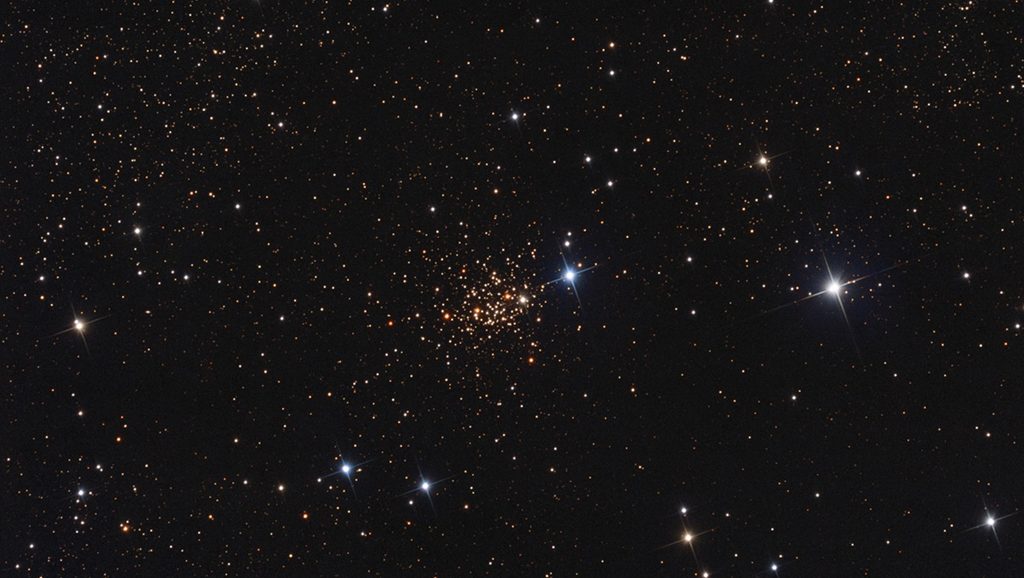
Deep in the constellation Cepheus lies NGC 7419, an oddball star cluster that may rewrite the rules of stellar aging. In a typical cluster’s lifecycle, colossal stars expand into glowing blue supergiants before cooling into red ones. Yet, a recently published study claims that NGC 7419 completely skipped this phase, hosting five red supergiants and zero blue ones alongside a swarm of fast-spinning “Be” stars.
Located some 10,000 light years away from the Earth, the open cluster NGC 7419 has long baffled astrophysicists because its stellar population looks entirely out of balance. By combining high-precision astrometric data from ESA’s Gaia space telescope with spectroscopic mapping, researchers led by Nasser M. Ahmed of the National Research Institute of Astronomy and Geophysics (NRIAG) in Cairo, Egypt, have now uncovered that the cluster’s odd demographic is the direct result of violent stellar interactions.
When massive binary stars orbit close together, one can siphon away its companion’s outer layers, transferring momentum and spinning the surviving star up to breakneck speeds. This rapid rotation triggers extreme mass loss, driving stars straight into red supergiant status while simultaneously spawning glowing disks around nearby rapidly rotating stars, completely bypassing the traditional blue supergiant phase.
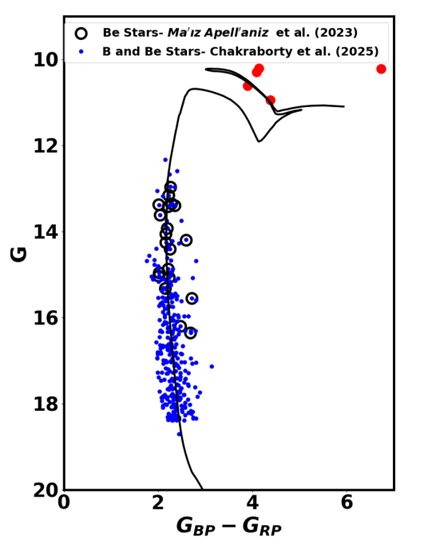
The solid black line represents the best-fitting PARSEC
isochrone (Bressan et al. 2012) corresponding to an age of
15 ± 2 Myr and a metallicity of 𝑍 = 0.0152. It is evident
that B and Be stars do not induce variations in reddening.
Credit: Nasser M. Ahmed et al., 2026.
The study also reveals a fundamental shift in how NGC 7419 was assembled. For decades, astronomers assumed star clusters followed a standard, single-tier birth model according to which stars form in a predictable distribution across light, medium, and heavy weights. However, Ahmed’s team found that NGC 7419’s mass distribution actually fits a three-component model, unmasking three statistically distinct star populations coexisting within the exact same cluster boundary.
Based on these findings, the authors of the study propose that the giant molecular gas cloud originally feeding NGC 7419 fragmented into distinct, clumpy pockets as it collapsed, birthing three separate stellar families almost simultaneously
Therefore, in general, the new study may help astronomers gain a clearer lens through which to view the birth, life, and explosive deaths of the universe’s most impactful stars. What once looked like an oddball outcast in Cepheus may very well be the blueprint for understanding massive star populations across the cosmos.
“The highly pure member catalogue and the precisely updated parameters derived in this work provide a solid empirical foundation for future high-resolution spectroscopic followups. These constraints will be essential for resolving the anomalous absence of blue supergiants and understanding the evolutionary pathways of the massive red supergiant and classical Be star populations in NGC 7419,” the researchers concluded.




Leave a Reply