
By taking a clever shortcut through the laws of electromagnetism, researchers in Germany are building Europe’s first tabletop-style detector to search for elusive high-frequency ripples in spacetime.
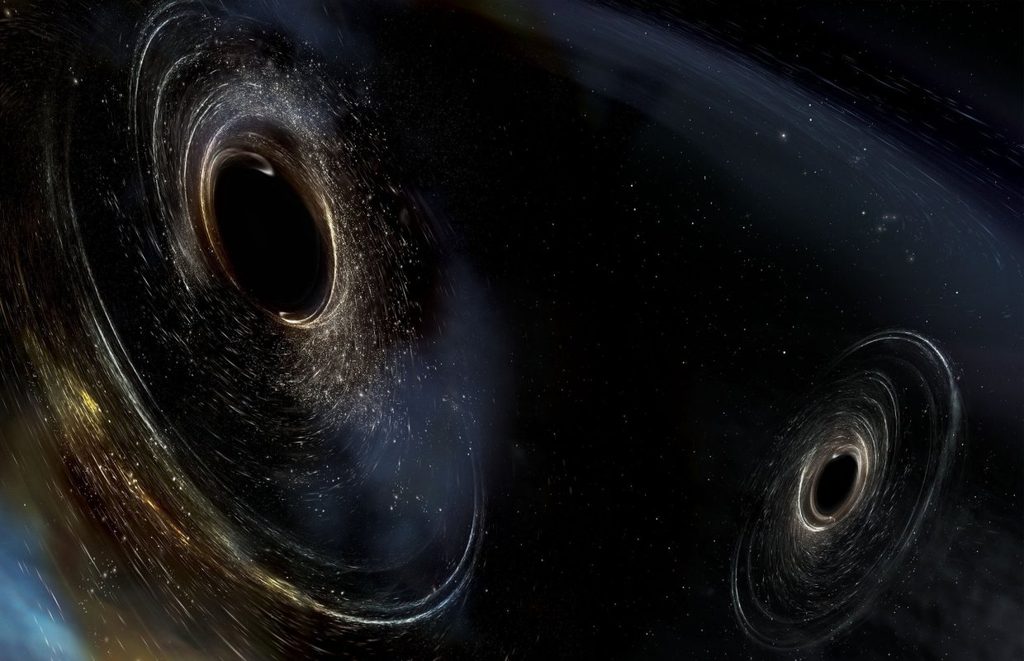
Since 2015, colossal observatories like the Laser Interferometer Gravitational-Wave Observatory (LIGO) and Virgo have regularly “listened” to the universe by detecting gravitational waves, which are ripples in the fabric of spacetime created by cataclysmic events like colliding black holes and neutron stars. But these multi-kilometer facilities are tuned to the cosmic “bass”: low-frequency waves born from massive, lumbering giants.
What about the cosmic soprano?
Physicists theorize that the universe is also humming with High-Frequency Gravitational Waves (HFGWs), which could be generated by exotic phenomena in the very early universe or by microscopic primordial black holes. Detecting them, however, requires a completely different approach. Enter MAGGIE (Magnetic Gravitational Wave Induction Experiment), a newly proposed detector under construction at the University of Hamburg in Germany.
Detailed in a recent paper by Dieter Horns, Jasper Jödicke, Marios Maroudas and Toma-Stefan Cezar, MAGGIE represents a shift in how we hunt for ripples in spacetime. Instead of using massive laser interferometers, the Hamburg team is using a powerful magnet and a bit of quantum-scale trickery.
Turning Gravity into Electricity
How do you catch a wave that barely interacts with matter? You make it interact with light.
The underlying physics relies on a phenomenon known as the inverse Gertsenshtein effect. When a gravitational wave passes through a strong, static magnetic field, it can actually induce a faint electromagnetic signal, effectively converting a spacetime ripple into a measurable electrical current.
By exploiting this effect, physicists realized they could repurpose technology originally designed for an entirely different cosmic hunt: the search for dark matter.
“The gravitational wave will shake the magnetic field of the magnet and this will change the magnetic flux in the MAGGIE detector. A time dependent magnetic flux will induce a voltage and that is what we are looking for. In the graviton picture, we are looking for the mixing of the graviton with photons in an external magnetic field,” Dieter Horns told Universelost.com.

Prof. Dr. Dieter Horns (on the left) is a prominent physicist and the Head of the Institute of Experimental Physics at the University of Hamburg, where he has served as a Professor of Astroparticle Physics since 2007. His research spans a wide array of high-energy and astroparticle physics, with a particular focus on high-energy astrophysics, the search for low-mass dark matter, and the development of innovative experimental techniques.
In addition to his leadership in the MAGGIE experiment, Horns is deeply involved in major international astronomy collaborations, including the High Energy Stereoscopic System (H.E.S.S.) and the Cherenkov Telescope Array (CTA). He also acts as a Principal Investigator and Director for the Quantum Universe Cluster of Excellence, cementing his role at the forefront of efforts to understand the most elusive and energetic phenomena in our universe.
First of a Kind
MAGGIE is the first broadband, lumped-element HFGW detector of its kind under construction in Europe. The beating heart of the experiment is a massive solenoidal superconducting magnet originally procured for the Weakly Interacting Slender Particle detection with LC circuit (WISPLC) dark matter experiment.
This magnet generates a staggering 14-Tesla magnetic field, therefore roughly 280,000 times stronger than Earth’s magnetic field, and comparable to the powerful magnets used in magnetic resonance imaging (MRI) machines. The superconducting coils are supercooled to a frigid 4 degrees Kelvin, but the central cylinder, a 755-millimeter-long, 125-millimeter-wide “bore”, is kept at room temperature. This warm bore allows the team to easily install and calibrate their sensitive measuring equipment without needing to cryogenically freeze everything.
Inside this bore sits a specialized “pickup loop”. If a high-frequency gravitational wave washes over the earth and passes through the 14-Tesla field, it should generate a minute change in magnetic flux. The loop is designed to capture this change as a tiny electrical current, processing signals at frequencies up to roughly 40 MHz.
“MAGGIE is in the research and development phase with first prototypes under tests,” Horns says. “We do have the necessary hardware already in place. The main part is the powerful magnet which provides a 14-Tesla field.”
When asked when the detector might be fully operational, Horns remains cautiously optimistic about the path forward.
“In my experience, there is usually a tendency to provide unrealistic time-lines for future experiments. In that sense, I would rather not even try to make a statement, which would join the club of un-kept timelines,” he notes. “Realistically, I believe that we will have science data with a prototype assembly within a year. We have many interesting ideas on how to improve the sensitivity using a combination of unique real-time analysis and improvements in the design of the setup. Ultimately, we will install additional hardware to push the noise down.”
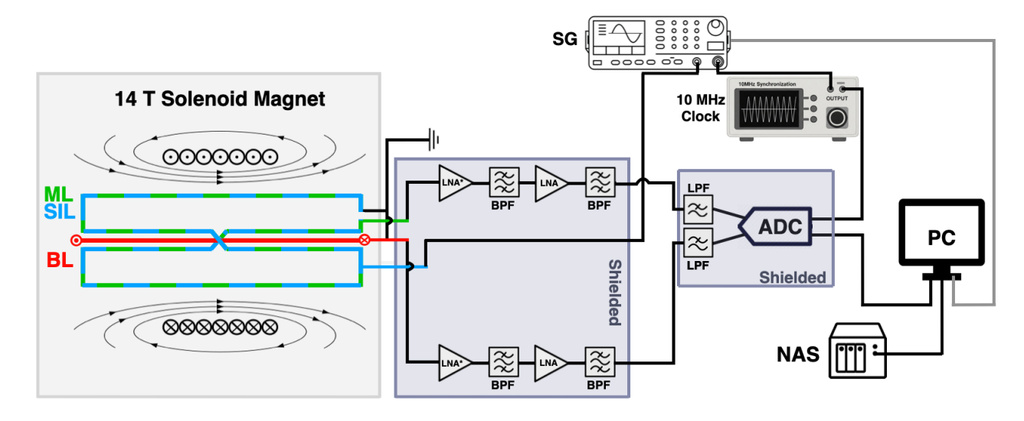
two-channel analog-to-digital converter (ADC) located in a separate shielded enclosure. A signal generator (SG) injects calibration signals via the SIL. Image Credit: Jasper Jödicke et al., 2026.
Engineering Around the Noise
The greatest enemy of any tabletop physics experiment is earthly noise. But because MAGGIE is looking for the “cosmic soprano,” the typical low-frequency culprits like seismic hums or vibrations from a passing truck aren’t the primary concern.
“The frequencies we are interested in are more like the ones that a bat would be able to pick up (100 kHz) or are used in medical ultra-sound applications (several MHz),” Horns points out. “So unless a bat comes along or somebody is doing an ultra-sound, we will not be affected by noise. That’s of course not entirely true, we pick up radio frequency noise from the environment. However, we do look for specific signals that are very distinct from these external noise sources.”
To further combat this stray electromagnetic interference (EMI), the MAGGIE team employs a clever veto system using a “blind loop”. This secondary loop acts as a reference channel. When the massive magnetic field is turned off, the blind loop establishes a baseline for the ambient environmental noise. When the magnet is on, the blind loop continues to listen; if a signal appears simultaneously in both the main pickup loop and the blind loop, the team knows it’s just earthly interference and can confidently throw the data out. They also use a calibration loop to inject artificial signals, ensuring the delicate readout chain is perfectly tuned.
Unveiling Known Unknowns and Unknown Unknowns
While LIGO requires incredibly massive infrastructure to measure the stretching of space over miles, MAGGIE showcases the ingenuity of modern tabletop physics. By piggybacking on dark matter hunting technology, MAGGIE provides a relatively cost-effective, innovative way to peer into a previously unexplored frequency band of the gravitational wave spectrum.
Even if MAGGIE doesn’t immediately detect a high-frequency wave, it is laying the groundwork for a new era of multi-messenger astronomy. As these magnetic detectors grow more sensitive, we may soon be able to tune our cosmic radios to the highest, most elusive frequencies of the universe.
In general, Horns believes that capturing HFGWs with MAGGIE could illuminate some of the universe’s deepest mysteries, even the entirely unpredicted phenomena that humanity cannot yet conceptualize.
“There are several known unknowns in the sky that could contribute signals, among those are primary black hole mergers, superradiance, colliding neutron stars and of course the real challenge, stochastic gravitational background from inflation,” Horns explains. “And then there are the unknown unknowns.”
Let that sink in.



Leave a Reply