
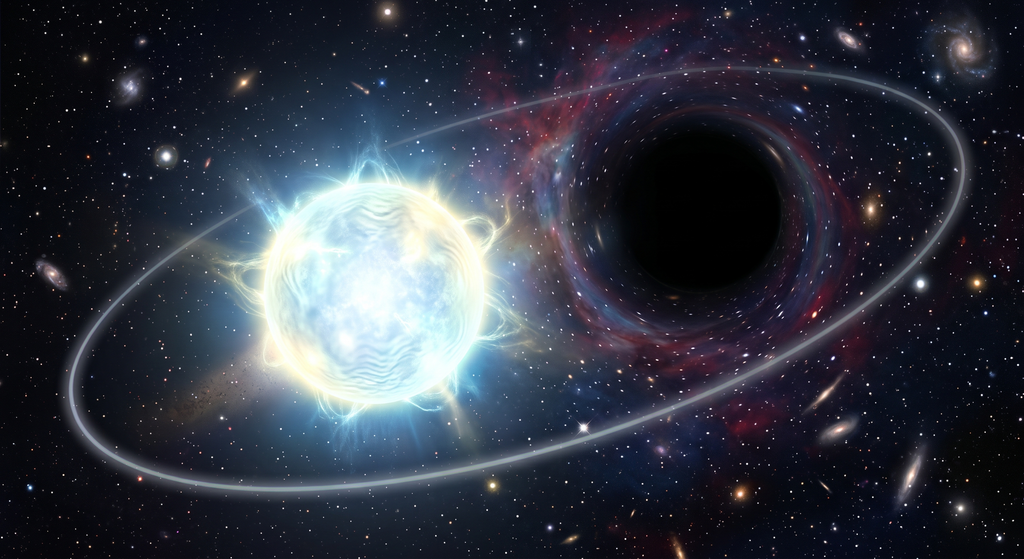
Astronomers have discovered a massive, unseen object lurking in the orbit of a distant, pulsating star. By “listening” to the rhythmic vibrations of the star TIC 160582982, researchers detected the gravitational tug of a mysterious companion that is heavy enough to be a neutron star or even a stellar-mass black hole, yet emits no conspicuous light of its own.
The discovery, detailed in a recent paper by a team of astronomers including Chenglong Lv, Javier Pascual-Granado, and Ali Esamdin, highlights the power of a technique called asteroseismology, therefore the study of “starquakes” and stellar vibrations.
The primary star in this system, TIC 160582982, is a Delta Scuti variable. These types of stars act like giant cosmic bells, swelling and shrinking rapidly, causing their brightness to fluctuate on timescales of just hours. Using data from NASA’s Transiting Exoplanet Survey Satellite (TESS), the researchers were able to track these pulsations with remarkable precision.
By analyzing the light curves captured every two minutes by TESS, the team noticed something unusual. The star’s natural heartbeat wasn’t perfectly steady. Instead, the timing of its high-frequency pressure pulsations shifted slightly back and forth.
This phenomenon, known as a phase-modulation or light-travel-time effect, happens when a star is being pulled back and forth by the gravity of an orbiting companion. As the star is pulled away from us, its pulses take slightly longer to reach Earth. As it swings back toward us, the pulses arrive sooner.
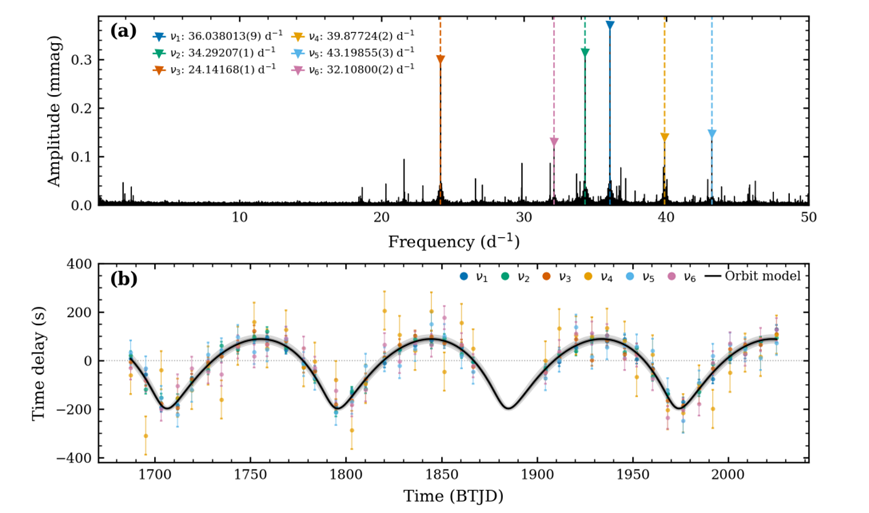
Calculations revealed that the primary pulsating star is about twice the mass of our Sun (about 1.93 solar masses), but the real surprise was the object pulling on it. The measurements suggest that the unseen companion must have a minimum mass of about 1.8 solar masses. Accounting for the geometry of the orbit, the mass estimate jumps to around 2.2 solar masses.
However, what baffles the authors of the paper is that an ordinary, healthy star of that mass should be shining brightly. Yet, they found no obvious spectral signature or infrared glow of a second star in the system.
So, what is this invisible heavyweight object?
The researchers ponder a few possibilities. It could be a normal main-sequence star whose light is simply overwhelmed by the brilliant glare of the primary Delta Scuti star. It might even be a tightly bound pair of smaller stars, hence an “inner binary”, masquerading as a single massive object.
However, the absence of light from such a heavy companion raises a more exotic scenario. The scientists note that the data “suggests the presence of a massive compact object, such as a neutron star or even a stellar-mass black hole, as the massive unseen binary companion.”
To solve the mystery, astronomers will need to follow up with phase-resolved, high-resolution spectroscopy to look for the faintest hints of a second star’s light. Furthermore, precise astrometry from ESA’s Gaia satellite could help measure the exact tilt of the system’s orbit, locking in the companion’s true mass.
Until then, TIC 160582982 remains a captivating cosmic mystery, a bright, pulsating beacon dancing with a ghost in the dark.


Leave a Reply