
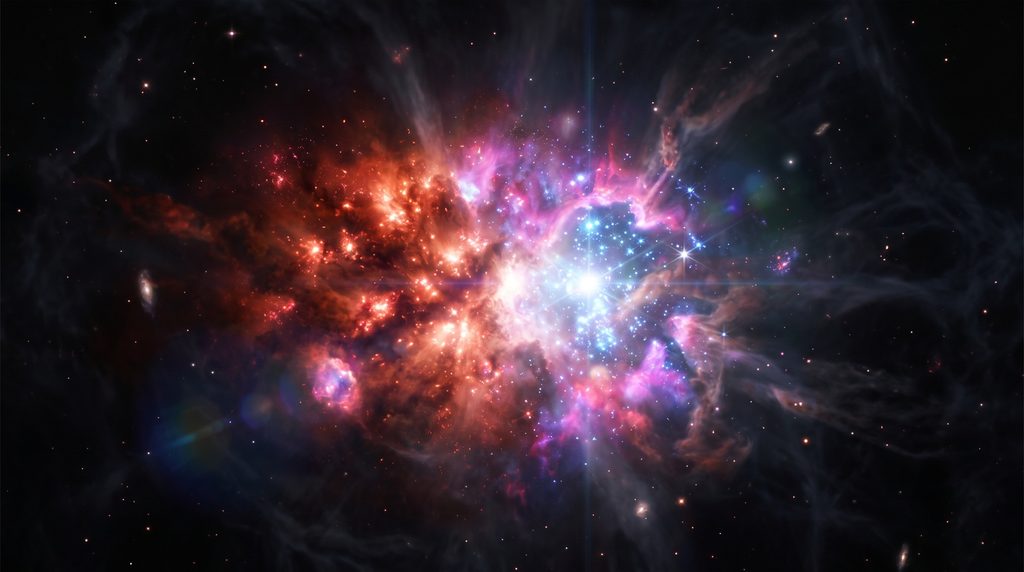
When astronomers peer back to the very dawn of the cosmos, they expect to find small, chaotic galaxies still trying to pull themselves together. Instead, the James Webb Space Telescope (JWST) keeps finding galaxies so unexpectedly massive and bright that they have forced cosmologists to rethink the timeline of the early universe.
Now, astronomers led by Lorenzo Parente of the University of Bologna in Italy have identified a unique system named Janus-11, sitting at an extreme redshift of nearly 11.0. We are seeing it as it existed when the universe was just about 425 million years old. But Janus-11 isn’t just another early giant; it appears to be a galaxy caught right in the middle of a massive evolutionary metamorphosis.
A Rare Beacon in the Cosmic Dawn
Finding any galaxy at this extreme distance is a challenge, but analyzing its chemical makeup is even harder.
“Even today, only a few sources at a redshift of more than 10.0 have been spectroscopically characterized, although JWST is enabling more and more detections,” Parente told. Universelost.com. “For this reason, every new object in the early Universe is extremely interesting in its own right. On top of that, Janus-11 shows a plethora of strong, well-detected emission lines, which allow us to characterize the conditions of its interstellar medium (ISM).”
What truly caught the team’s attention was a faint, incredibly rare signal: the auroral oxygen line, known as [OIII]λ4363.
“This line is usually quite weak and difficult to detect, even at lower redshift, and it had previously been observed only up to redshift 10.6, in GN-z11,” Parente says. “What makes it so interesting is its intensity… strongly depends on the gas temperature, which allows us to measure the electron temperature and, in turn, the metallicity of the ISM.”
Knowing the metal content of these early galaxies is essential for astronomers. It tells them how much dust has formed and provides a crucial benchmark. Right now, the researchers use “strong-line diagnostics” to guess the metallicity of distant galaxies based on nearby, modern ones. Janus-11 gives them a rare chance to see if those local calibrations actually hold true at redshifts higher than 10.0.
A Tale of Two Monsters
In the first few hundred million years after the Big Bang, astronomers have noticed a strange split in the massive galaxies they observe.
“The galaxies known to date… are either dust-poor, with almost completely unobscured ultraviolet (UV) emission and thus bluer light, or relatively dusty for their age, with substantially obscured UV emission and thus redder light,” Parente notes. “Coupled with the higher-than-expected luminosity and mass this led to the blue monster and red monster dubbing.”
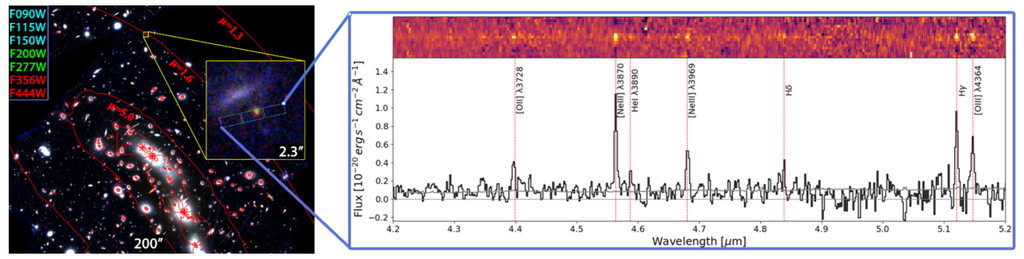
Image credit: Lorenzo Parente et al., 2026.
Why do early galaxies fall into these two extreme camps? One leading idea, known as the attenuation-free model, suggests these aren’t two different types of galaxies, but rather two phases of the same life cycle. In this model, a galaxy undergoes a massive starburst phase that creates a ton of dust, obscuring the light and making it look like a “red monster.” But eventually, the intense radiation from all those new stars creates so much outward pressure that it literally blows the dust away, transforming it into a brightly shining “blue monster.”
This is exactly why Janus-11 is so special.
“Observing an object such as Janus-11, with intermediate characteristics, is therefore extremely interesting, as it could provide strong evidence supporting outflow-driven models such as the attenuation-free model,” Parente explains.
Breaking the Universe? Not Quite.
Whenever JWST finds impossibly massive galaxies in the early universe, headlines often declare that the “Big Bang theory is broken.” However, Parente clarifies that while Janus-11 is a beast, it doesn’t break our fundamental understanding of cosmology.
“Although Janus-11 is one of the most massive galaxies known at redshifts higher than 10.0, its mass is compatible with the Lambda cold dark matter (ΛCDM) cosmological model,” he states, referring to the standard model of Big Bang cosmology.
What’s Next for Janus-11?
If Janus-11 is indeed a red monster blowing away its dust to become a blue monster, the next step is to catch that dust in the act of fleeing.
“It would be really interesting to test for the presence of outflows, as this would be strong evidence supporting the transition from a red monster to a blue monster phase,” Parente says.
The team hopes to use JWST’s Mid-Infrared Instrument (MIRI) for longer exposures.
“Moreover, these observations would allow us to check for broad components exclusive to the Balmer lines, which would indicate active galactic nucleus activity in Janus-11 and allow us to measure the mass of its central supermassive black hole when the Universe was just about 425 million years old.”



Leave a Reply