
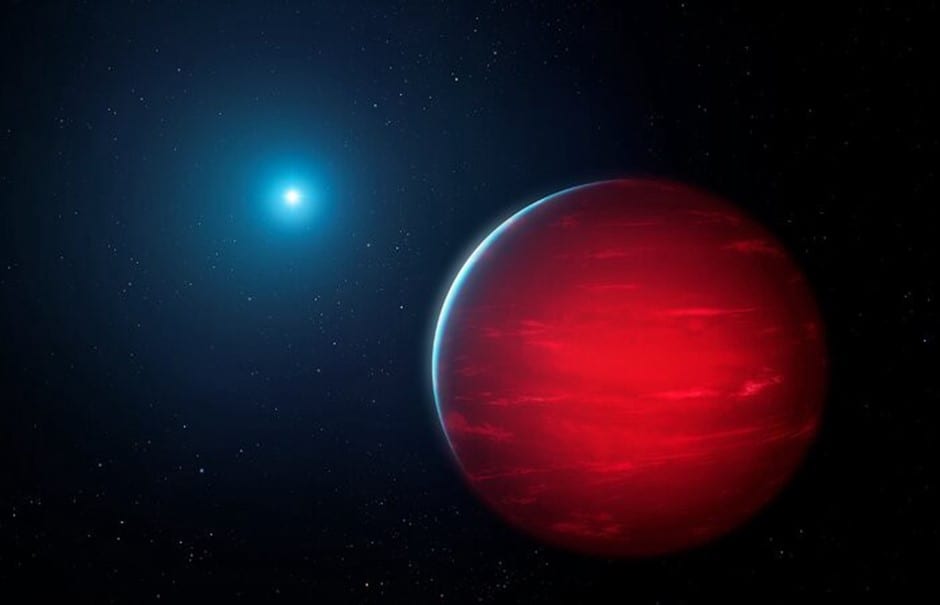
When you watch the clouds on Earth, you’re seeing water vapor that has cooled and condensed into liquid droplets or ice crystals. But if you were to travel to a brown dwarf, which is a celestial object somewhere between a giant planet and a small star (with a mass ranging from 13 to 80 Jupiter masses), you wouldn’t find rain clouds of water. Instead, you would find skies filled with hot sand, quartz, and molten rock.
For decades, astronomers have known that these extreme worlds, which are a subtype of brown dwarfs, known as L-dwarfs, are smothered in thick clouds of silicate minerals. But exactly how those rocky clouds form out of the hot atmospheric gases has remained largely obscured. Now, thanks to the unprecedented infrared view of the James Webb Space Telescope (JWST), a new study has caught this alien meteorology right in the middle of its formation.
In a recently published paper, a team of astronomers led by Zhijun Tu at the Chinese Academy of Sciences revealed that they have successfully detected gaseous silicon monoxide (SiO) in the atmospheres of three “benchmark” early-L dwarfs. This discovery provides the long-sought missing link, allowing scientists to directly trace how hot silicon gas cools and condenses into the solid, sandy clouds that define these substellar objects.
The Missing Link in Alien Weather
Brown dwarfs are often called “failed stars.” They are more massive than planets like Jupiter, but not quite massive enough to ignite the sustained nuclear fusion of hydrogen that powers stars like our Sun. Because they don’t have a steady internal furnace, they spend their entire lives slowly cooling down.
As a brown dwarf cools through a temperature phase known as the L-dwarf classification, something dramatic happens in its atmosphere: it starts to “snow” rock. At thousands of degrees, silicon and oxygen exist freely as gaseous silicon monoxide. But as the atmospheric temperature drops, thermodynamics takes over. The SiO gas combines with other elements like magnesium to form solid silicate minerals, and essentially, grains of sand and rock like forsterite and enstatite. These solid particles clump together, creating thick, opaque clouds that give L-dwarfs their characteristically red appearance in telescopes.
While astronomers have previously detected the broad spectral signatures of these solid silicate clouds, spotting the precursor gas, the SiO itself was incredibly difficult. The fundamental absorption bands of gaseous SiO overlap almost perfectly with the signals produced by the very silicate clouds they form. Untangling the two requires an instrument capable of seeing a broad range of infrared light with extreme precision, such as the JWST.
Peering Through the Dust
Using JWST’s NIRSpec and MIRI instruments, Tu and colleagues targeted three specific L-dwarfs: HD 89744B, GJ 1048B, and LSPM J0632+5053B. These targets are particularly valuable “benchmark” objects because they orbit larger, normal stars whose ages and chemical compositions are already well-understood, giving the researchers a cosmic answer key to check their atmospheric models against.
By analyzing the broad infrared spectrum from 0.8 to 12 micrometers, Tu’s team was able to separate the signals. They found clear, unambiguous signatures of gaseous SiO peaking around 4.0 to 4.2 micrometers, as well as between 7.7 and 8.2 micrometers.
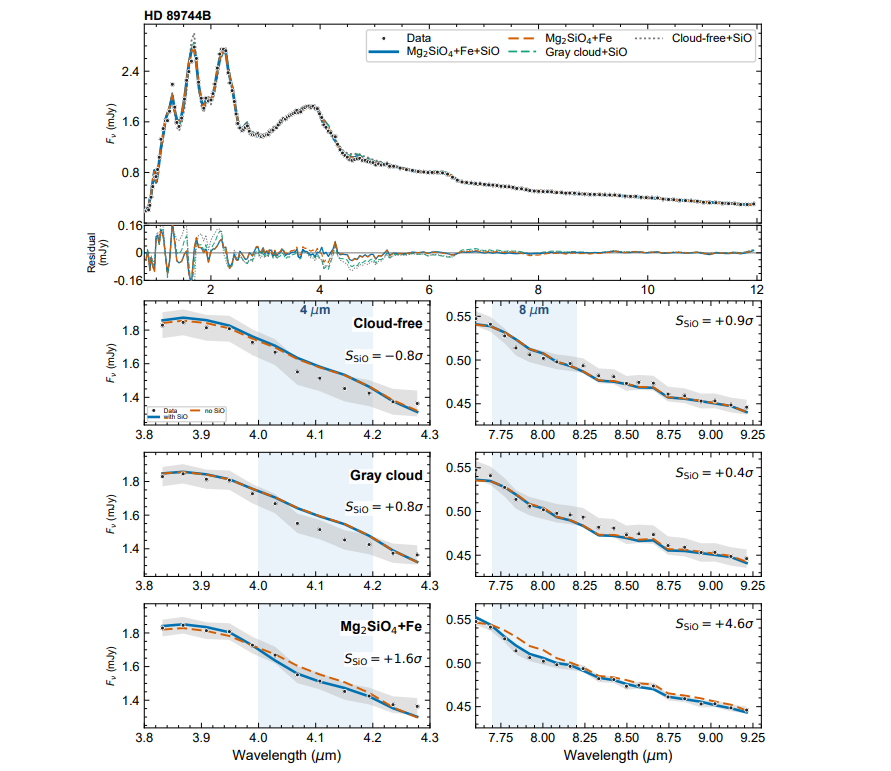
More importantly, the researchers mapped where this gas lives. They discovered that the gaseous SiO signatures originate from deeper, hotter layers of the brown dwarfs’ atmospheres, where temperatures are still too extreme for rocks to solidify. As you move higher up into the cooler, lower-pressure layers, the gas vanishes. It is depleted as it’s gobbled up by the condensation process that forms the thick silicate cloud decks above it.
A Window into Planetary Formation
The implications of this discovery stretch far beyond just brown dwarfs. The chemical transition from gaseous SiO to solid rock is the exact same process that occurs in the dusty, swirling protoplanetary disks where true planets, like our Earth, are born.
By analyzing the specific light signatures, the researchers could even determine the mineral makeup of the clouds raining out of the gas. For HD 89744B, the clouds appear to be dominated by forsterite (a magnesium-rich mineral often found in Earth’s mantle). For GJ 1048B, it was a mix of forsterite and enstatite. Furthermore, the team found that the ratio of carbon to oxygen in the remaining gas perfectly matched the composition of the brown dwarfs’ host stars, once they accounted for the oxygen that had been locked away in the rocky clouds.
In general, this new breakthrough study marks a major leap in our understanding of exotic atmospheres. By extending this framework to even cooler brown dwarfs and exoplanets in the future, astronomers will be able to watch this rocky condensation process evolve in real-time across the cosmos.




Leave a Reply