
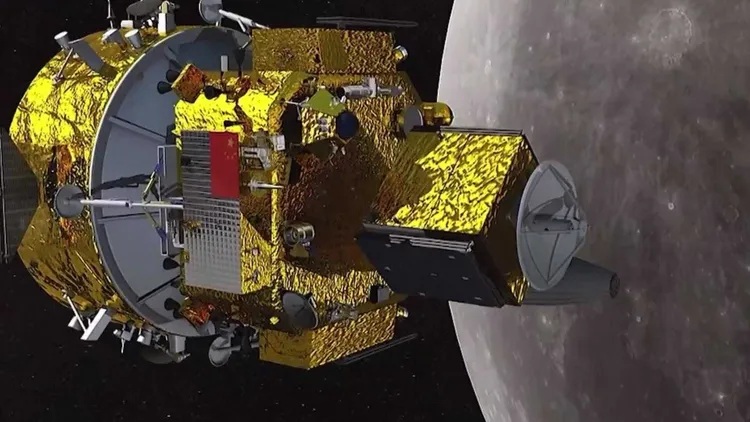
When China’s Chang’e-7 lander touches down near the Shackleton Crater on the Moon, it will carry a compact, low-mass instrument carrying massive scientific potential: the ILO-C camera-telescope. Built through an international collaboration between Hawaii’s International Lunar Observatory Association (ILOA), the University of Hong Kong’s Laboratory for Space Research (HKU-LSR), and the Chinese National Space Agency (CNSA), this 20-millimeter aperture payload is designed to conduct optical astronomy from the lunar surface.
Free from the distortion of Earth’s atmosphere, ILO-C aims to capture static, panchromatic optical views of the Milky Way’s Galactic plane, serving both as a landmark scientific project and a pathfinder for future long-term observatories on the Moon. Developed by the Beijing Institute of Space Mechanics and Electricity (BISME), the compact, low-mass instrument with a 20-mm aperture features a Sony IMX253 sCMOS sensor delivering approximately 12.37 megapixels (a 4,096 × 3,000 pixel array). This configuration provides high spatial resolution and a wide field of view required for effective Galactic imaging.
“The instrument will take broad, detailed images of the celestial sky which will include portions of the Milky Way Galaxy, stars, star clusters, visible planets, galaxies, and any objects of interest that happen to come into view such as comets or meteorites. Because ILO-C operates as a fixed payload, its specific target fields are dependent on the final landing coordinates and physical orientation of the Chang’e-7 lander,” Elisa Perednia, President and Chair of ILOA told Universelost.com.
Chang’e-7 mission is primarily designed to search for water ice and assess volatile resources at the Moon’s south pole, targeting a landing near the sunlit rim of Shackleton Crater. To accomplish its massive scientific scope, the mission consists of an orbiter for regional mapping, a stationary lander, a rover for surface navigation, and a specialized mini-flying probe designed to hop into permanently shadowed craters to analyze subsurface soil.
Mounting the ILO-C payload directly on the stationary lander leverages Chang’e-7’s prime polar real estate. It is a site chosen for its long windows of solar illumination and continuous line-of-sight communication in order to give the mini camera-telescope a stable foundation, power supply, and relay network needed to capture deep-space optical images free from terrestrial interference.
“The Moon provides a unique and advantageous platform for astronomical observations, particularly in the visible and ultraviolet wavelength ranges, owing to its extremely tenuous exosphere, the absence of atmospheric turbulence, and a stable surface environment. These characteristics enable long-duration, continuous observations free from atmospheric interference.” says Prof. Quentin Andrew Parker of HKU-LSR, who led, designed and mostly funded the ILO-C project.
“With the establishment of human-occupied lunar bases, ILOA also hopes that any instruments placed on the lunar surface can be maintained and repurposed in the future as is done on Earth,” Perednia adds.
ILO-C is a result of decades of cooperation between ILOA and China. The seeds for the ILO-C instrument were planted back in the 1980s by ILOA founding director Steve Durst, a visionary space advocate who spent decades building bridges with China’s aerospace sector. His long-standing relationship with key figures like Prof. Suijian Xue yielded a historic milestone in 2014.
“The International Lunar Observatory Association’s deep connection with China’s aerospace sector began in the 1980s through founding director Steve Durst, who unfortunately passed away earlier this year.” Perednia notes. “His decades-long relationship building—including with Prof. Suijian Xue—led to a landmark 2014 collaboration on the Chang’e-3 lander and the Lunar Ultraviolet Telescope (LUT). Building on this legacy, ILOA proposed a small camera for the Chang’e-7 mission, which was selected in 2024.”
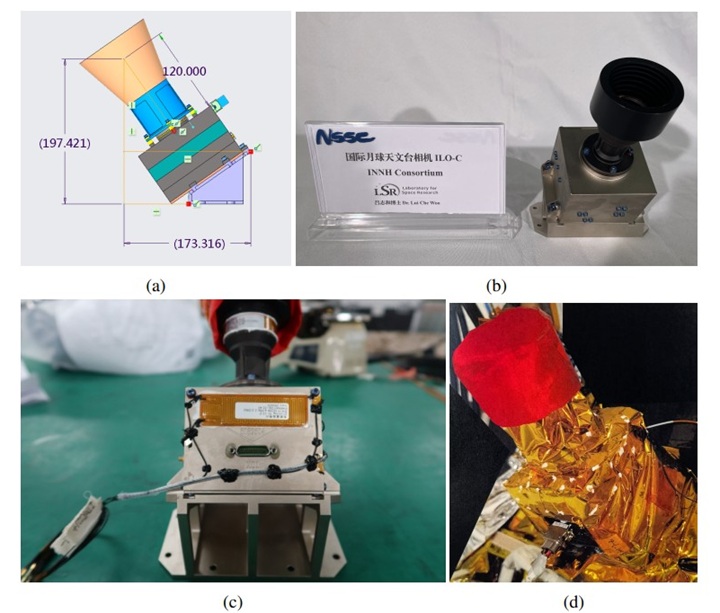
Beyond its immediate imaging mission, ILO-C represents a crucial proof-of-concept for the future of surface-based lunar astronomy. If successful, this micro-telescope could pave the way for ILOA’s ultimate ambition: the flagship ILO-1 observatory, a larger, permanent facility designed to establish a continuous, human-assisted astronomical presence on the Moon.
“The ILO-C instrument itself will act as a precursor and serve as a model for astronomical science while providing on-orbit verification for future related technologies. It will give us data on how to improve future telescopes and their sensors – whether that means improving the baffle for stray light or reflectivity from the lunar surface, or engineering aspects to combat lunar dust after landing. ILO-C can contribute data toward the long-term goal of building out an international, astronomical network,” Perednia says.
Although planned to lift off atop a Long March 5 rocket from the Wenchang Satellite Launch Center on Hainan Island during an initial window of August 23 to 24, 2026, the Chang’e-7 mission faced an unexpected setback when the launch was delayed until at least 2027.
Addressing the postponement, the China Manned Space Agency stated that the probe “does not meet launch conditions, and its launch therefore cannot take place during the planned window this year,” adding that “the assessment was conducted following the principle of prudence, reliability and absolute mission success.”
While the delay temporarily pauses the debut of the ILO-C instrument, it underlines the extreme operational precision required for deep-space science: when exploring the lunar south pole, absolute mission reliability takes precedence over any set calendar date.





Leave a Reply