
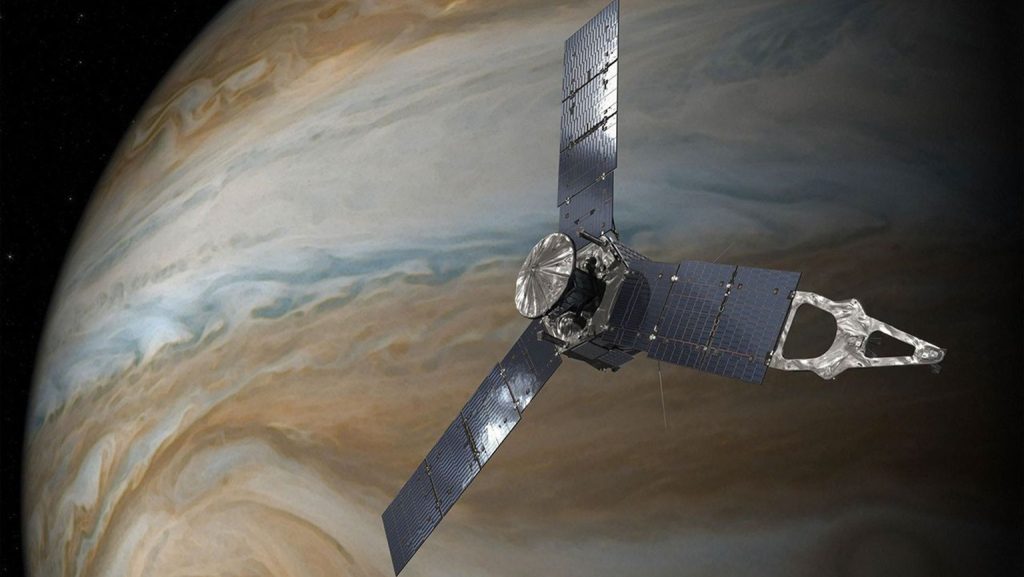
Originally planned to complete 34 orbits around Jupiter, NASA’s Juno spacecraft arrived at the gas giant on July 4, 2016 with the aim of completing its scientific mission in less than two years. But 10 years after, and a staggering record of over 80 orbits concluded, the solar-powered probe is still going strong, striving to collect more stunning shots of the fifth planet.
Staying Higher
The original plan for Juno was to complete two initial 53-day capture orbits, then lower its path to encircle Jupiter 33 times on rapid, 11-day orbits. However, technical issues forced the engineers to implement an alternative plan for newly arrived Jupiter’s satellite.
“We stayed in a 53-day orbit because we saw some suspicious risks associated with firing the rocket to change the orbit. So we left it in this long orbit, but we didn’t expect that we would last over 85 orbits. We’re still going,” Scott Bolton, Juno principal investigator from Southwest Research Institute (SwRI) in San Antonio told Universelost.com.
What might have seemed as a major stepback at first, turned out to be a blessing for the scientists as it enabled “bonus science” that wasn’t part of the original mission design.
“That was really great because it has enabled all kinds of additional science that we hadn’t planned, but also allowed us to follow up on some of the major discoveries and surprises that we made,” Bolton says.
The Radiation Vault
Another hurdle that might have shortened the operational lifetime of Juno are Jupiter’s intense radiation belts, therefore a cosmic equivalent of walking through a nuclear reactor. Yet, Juno has managed to thrive where previous electronics would have been fried within weeks.
When asked how the spacecraft has managed to stay healthy for so long in such a hostile environment, Bolton points directly to pioneering engineering.
“Well, it was well-designed,” Bolton says. “We invented some things associated with protecting it from the high-energy radiation. We created what we call the radiation vault in the middle of the spacecraft that was surrounded by a lot of shielding and then inside were the sensitive electronics. I don’t think any other spacecraft had ever been designed that way. And that seems to have worked really well since then.”
Pioneering Cosmic Repairs
Beyond the physical shielding, Juno’s extended lifespan is also the result of real-time problem-solving by the engineering team. Over the course of dozens of close flybys (perijoves), the team has essentially written a new manual on how to manage radiation degradation on the fly.
“We’ve also learned quite a bit as we go through the orbits. We’re learning how to actually repair damage from the radiation,” Bolton explains. “That’s really never been understood very well. And we’re kind of pioneering new techniques.”
Therefore, rather than giving up when the harsh Jovian environment takes a toll on the spacecraft, the team has turned the mission into a laboratory for deep-space maintenance.
“We’ve actually had some subsystems or instruments that have had problems and then through some experimentation, we’ve been able to get them to start working again. And so that’s also amazing,” says Bolton. “So we’re learning a lot from Juno about how spacecraft behave in high radiation environments and also how to maybe design them to last longer, as well as potentially repair things that start to have problems. So this is all brand new. I’m very proud of the team and happy to be involved with such a team that’s so innovative and creating new things, but it was really unexpected.”
A Decade of Discovery and Natural End Ahead
What began as a high-stakes gamble in the solar system’s most punishing radiation environment has transformed into a masterclass in resilient engineering and real-time operational ingenuity. The spacecraft has not only completely rewritten our understanding of Jupiter’s churning atmosphere, deep interior structure, and massive magnetosphere, but it has also proven that solar-powered exploration is viable even at the chilly outer edges of our cosmic backyard.
So how long Juno can still be functional and how the mission is planned to be terminated?
Early mission designs called for a deliberate, controlled death dive into Jupiter’s crushing atmosphere to protect the surrounding icy moons from potential contamination. However, the stability of Juno’s prolonged 53-day orbit allowed the team to implement an alternative solution.
“So the plan has changed now. We no longer have to dispose of the spacecraft. It will just keep going around,” Bolton reveals. “Eventually, I don’t know how many years away from now, but it will naturally eventually fall into Jupiter many years from now. So there is no disposal plan anymore where you do this dive into the atmosphere. It will happen naturally.”
While the final plunge is inevitable, it will be a quiet departure rather than a dramatic event. The probe is expected to outlast its own operational lifespan before gravity finally pulls it home.
“It will most likely happen after the spacecraft is no longer functioning,” Bolton concluded. “So we won’t necessarily get data from that.”
As the resilient spacecraft continues its trailblazing journey, its ultimate legacy may lie in the blueprint it leaves behind for the next generation of explorers. The lessons learned from Juno’s radiation vault and the engineering team’s innovative, remote repair techniques have fundamentally changed how we design and build probes for deep space.





Leave a Reply