
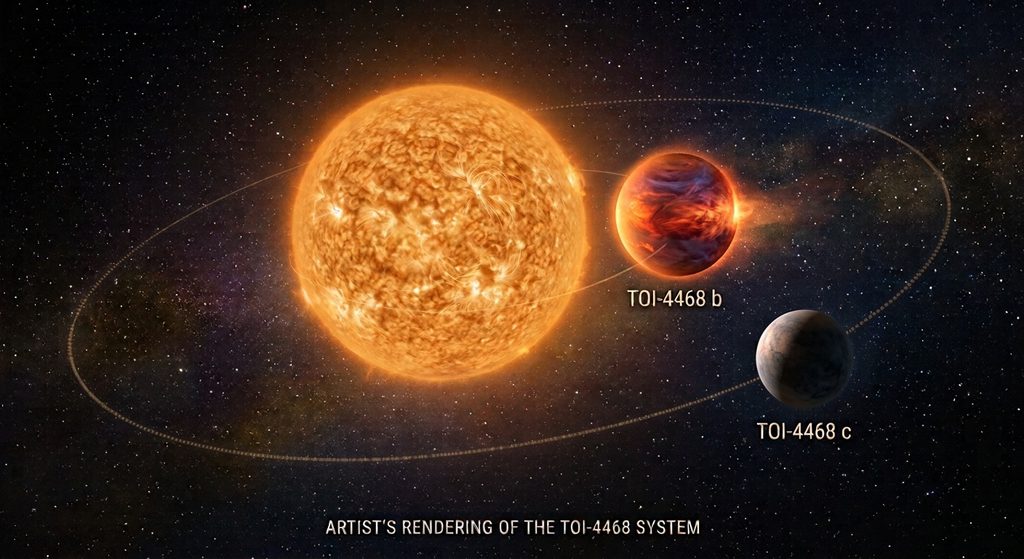
Using the Transiting Exoplanet Survey Satellite (TESS), an international team of astronomers has discovered a new planetary system about 1,200 light years away. The newfound system is unique among others as it hosts a close outer companion to a hot Jupiter without an accompanying inner planet.
The so-called hot Jupiters are gas giants that circle their host stars in less than 10 days. They have high surface temperatures as they orbit their parent stars very closely. Decades of astronomical observations have led to the prevailing theory that as these massive giants migrate inward toward their star, their intense gravitational pull acts like a cosmic wrecking ball, destroying or ejecting any neighboring planets in their path.
The discovery of planets around the star TOI-4468 directly challenges this long-held “lonely giant” scenario. By preserving a nearby companion on an outer trajectory while lacking an inner sibling, TOI-4468 offers a rare window into an alternative, far gentler migration history in which a gas giant travels inward without completely decimating its surrounding planetary neighborhood.
“This system centers on a Teff = 5,200 K K-dwarf star and is the second observed, after WASP-47, that contains a hot Jupiter and a nearby outer companion, and is the first observed with only an outer companion. This novel architecture presents the opportunity to further investigate the formation mechanism of hot Jupiters with nearby companions,” astronomers led by Joseph R. Livesey of University of Wisconsin–Madison wrote in a research paper announcing the discovery.
The hot Jupiter in the system received designation TOI-4468 b. It is the size of Jupiter, while its mass is estimated to be only half of the solar system’s biggest planet. TOI-4468 b orbits the host star every 2.77 days, at a distance of some 0.036 AU from it. The equilibrium temperature of this giant alien world is predicted to be around 1,153 K.
The outer exoplanet, designated TOI-4468 c, is about three times smaller than Jupiter but its mass, which is estimated to be at a level of 0.035 Jupiter masses, has yet to be confirmed. The planet has an orbital period of approximately seven days, semi-major axis of 0.067 AU and its equilibrium temperature is expected to be 846 K. The researchers classified TOI-4468b as a sub-Neptune.
What makes this configuration unusual is the absence of an inner sibling world. In one of systems similar to TOI-4486, like WASP-47, hot Jupiters are flanked on both sides by nearby planets, suggesting a multi-stage, highly synchronized inward drift.
“TOI-4468 b is to date the only known hot Jupiter accompanied by a small outer planet but no inner planet. The only other hot Jupiter with an identified outer companion, WASP-47 b, also harbors a small interior planet,” the authors of the paper explain.
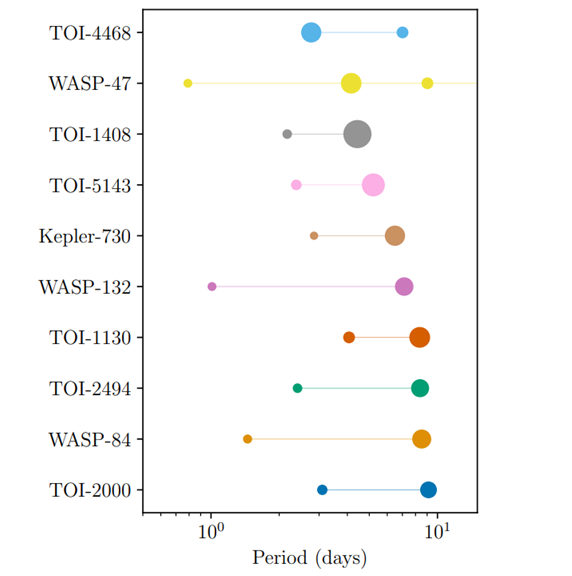
Therefore, TOI-4468’s asymmetrical layout, which features a lone sub-Neptune outside the giant’s scorching orbit, presents a fresh puzzle for astronomers.
Beyond the close-orbiting duo, the radial velocity data hinted at an even larger architectural mystery lurking further out in the system. Livesey’s team identified a distinct secondary signal corresponding to a potential outer giant planet with a wide, 624-day orbital period. While this distant candidate remains unconfirmed and requires continued long-term monitoring, its presence would fit a growing pattern in exoplanetary science where inner hot Jupiters are anchored by cold, distant gas giants.
If confirmed, this outer world could provide the subtle gravitational nudge that initially steered TOI-4468 b onto its inward path, offering a complete look at how a multi-planet system balances stability with extreme migration.





Leave a Reply