
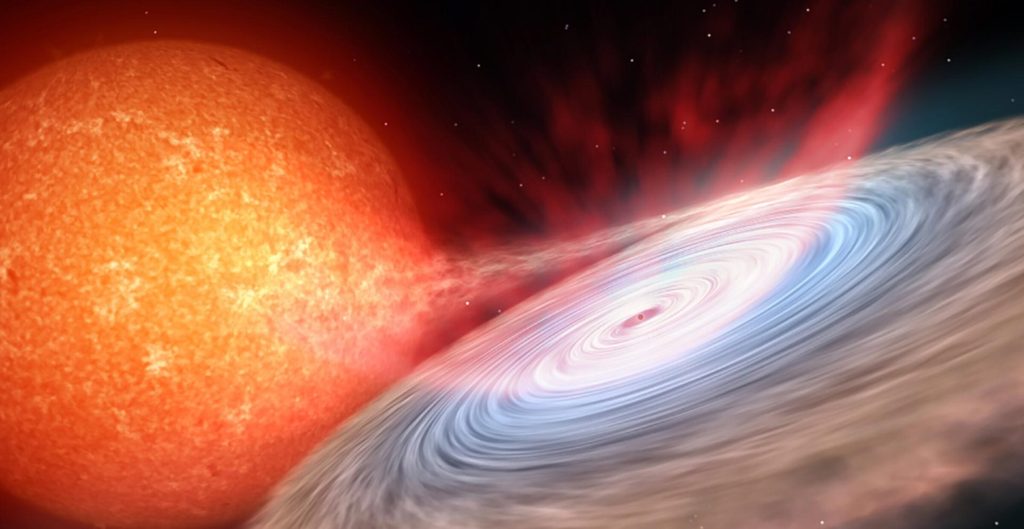
Recent observations performed by an international team of astronomers have revealed a surprising phenomenon: the exact same black hole launched jets with drastically different velocities, ranging from mildly relativistic to hyper-fast speeds, across successive state transitions.
The new discovery made by a group of researchers led by Callan M. Wood of Curtin University in Australia challenges long-held astrophysics assumptions that static properties like a black hole’s mass, spin, or alignment dictate the speed of its material ejections, suggesting that the dynamic environment surrounding these cosmic engines plays a far more volatile role than previously imagined.
The findings are a result of intensive radio and X-ray tracking of Swift J1727.8-1613, a low-mass X-ray binary (LMXB) with a stellar-mass black hole roughly 10,000 light-years from Earth in the constellation Ophiuchus. When the system violently awakened in late 2023, triggering one of the brightest X-ray outbursts ever recorded, astronomers turned global radio arrays toward the spectacle. By resolving nine distinct “knots” (dense clouds of superheated plasma hurled into interstellar space) the team reconstructed the black hole’s ejection history frame by frame, capturing a level of physical detail rarely seen in such systems.
“What made the system particularly interesting was that our subsequent observations coincided with sudden bright X-ray and radio flares, indicating rapid changes both in the material flowing towards the black hole and in the radio jet. We therefore continued monitoring the source as it went through multiple X-ray and radio flares,” Wood told Universelost.com.
He noted that Swift J1727.8-1613 is extraordinary as for many LMXBs, astronomers may only get to observe a single bright flare during an outburst.
“Swift J1727.8-1613 is exciting because it has shown repeated flaring, giving us multiple opportunities to investigate how changes in the material falling towards the black hole are connected to the launching and powering of relativistic jets. It also allows us to investigate how individual jets launched by the same black hole can differ, and whether those differences are related to the changing conditions close to the black hole,” Wood explains.
By linking high-resolution radio observations with X-ray tracking, the team was able to match specific plasma ejections directly to those state changes near the event horizon. Beyond solving a local cosmic puzzle, the findings establish Swift J1727.8-1613 as a pivotal prototype for understanding relativistic outflows across all size scales.
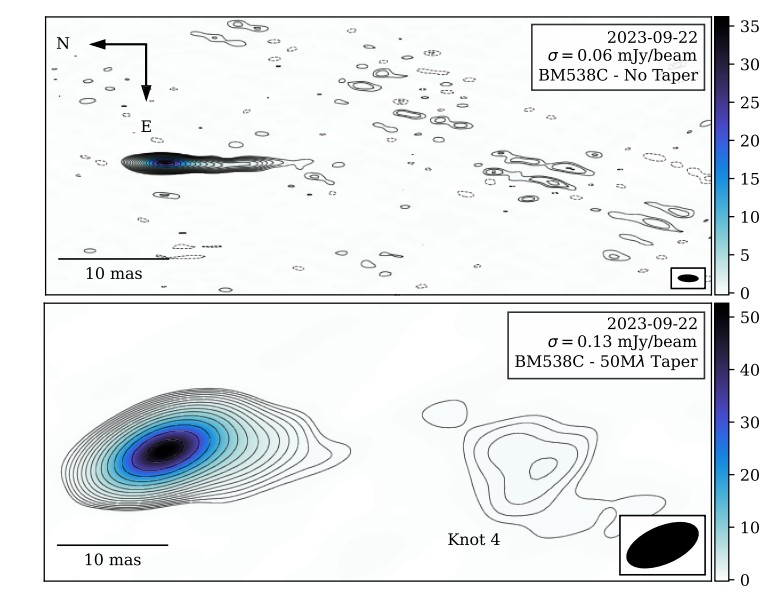
bottom panel shows an image made using a Gaussian taper with 30% power at 50 Mλ. Credit: Wood et al., 2026.
Stellar-mass black holes evolve over human timeframes of weeks and months, whereas supermassive black holes (SMBHs) at the centers of galaxies take millions of years to undergo similar state changes. By watching this local system shift gears in real time, astrophysicists have gained a rare, front-row seat to the fundamental mechanisms that govern cosmic feedback and high-energy particle acceleration throughout the universe.
“Stellar-mass black holes in our Galaxy, such as Swift J1727.8-1613, give us a kind of laboratory for studying the same fundamental physics on much shorter, humanly accessible timescales. We can watch jets form and evolve and compare those changes with the rapidly changing material flowing towards the black hole. This helps us understand how jets are launched and powered, and ultimately how the same processes may operate around much more massive black holes at the centres of galaxies,” Wood said.
Beyond the varying jet speeds, the behavior of Swift J1727.8-1613 during its “quenched” states offers another critical window into how black holes manage their colossal energy budgets. When the central relativistic jet shuts down or diminishes, the energy launched into space doesn’t simply disappear; instead, the system shifts its output mode. Rather than channeling energy into tight, highly focused beams of plasma visible in the radio spectrum, the system redistributes that force into broad, wide-angled disk winds.
These powerful optical-wavelength outflows sweep away material from the accretion disk itself, creating a cosmic balancing act where disk winds dominate precisely when radio jets fade.
“Understanding how the character and properties of the outflows change throughout an outburst, and their connection to the properties of the accretion inflow, is important to understand the underlying extreme physics surrounding feeding black holes,” Wood noted.
Mapping these state transitions reveals that black holes are not static vacuum cleaners, but highly responsive engines capable of shifting their energy discharge pathways in response to minute changes in their immediate environment.
Looking ahead, the team’s research is now focused on catching these unpredictable cosmic engines whenever and wherever they ignite. Because systems like Swift J1727.8–1613 enter outburst sporadically, astronomers cannot simply schedule their observations in advance. Whether this particular black hole flares again in the coming years or remains quiet for decades, the methodologies refined during this campaign have already established a new blueprint for studying binary systems across the galaxy.
“We primarily study these systems during their sporadic bright outbursts. We don’t know when, or even if, Swift J1727.8-1613 will go into another outburst,” Wood said. “While we would be very excited to see Swift J1727.8-1613 go into another bright outburst, we can also apply the same observing and modelling techniques to other black hole X-ray binaries when they go into outburst. These could be previously known systems, or potentially new black hole X-ray binaries that have yet to be discovered.”
As Wood emphasized, every new outburst provides a fresh lens on the dynamic environment surrounding event horizons, using these natural cosmic laboratories to test the outer limits of modern physics.




Leave a Reply