
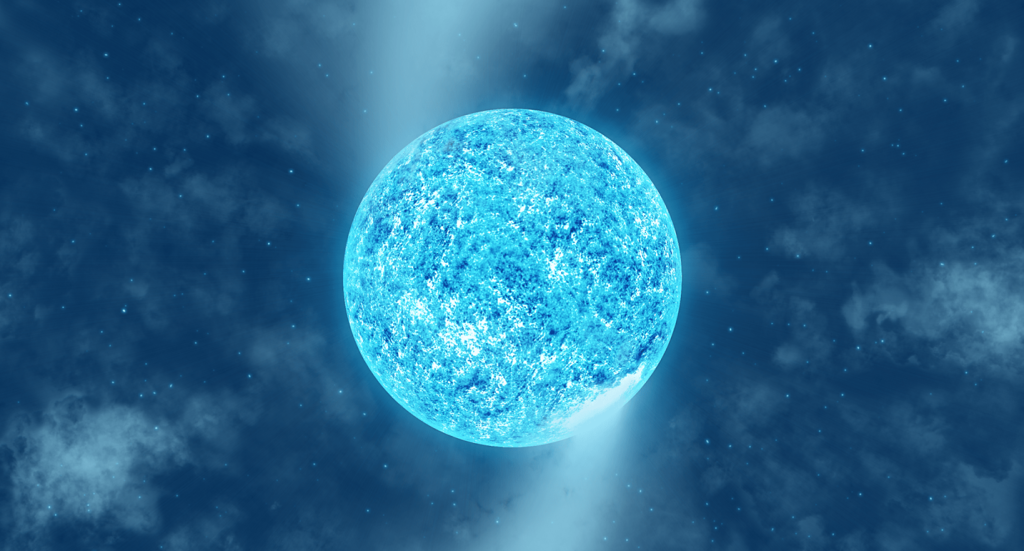
Deep in the cosmos, some stars burn so hot and bright that they were long thought to be chemical wastelands. Their ultraviolet (UV) radiation is powerful enough to shred molecular bonds, leaving nothing but a sterile zone of atomic gas. Or so we thought.
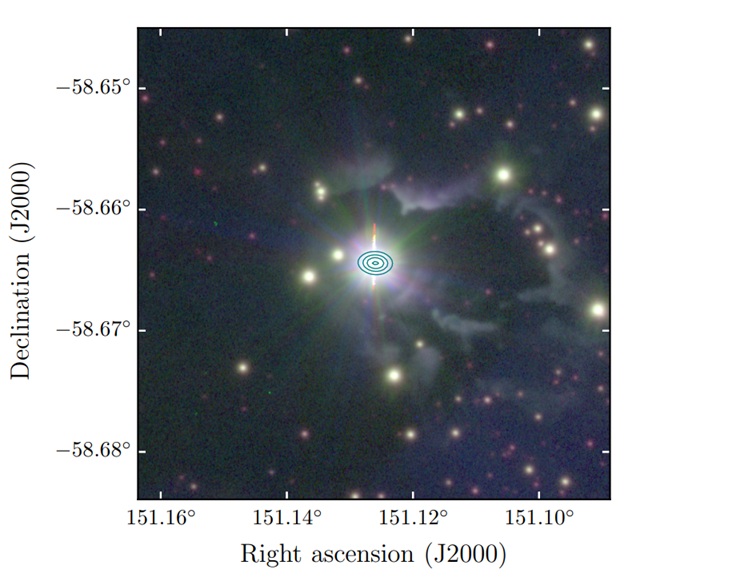
In a groundbreaking study, an international team of astronomers has shattered this assumption. Using the Atacama Large Millimeter/submillimeter Array (ALMA) in Chile, researchers led by Cristobal Bordiu of the National Institute for Astrophysics (INAF) in Italy have detected complex sulfur oxides floating in the violent ejecta of a monstrous star named HD 87643.
Not only does this discovery rewrite the rules of cosmic chemistry, but it also provides an unexpected “time machine” to study the atmosphere of the early, primordial Earth.
The Myth of the Sterile Supergiant
With a mass of about 24 solar masses, HD 87643 is a B[e] supergiant, representing a rare class of incredibly luminous, highly evolved massive stars. These cosmic titans are surrounded by thick, dusty disks of ejected material. Historically, astronomers believed that the only molecule hardy enough to survive the relentless onslaught of a B[e] supergiant’s UV radiation was carbon monoxide (CO). The surrounding environments of these stars were presumed to be chemically dormant.
To test this, Bordiu and his team pointed ALMA at HD 87643. What they found surprised everyone: a vibrant, active chemistry. Among the cosmic debris, they identified clear chemical signatures of sulfur monoxide (SO) and sulfur dioxide (SO2), marking the very first time these sulfur oxides have ever been detected around an early-type, massive evolved star.
“There are a few detections of silicon monoxide (SiO) in B[e] supergiants in literature, in the near-infrared, so we were confident we would find something else apart from carbon monoxide, but we were not explicitly expecting sulfur oxides. This came as a surprise,” Bordiu told Universelost.com.
A Chemical Snapshot
But how can these fragile molecules exist in such a hostile environment? According to the researchers’ chemical modeling, the sulfur oxides are not permanent fixtures, but rather a fleeting cosmic phase. The sheer density of the oxygen-rich gas and dust ejected by HD 87643 provides a brief shield against the star’s destructive radiation. Under these conditions, a rapid, “out-of-equilibrium” chemistry takes place.
The models show that these molecules can assemble in as little as 10,000 years. What ALMA has captured is a short-lived chemical snapshot of a rapidly evolving stellar system.
“What is clear is that we are far from chemical equilibrium here; a snapshot thousands of years in the future will certainly show a different picture. In a broader sense, we know that dust and molecules are being constantly created and destroyed in the outskirts of early-type supergiants, so this is a dynamic environment.” Bordiu notes.
Isotopic Anomaly
While finding sulfur oxides around a supergiant is exciting for astrochemists, the most startling revelation lay in the stellar isotopes.When the team analyzed the ratio of different types of sulfur, they discovered an anomalously low ratio of Sulfur-32 (32SO) to Sulfur-33 (33SO).
“The presence of sulfur oxides simply tells us that this is an oxygen-rich environment. However, it is the fractional abundances that suggest the intense ultraviolet radiation is likely having a huge impact: the anomalously low 32SO/33SO ratio is what prompted us to explore more speculative scenarios, such as the mass-independent-fractionation due to isotope selective photochemistry,” Bordiu explains.
A Mirror to Ancient Earth
But what does this have to do with the chemistry of the ancient Earth? The mass-independent fractionation of sulfur is found written in the rock record of the Archaean Earth (spanning 4 to 2.5 billion years ago). Before our planet had an ozone layer to shield it, intense solar UV radiation blasted our atmosphere, driving the same photochemical reactions and embedding anomalous sulfur signatures into Earth’s earliest sediments.
The discovery made by Bordiu’s team establishes HD 87643 and its B[e] supergiant siblings as unique, extreme laboratories. However, some questions still remain open: what will happen to these sulfur oxides next? Will they eventually be destroyed by the star’s radiation, or could they go on to form dust, planets, or other space rocks?
“For sure planets won’t form in HD 87643, this is an evolved star approaching the end of its life and the conditions are far from ideal,” Bordiu claims. “However, we don’t really know how this molecular envelope will evolve. For starters, we lack information on the exact spatial distribution of the different molecules relative to the dust, so we cannot be certain about the amount of shielding.”
The Hidden Companion
Astronomers have long known that HD 87643 doesn’t travel alone as it has a faint, elusive companion star. Whether this object is actively fueling the supergiant’s chaotic environment, or completely reshaping its chemistry, remains an open question.
“Not with the current data,” Bordiu admits when asked if the discovery can unlock the nature of this hidden partner. However, the team already has an idea of how to disentangle the properties of the faint companion. “We want to revisit HD 87643 at higher sensitivity and resolution to resolve the molecular envelope. If we can achieve about 50 milliarcsecond resolution, we might be able to see how the companion shapes or affects the circumbinary structure, and perhaps derive some of its properties.”
Unmasking this companion is about more than just satisfying scientific curiosity. It addresses one of the most fundamental questions in planetary science. As Bordiu notes, “Understanding how binarity influences the circumstellar chemistry in evolved massive binaries is a hot topic in molecular astrophysics.”
The Hunt Expands
With the chemical rulebook officially rewritten, the researchers are not content with looking at just one cosmic anomaly. The discovery of these unexpected sulfur reservoirs has opened up an entirely new territory of exploration.
“We want to dig deeper into the molecular chemistry of HD 87643, but in parallel, our goal is to explore similar objects,” Bordiu says.
The ultimate goal for astronomers now is to figure out exactly how unique this extreme laboratory really is.
“It’s important to determine whether HD 87643 is a special case, possibly favored by its complex circumstellar environment, or just an exemplar of a common phenomenon,” Bordiu explains.
If it proves to be the latter, our galaxy may be absolutely packed with violent, glowing time machines, all silently preserving the chemical history of our own ancient origins.




Leave a Reply