
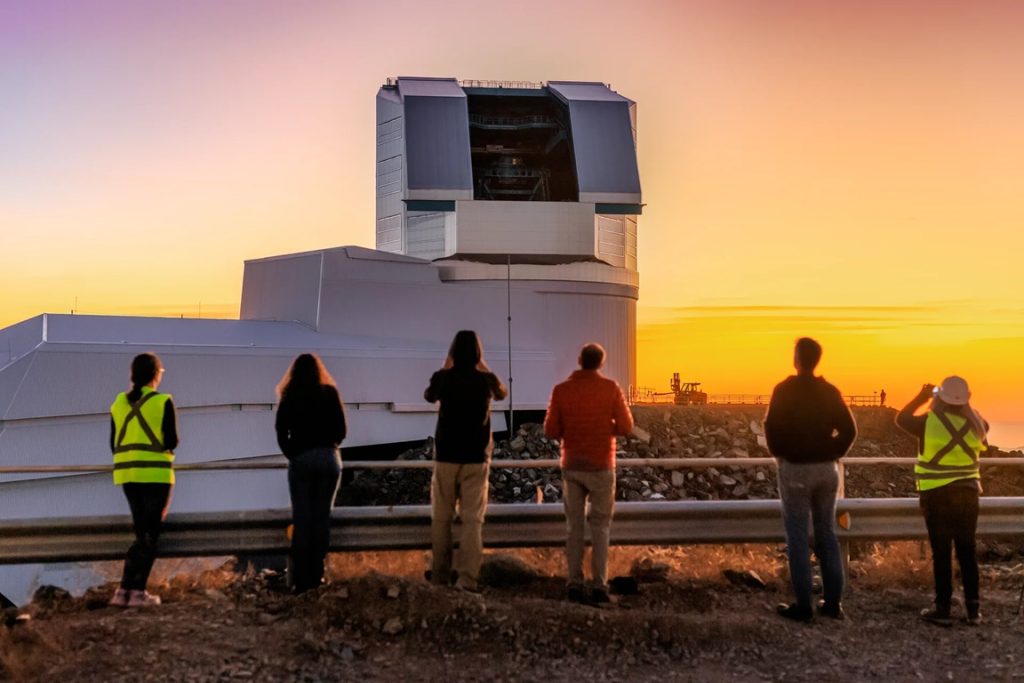
“Ready, set, action!” Bob Blum, the Director for Operations at the Vera C. Rubin Observatory might shout if he were a director of a Hollywood movie. Instead, he’s in charge of something far more ambitious: the Legacy Survey of Space and Time (LSST). Over the next ten years, this project will scan the entire southern sky every few nights, capturing “The Greatest Cosmic Movie Ever Made.”
Cosmic Camera on Set
To film such a blockbuster cosmic movie you need the greatest camera ever pointed at the sky. Sitting on a mountaintop in Chile, the Rubin Observatory combines an enormous light-collecting mirror with a field of view wide enough to swallow several full moons at once. Every 40 seconds, it pivots briskly, snapping ultra-high-definition images of the night sky. By returning to the same patches of sky roughly 800 times over the next decade, it will allow us to see the universe change in real-time.
Rubin Observatory is a U.S. government facility jointly operated by National Science Foundation (NSF) NOIRLab and the Department of Energy’s SLAC National Accelerator Laboratory. NOIRLab is managed by the Association of Universities for Research in Astronomy (AURA).
At the heart of this machine sits the LSSTCam, a technical marvel built by the SLAC National Accelerator Laboratory. This 3,200-megapixel camera produces images so detailed that displaying just one would require a grid of hundreds of ultra-high-definition TVs. It is the largest digital camera ever constructed for astronomy.
The Plot
So what story will this cosmic blockbuster actually tell us? Scientists are bracing themselves for an unprecedented deluge of data. Each night, the observatory will generate roughly 10 terabytes of information, resulting in up to seven million automated alerts every single night to flag anything that has moved, flared, or changed brightness.
“The LSST holds great promise for discovering new objects or phenomena we have never seen before. Discovering the unknown is expected and a source of great excitement within the team and community. At the same time, we plan to add precision measurements to further the understanding of dark energy and dark matter. In this sense the LSST is a high energy physics experiment coming at the time we know much but want to know more,” Blum told Universelost.com.
Screenings Open for Everyone
However, the most radical aspect of the Rubin Observatory may be not its hardware, but its data philosophy. Historically, telescope time was tightly hoarded by elite institutions. Rubin’s massive stream of measurements will be delivered openly through regular data releases.
From professional cosmologists to backyard stargazers and school students, anyone will have the ability to explore this live map of the cosmos. As the survey rolls into its decade-long run, it promises to democratize discovery, ensuring that the next groundbreaking cosmic breakthrough could come from absolutely anywhere.
In the latest press release, NOIRLab stated that this is the first time so much astronomical data will be available to so many people, opening the door to new kinds of discovery by both scientists and the public.
“Rubin invites anyone in the world to engage with its data and explore the dynamic universe in ways never before possible,” the press release reads.
Film Noir
When the Rubin Observatory will look out at the night sky, it will face a humbling truth: everything we can see makes up a tiny 5 percent of the universe. The remaining 95 percent is entirely invisible, composed of two mysterious entities known as dark matter (the cosmic glue holding galaxies together) and dark energy (the mysterious force driving the universe to expand at an accelerating rate).
Understanding these twin enigmas is arguably the greatest challenge in modern physics. If we want to learn what the universe is made of, how it evolved, and how it will ultimately end, we have to find a way to map the unseen. This is exactly why the launch of LSST is a historic milestone. By transforming the sky into a dynamic, ten-year time-lapse, the Rubin Observatory isn’t just taking pictures, but it is building the most precise laboratory ever conceived to test the fundamental laws of our existence.
“Large scale galaxy surveys and observations of resolved stellar populations are two very good approaches to study dark matter and dark energy,” Blum says. “Large samples of precision measurements of the positions of galaxies in the sky and their correlations in separation constrain models of the expansion history of the universe, leading to better understanding of dark energy.”
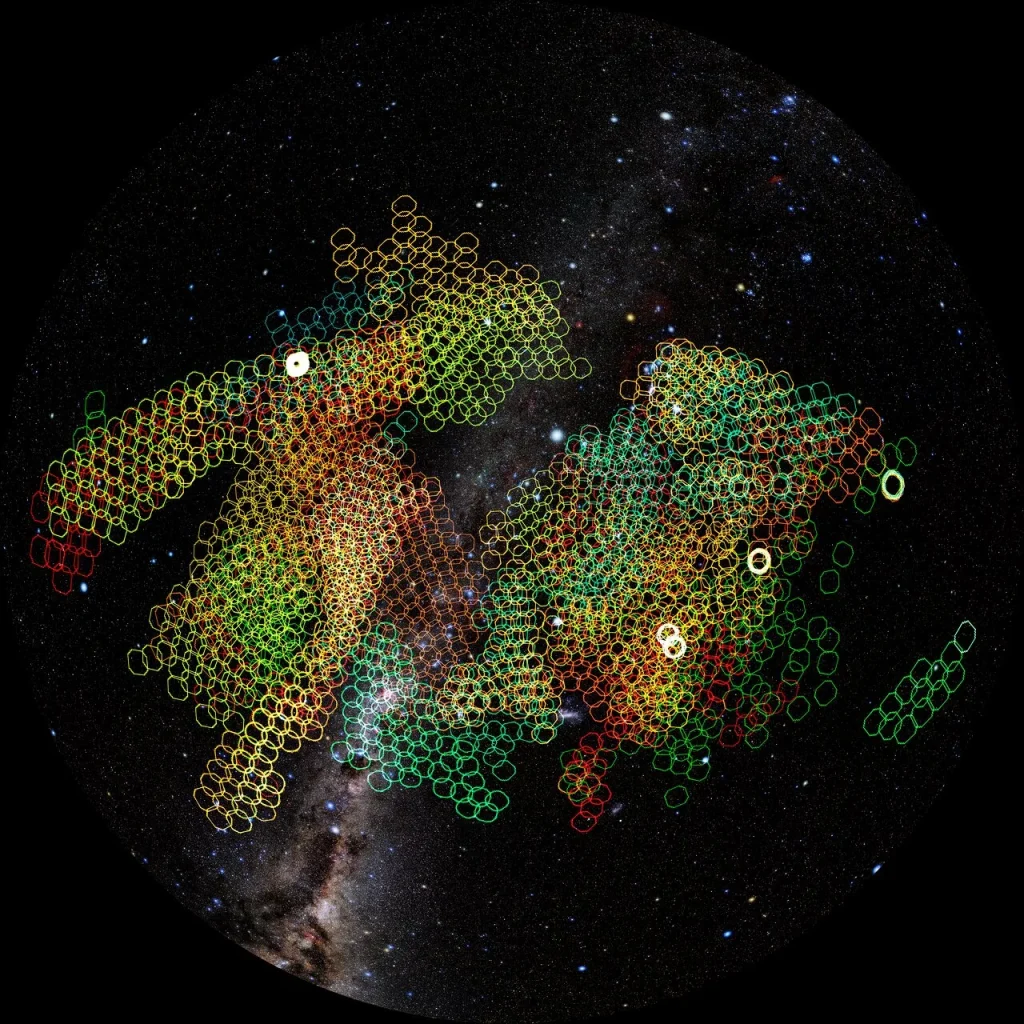
Credit: NSF–DOE Vera C. Rubin Observatory/NOIRLab/SLAC/AURA.
By tracking these galactic positions over billions of light-years, Rubin allows cosmologists to map out how dark energy has driven the accelerating expansion of space over time. But the observatory won’t just look at where galaxies are as it will look at how their light is warped on its way to us.
“Precise shape measurements can detect variations in shape (called shear) due to gravitational lensing of the light from distant galaxies by galaxies in the foreground,” Blum explains. “This weak lensing technique produces a dark matter map of the observed sky because dark matter deflects light just like normal matter does.”
Finally, Rubin will bring this detective work much closer to home, looking at the fine structure of galaxies in our immediate cosmic neighborhood. Here, dark matter leaves a physical trail that the observatory’s massive camera is uniquely equipped to hunt down.
“Finally, we hope to study dark matter in detail by using measurements of streams of stars in nearby galaxies that are perturbed by the interaction with other small galaxies,” says Blum. “The dark matter halo of the perturbing galaxy can cause gaps in the stream of stars in the other galaxy, like a boat crossing the wake of another boat.”
By tracking these stellar “wakes,” astronomers can finally deduce the exact size and behavior of the invisible dark matter halos guiding the evolution of galaxies.
10 Terabytes a Night
Capturing the secrets of dark matter and dark energy requires a staggering amount of raw power. The observatory features a 3,200-megapixel camera, which means every click of the shutter generates an enormous file size. Over the course of a single night, the telescope produces roughly 10 TB of data.
To put that in perspective, processing and storing that much information daily would crush standard computing infrastructure. When asked about the practical challenges of handling this nightly deluge, Bob Blum highlighted a massive logistical feat of digital transport.
“The main challenge here is to achieve reliable transfer of the data in real time from Chile to California (SLAC),” Blum says. “Because each new image generates a real-time stream of objects that have changed brightness or position (transient and variable star alerts), it must be transferred in seconds. Keeping up with this relentless cadence assures the data all reach California by the end of the night.”
To prevent a catastrophic data traffic jam, the observatory relies on a specialized, ultra-high-speed pipeline stretching across hemispheres.
“We achieve this using a dedicated, high-bandwidth, long-haul network comprised of Research and Education Networks (RENs) in Latin America and the DOE ESNet in the US,” Blum explains. “Coordination of the RENs is via AmLight, an NSF-supported program based at Florida International University in Miami.”
Solar System Spin-off
While Rubin is optimized to map the furthest reaches of the cosmos, it is simultaneously functioning as the most powerful Solar System discovery machine ever constructed. Because it sweeps across the sky continuously, it catches anything that moves against the static background of the stars.
During early optimization and testing phases alone, Rubin’s hardware stunned the astronomical community by identifying over 11,000 asteroids. Now that the official 10-year survey is underway, the astronomers expect even more discoveries in this field.
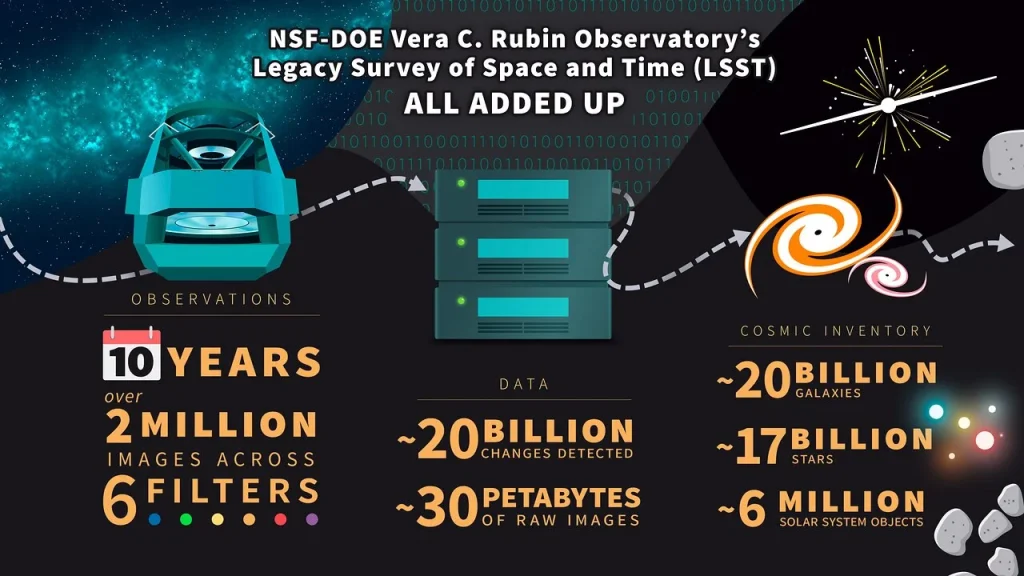
“We will discover about 5 million new main-belt asteroids and a hundred thousand near-Earth objects (NEOs),” Blum anticipates. “And tens of thousands of dwarf planets like Pluto (trans-Neptunian Objects, or TNOs).”
Beyond mapping the rocky leftovers of our own cosmic backyard, Rubin’s sensitivity opens up a thrilling new frontier: hunting for interstellar hitchhikers that have drifted into our neighborhood from other star systems, like comet 3I/Atlas.
“We should even discover 10s of new interstellar asteroids/comets like the three discovered so far,” Blum notes, “including one that Rubin observed last year called 3I/Atlas.”
The case of comet 3I/Atlas perfectly highlights the observatory’s sheer capability. While another automated network officially flagged it first in July 2025, archival lookbacks revealed that Rubin had actually captured this object 10 days prior, during early test runs. Armed with its full operational speed and automated alert stream, Rubin is poised to transform these incredibly rare interstellar discoveries into a regular, monthly routine.
Behind the Scenes: A Cast of Hundreds
If the Legacy Survey of Space and Time is truly the greatest cosmic movie ever made, who then, besides Blum, is running the show behind the scenes?
“Fundamentally it is produced by our scientific community who have worked for decades to plan the strategy,” Blum says. “The movie studios and executive producers are our funding agencies and international partner institutions and agencies and their program officers.”
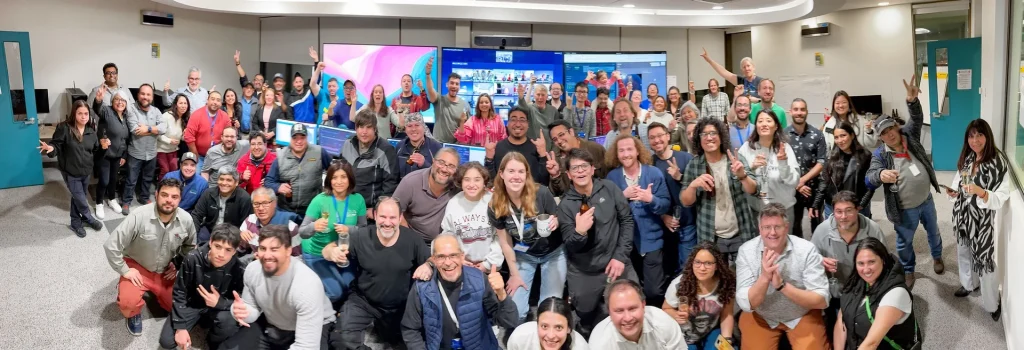
Credit: RubinObs/NOIRLab/SLAC/NSF/DOE/AU.
In this analogy, the universe provides the script, while a shifting crew of scientists handles the production behind the camera.
“The directors change from episode to episode,” Blum notes. “The Construction Project Program Manager and Project Directors directed the first phases with a cast of hundreds of dedicated professionals. The next episode is early operations and the start of LSST with a new set of directors.”
With the opening credits now rolled and the cameras actively capturing the sky, this massive collaboration has officially entered its grandest chapter yet. This “Greatest Cosmic Movie Ever Made” began streaming continuously to the world, which may result in rewriting our understandings of dark matter, dark energy, and our own planetary neighborhood.




Leave a Reply