
Venus is a world roughly the same size and mass as Earth, wrapped in a blanket of reflective clouds. Between 1961 and 1984, the Soviet Union launched a quiet, relentless campaign to breach those clouds. However, since the conclusion of the Venera program, no spacecraft has touched down on Earth’s sister planet. To understand why, and what we lost when the landers stopped, one must first appreciate the absolute hell of the Venusian environment.
Hell on Earth’s Twin
When Soviet engineers sent their earliest probes toward Venus, they expected a tropical world hiding under clouds. Instead, their early landers were crushed like discarded aluminum cans long before reaching the ground.
The atmosphere of Venus is roughly 96 percent carbon dioxide, producing an extreme runaway greenhouse effect. At ground level, the atmospheric pressure equals 92 atmospheres, an environment identical to being three thousand feet underwater on Earth. Temperatures hover at an infernal four 465 degrees Celsius, hot enough to melt lead and destroy conventional electronics within minutes, while dense overhead clouds rain droplets of concentrated sulfuric acid.
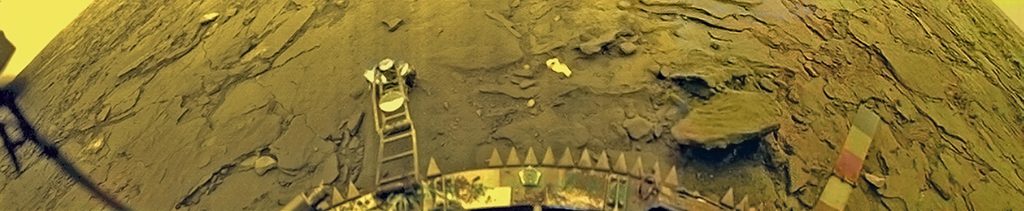
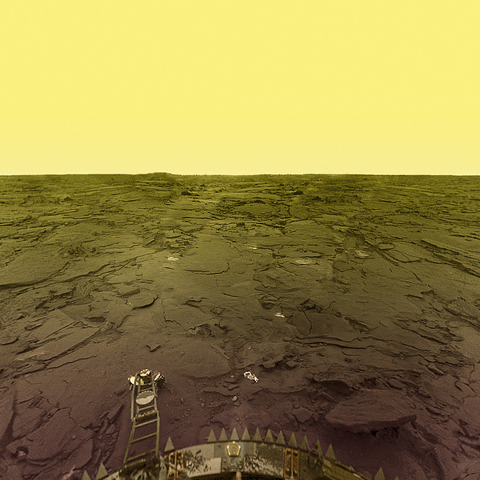
To survive touchdown, Soviet engineers stopped building conventional spacecraft and began constructing sphere-shaped, titanium-armored pressure vessels like effectively heavy-duty deep-sea submarines with titanium aerobrakes. The strategy worked. In 1970, Venera 7 survived a rough touchdown to become the first human-made object to transmit data from the surface of another planet. Five years later, Venera 9 transmitted the first black-and-white photos of an alien landscape, revealing a rocky, cracked volcanic field bathed in a pale, amber light.
Surviving the Hell
Venera 13 deserves special recognition as the undisputed crown jewel of the entire Soviet planetary program. Landing on March 1, 1982, in the Phoebe Regio region, the spacecraft carried a sophisticated suite of experiments protected inside a giant insulated shell cooled down to minus ten degrees Celsius prior to atmospheric entry. Against all physical odds, the lander survived for a record-breaking 127 minutes in the 457 degree heat.
In that brief window, its automated drill punched three centimeters into the rock, vacuumed the crushed basalt into a hermetically sealed chamber, and successfully calculated the soil’s chemical makeup using an internal X-ray fluorescence spectrometer. Beyond the scientific data, the mission earned an immortal place in history by capturing the iconic eight-millimeter color views of the orange Venusian sky and using acoustic sensors to record the haunting, muffled roar of wind sweeping across another world’s surface.
Why Did the Landings Stop?
After the twin Vega missions in 1985, which deployed landers and atmospheric balloons, surface exploration stopped cold. The primary driver was the fall of the Soviet Union. The Venera program was an immense economic burden, and by the late 1980s, Soviet space research funds were redirected toward low-Earth orbit projects like the Mir space station and the costly Buran shuttle program. When the USSR dissolved in 1991, ambitious follow-ups like Venera-D were indefinitely shelved due to severe budget cuts.
Simultaneously, Western space agencies pivoted heavily toward Mars. The red planet offered a crucial advantage in longevity, as a solar-powered rover on Mars could operate for over a decade and produce a continuous stream of scientific discoveries. A Venus lander, no matter how heavily armored, was a suicide mission designed to die in a matter of hours. Furthermore, planetary scientists realized that radar orbiter missions could peer straight through the dense cloud cover and map the planet’s surface at scale without risking expensive hardware in the planetary furnace below.
What We Lost
When the Venera landers fell silent, our direct link to Earth’s twin was severed. The premature end of surface lander programs cost planetary science dearly. As a primary warning sign for Earth, Venus represents the ultimate cautionary tale for runaway climate change. Halting direct atmospheric sampling deprived scientists of crucial ground-truth data regarding how super-dense carbon feedback loops evolve over geological timescales.
Additionally, orbiters show thousands of volcanoes on Venus, but without ground-based seismometers, we still struggle to prove how actively volcanic Venus is today. Pushing lander technology further would have also forced the early development of wide-bandgap silicon carbide microchips, therefore electronics capable of running natively in extreme heat without needing massive, short-lived cooling systems.
Beyond the scientific data, humanity lost a profound comparative lens for understanding planet formation and habitability. Venus and Earth started as near-identical twins, yet one turned into a paradise while the other turned into a hellscape. By abandoning direct exploration of the Venusian surface, planetary scientists lost four decades of potential insights into why Earth developed oceans and plate tectonics while Venus trapped its water in space and choked itself on greenhouse gases. This knowledge gap directly hampers our ability today to evaluate whether distant Earth-sized exoplanets are temperate cradles for life or toxic, suffocating furnaces.
Looking to the Future
After decades in the scientific wilderness, a quiet renaissance for Venus exploration is finally taking shape. International interest has surged alongside breakthroughs in materials science, as engineers begin designing high-temperature electronics capable of operating in blistering heat without traditional, bulky refrigeration systems. Both NASA and ESA have scheduled new orbital and atmospheric missions, aiming to map the surface in high definition and sample the clouds for potential biosignatures.
At the center of this revival is Russia’s attempt to reclaim its planetary legacy through the flagship Venera-17 mission, historically developed under the name Venera-D. Explicitly renamed to honor the continuation of the classic Soviet exploration series from the 1980s, the mission pairs an advanced radar orbiter with a heavily armored lander built to survive on the surface for over three hours. Beyond its core lander, the project design has envisioned hosting long-lived micro-probes engineered with specialized wide-bandgap semiconductors, which could theoretically withstand the furnace of Venus for up to ninety Earth days to track weather patterns and chemical shifts.
Though geopolitics and technical delays have pushed Venera-17’s launch window deep into the 2030s (now targeted for 2036), its ambition serves as a crucial bridge between two eras of exploration. If successful, it will transform our understanding of Venus from a series of short, heroic survival sprints into a long-term laboratory. When humanity finally returns to the glowing, crushed rocks of our twin planet, we will be building directly upon the foundation laid by the titanium spheres that paved the way so long ago.
Earlier, NASA will try its luck with the DAVINCI mission (Deep Atmosphere Venus Investigation of Noble gases, Chemistry, and Imaging). Scheduled for launch in the early 2030s, DAVINCI will fly past Venus to collect remote-sensing data before releasing a specialized descent sphere directly into the planet’s crushing, acidic atmosphere.
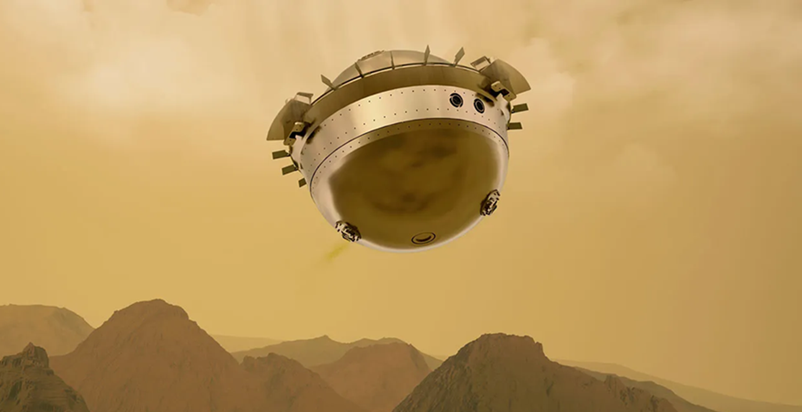
Operating as a flying analytical chemistry laboratory, the titanium sphere will measure trace noble gases, trace environmental chemistry, and isotopic ratios during its hour-long fall toward the surface, helping scientists determine whether Venus once hosted oceans of liquid water. As the probe breaches the lower cloud deck, it will capture unprecedented high-resolution infrared imagery of Alpha Regio, which is an ancient, mountainous highland region. NASA hopes that it will provide the first clear look beneath the thick clouds at terrain that may represent ancient continental crust.





Leave a Reply