
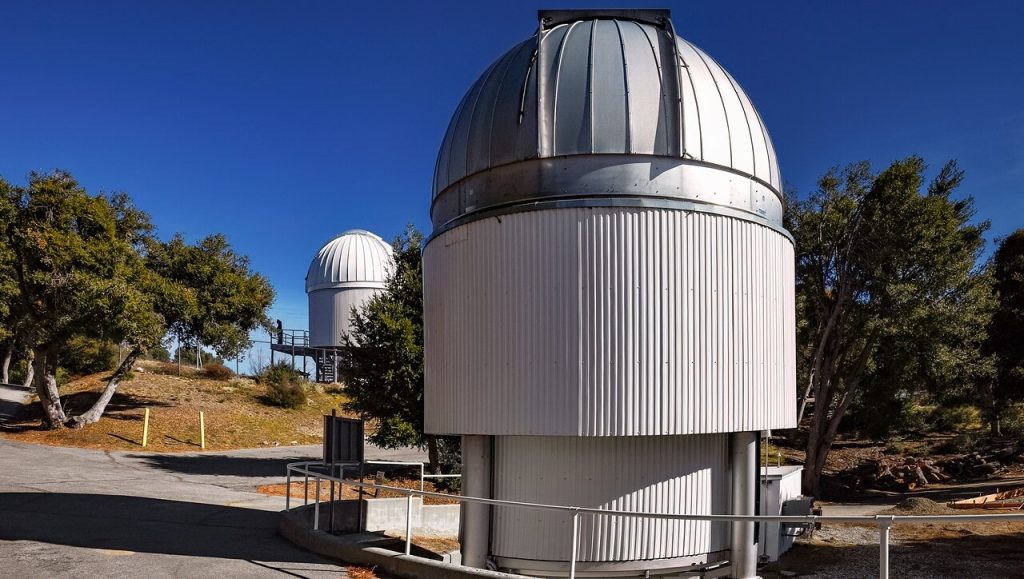
Astronomers have achieved the first successful on-sky demonstration of dual-field interferometry at the Center for High Angular Resolution Astronomy (CHARA) Array, using the ultra-high-resolution technique to resolve a long-suspected stellar twin in the Alpha Piscium system.
For decades, astronomers suspected that the bright star system Alpha Piscium, a prominent multi-star system in the constellation Pisces, was hiding a secret. While telescope observations showed two main stellar components (A and B) orbiting one another, spectral data suggested that the star B might be in fact an elusive tight pair of near-identical twins.
Now, an international team of researchers led by Narsireddy Anugu of the Georgia State University (GSU) has announced a real breakthrough in optical astronomy: the first on-sky demonstration of dual-field interferometry at GSU’s CHARA Array. Using this ultra-high-resolution technique, the team successfully resolved the hidden Ba-Bb subsystem, confirming the existence of the close-orbiting twin stars and calculating their physical properties with unprecedented precision.
Optical interferometry combines light from multiple separated telescopes to simulate the resolving power of a single giant dish hundreds of meters wide. However, atmospheric turbulence causes rapid phase jitter, making faint or extremely close targets difficult to observe.
To overcome this, the team deployed a dual-field setup using two state-of-the-art beam MIRC-X and MYSTIC beam combiners at the CHARA Array atop Mount Wilson, California. Observing in the H-band, MIRC-X locked onto the brighter primary star, monitoring and actively freezing out atmospheric turbulence in real time. Then, with the phase stabilized by MIRC-X, the MYSTIC instrument gathered science-grade K-band fringes on the secondary target. This “off-axis” phase-referencing technique allowed CHARA to achieve sub-milliarcsecond (sub-mas) astrometric precision.
“MIRC-X tracked component A in the H band, while MYSTIC observed component B in the K band, resolving the 7 mas Ba-Bb subsystem and measuring the relative astrometry of the 1.85 arcsec A-B pair with an uncertainty of 234 µas,” the astronomers wrote in the paper.
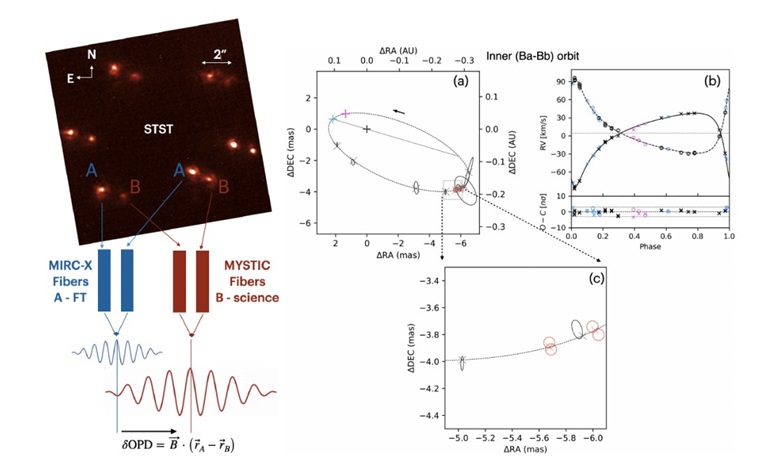
Image credit: Anugu et al., 2026.
By probing the B component at a projected separation of just 7 milliarcseconds, the team therefore directly detected the hidden companion Bb. It turned out that the H- and K-band flux ratios between the stars Ba and Bb are nearly equal, what confirmed that both are similar F-type main-sequence stars.
Moreover, by combining the new CHARA interferometry with archival VLTI/GRAVITY data and spectroscopic radial velocities (from NARVAL and ARCES instruments), the researchers mapped a 25-day orbit of the Ba-Bb binary with high eccentricity of approximately 0.6 and an inclination of about 65 degrees. The tight orbital fitting yielded precise fundamental masses for the twins, which were measured to be approximately 1.668 and 1.646 solar masses for Ba and Bb, respectively.
The authors of the study concluded that hierarchical multi-star systems like Alpha Piscium serve as essential cosmic laboratories for testing models of star formation, stellar evolution, and orbital dynamics.
Beyond solving a decades-old stellar puzzle, the newly published paper represents a milestone for observational astronomy. Demonstrating robust dual-field phase-referencing at the CHARA Array opens the door to high-precision differential astrometry and imaging of previously inaccessible close binaries, faint stellar companions, and exoplanetary systems using ground-based optical arrays.
Moving forward, researchers plan to leverage this “dual-star” technique paired with recent facility upgrades like a new mobile 7th telescope, modern field-programmable gate array (FPGA) control systems, and expanded baselines in order to target objects far fainter and more elusive than stellar twins.



Leave a Reply