
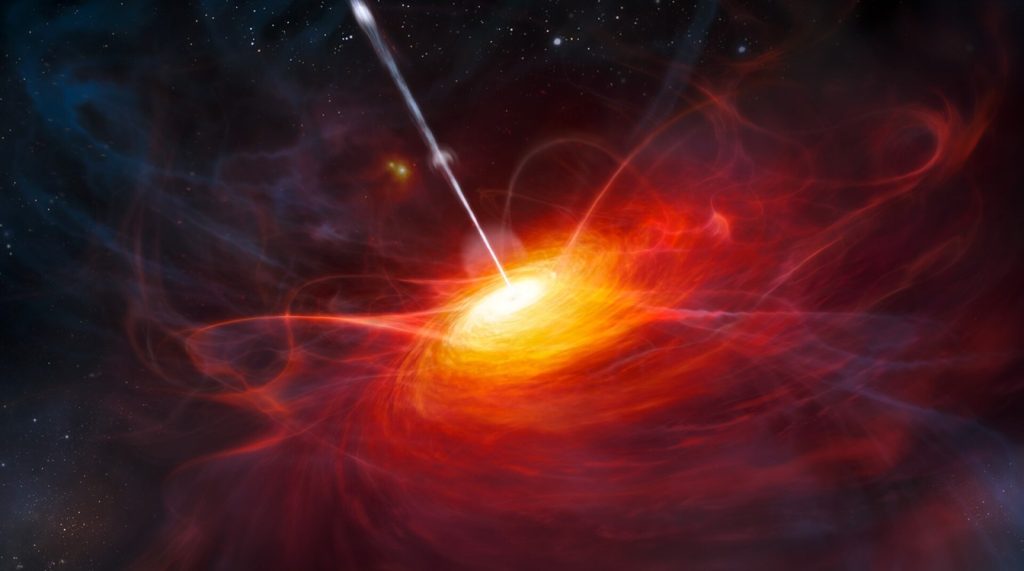
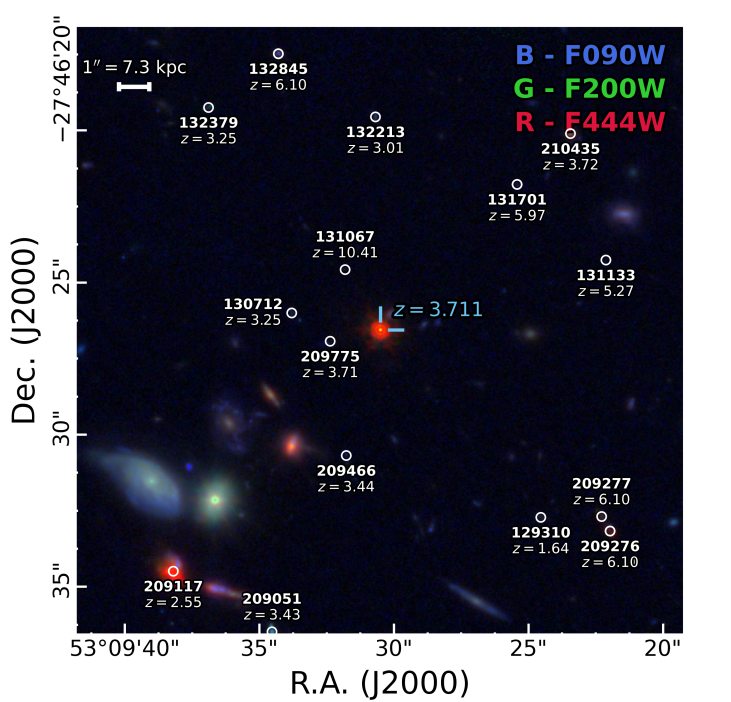
Astronomers have caught a quasar in a fleeting, violent evolutionary transition. Nicknamed “The Hatchling” (cataloged as JADES-GS 209777), the brilliant cosmic engine is actively blasting away the dense cloud of gas and star-forming dust that kept it hidden during its early growth.
Quasars, or quasi-stellar objects (QSOs), are active galactic nuclei (AGN) in the centers of active galaxies, which showcase very high luminosity and are powered by supermassive black holes (SMBHs). They emit electromagnetic radiation observable in radio, infrared, visible, ultraviolet and X-ray wavelengths.
For decades, theoretical models suggested that every brilliant quasar begins its life buried deep inside a thick, opaque cocoon of cosmic debris. This “red quasar” phase hides the central engine until its own violent energetic feedback blows the dust away. Yet, capturing an object in the exact act of shedding this envelope has proven notoriously difficult because the transition is brief on a cosmic timescale.
Breaking Free
That is precisely what makes JADES-GS 209777 so extraordinary: by combining the extreme infrared vision of the James Webb Space Telescope (JWST) with millimeter views from the Atacama Large Millimeter/submillimeter Array (ALMA), a team of researchers led by Zheng Ma of the University of Arizona captured high-velocity outflows of gas actively punching holes in the dust, giving humanity a front-row seat to a black hole’s dramatic grand entrance.
“We do not yet have a reliable estimate of how common—or how short-lived—this phase is. The observational challenge is that identifying such a transitional phase requires multiwavelength data revealing several features simultaneously: a directly visible active nucleus, substantial surrounding gas and dust, and outflows that may be clearing or redistributing that material. Therefore, the phase may not be intrinsically extremely rare; it may simply be difficult to recognize,” Ma told Universelost.com.
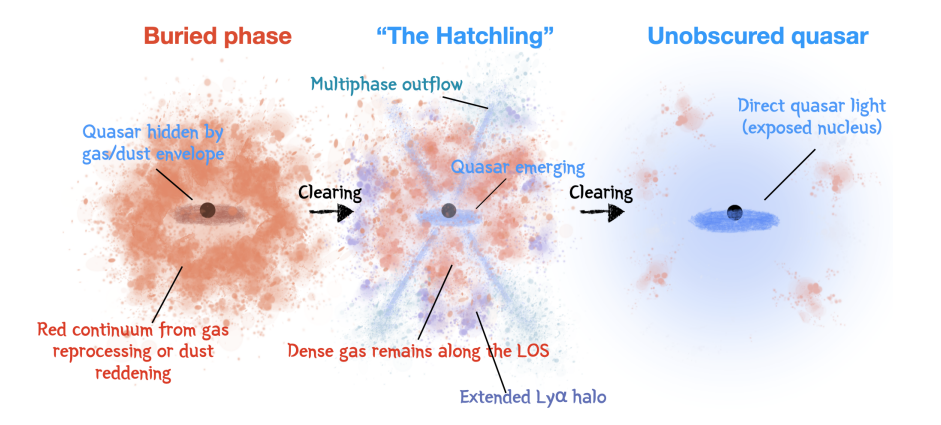
Ma’s team nicknamed JADES-GS 209777 “The Hatchling” as like a hatchling beginning to break out of its shell, the quasar is no longer completely hidden. It has started to emerge, but it is not yet fully exposed.
A Galaxy in Chaos
In order to fully expose it, the researchers employed JWST’s Near-Infrared Spectrograph (NIRSpec), what allowed them to detect ionized gas moving at speeds exceeding 1,000 kilometers per second, driven by the intense radiation pressure from the central SMBH. Complementary observations from ALMA peered through the surrounding host galaxy, mapping cold molecular gas and thermal dust emission. Together, these tools revealed a system in chaos: while the galaxy is furiously spawning new stars at a rate of roughly 300 solar masses per year, the central black hole is actively disrupting that birth environment, blowing away the raw materials needed to sustain future star formation.
What makes “The Hatchling” even more puzzling is its sheer size relative to its host galaxy. The central black hole accounts for approximately one percent of the galaxy’s total stellar mass, which is a ratio about ten times higher than what astronomers typically observe in the modern, local universe. This overmassive black hole suggests that in the early cosmos, giant black holes may have grown far faster than their surrounding galaxies, seizing control of their cosmic environments before the galaxies themselves had a chance to mature.
“The host [galaxy] has already assembled a substantial stellar mass, while the infrared observations indicate that vigorous star formation is still ongoing. The black hole appears more massive relative to its host than is typical in the local universe, so continued growth of the host could bring the system closer to the local black hole–galaxy relation. However, a single observational snapshot cannot tell us whether its star formation will continue, decline, or undergo further cycles of suppression and rejuvenation,” Ma explains.
A Missing Link to “Little Red Dots”?
This perplexing discrepancy also positions “The Hatchling” right at the heart of one of JWST’s most debated mysteries: the enigmatic class of objects known as “Little Red Dots” (LRDs). Discovered in surprising numbers across the early universe, these remarkably compact, red points of light harbor supermassive black holes that consistently appear far too heavy for their host galaxies. With its heavily dust-reddened spectrum, compact structure, and overmassive central engine, JADES-GS 209777 shares the fundamental hallmarks of the LRD population, leading astronomers to wonder if it represents an LRD caught in a moment of dramatic transformation.
If “The Hatchling” is indeed an LRD in the midst of shedding its cocoon, it could provide a long-sought “missing link” in cosmic evolution. Rather than LRDs being an entirely separate anomaly, they may simply represent the infant, deeply buried phase of supermassive black holes before their energetic feedback takes hold.
“The Hatchling combines properties associated with Little Red Dots or compact red AGNs and with mature, unobscured quasars. Like some LRDs, it has a red continuum, a compact nucleus, broad emission lines, and a black hole that appears relatively massive compared with its host galaxy,” Ma notes. “However, it also has properties that distinguish it from many LRDs, particularly its strong X-ray detection and relatively normal quasar-like infrared emission from heated dust. At the same time, we detect multiphase outflows that may be clearing or redistributing material around the nucleus, allowing us to see a partially exposed quasar.”
A Single Piece of a Larger Evolutionary Puzzle
Yet the authors of the study urge caution against drawing conclusions from a single extraordinary discovery. As for now they regard “The Hatchling” as a plausible bridge between compact red AGNs and mature, unobscured quasars.
“It may illustrate one way in which a buried or heavily reddened nucleus begins to emerge. However, it should not be taken as the only possible evolutionary pathway for little red dots or compact red AGNs; a single object cannot establish a universal evolutionary sequence,” Ma concludes.
To confirm whether “The Hatchling” represents a universal rite of passage or a rare cosmic exception, astronomers will need to peer even closer into its chaotic environment and search the skies for its siblings.
“Spatially resolved spectroscopy would be particularly valuable for mapping the ionized outflow and determining how it interacts with the host galaxy. Even more important, however, will be identifying and studying a larger sample of similar objects. By comparing their host-galaxy properties, outflows, obscuration and orientation-sensitive features, we could test whether the Hatchling-like appearance primarily represents an evolutionary transition or is partly produced by viewing angle. Such a sample would also help determine how common this combination of properties is and place indirect constraints on the duration of the phase,” Ma explains.
As deep-sky surveys continue to unearth more candidates from the cosmic dawn, JADES-GS 209777 stands as a powerful proof of concept. It demonstrates that the early universe’s most elusive secrets are no longer hidden behind opaque screens of dust. With next-generation observations already on the horizon, astronomers are closer than ever to witnessing the full story of how supermassive black holes hatched, grew, and shaped the ancient universe into the cosmos we see today.




Leave a Reply