
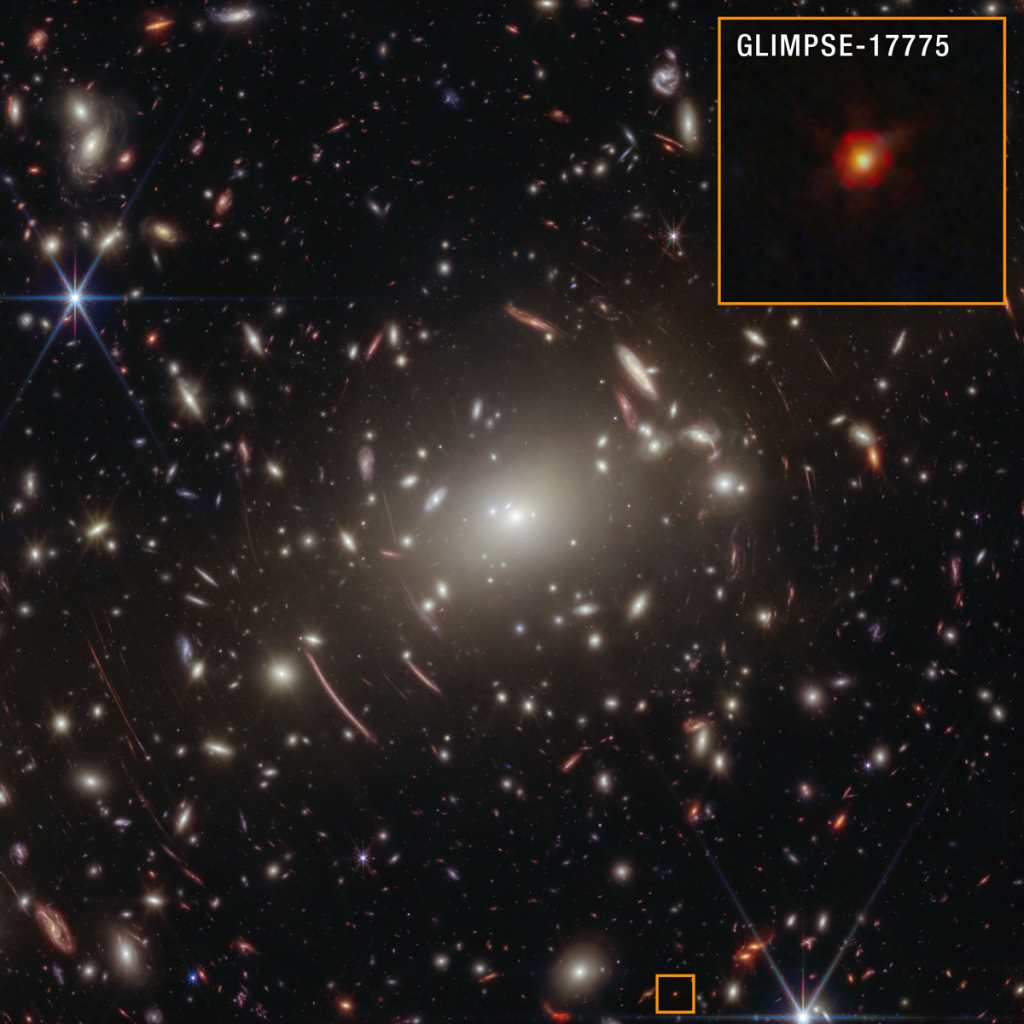
The James Webb Space Telescope (JWST) has captured the strongest evidence yet for “black hole stars”—theoretical cosmic anomalies long dismissed as pure science fiction. For decades, astrophysicists could only hypothesize about these fabled beasts, theorizing that a supermassive black hole could be completely enshrouded by a dense, suffocating cocoon of gas that reprocesses its raw energy into an eerie, ruby-red glow.
This breakthrough addresses one of JWST’s most baffling ongoing mysteries: a newly discovered class of early-universe objects known to astronomers as “little red dots” (LRDs). Abundant in the deep cosmos, these tiny, ruby-colored pinpricks emit an impossibly massive amount of light for their ultra-compact size, leading some scientists to fear they might “break cosmology” by hinting at galaxies that had somehow grown too large, too fast.
Nature’s Own Lens Reveals the Unseeable
Now, by peering through a massive gravitational lens to analyze the 1.8-billion-year-old light of one specific LRD named GLIMPSE-17775, an international team led by Vasily Kokorev at the University of Texas at Austin (UT Austin) has finally mapped the unique chemical fingerprints of this long-sought cosmic shield. Their results, published in The Astrophysical Journal, suggest that these mysterious little red dots are actually the mythical monsters scientists have been looking for.
GLIMPSE-17775 sits deep in the ancient universe, dating back to about 1.8 billion years after the Big Bang. Normally, an object this distant and compact would be nearly impossible to study in detail. However, the research team caught a spectacular cosmic break.
The dot happened to line up perfectly behind Abell S1063, a massive foreground galaxy cluster. The immense gravity of this cluster bent and magnified the light traveling from GLIMPSE-17775 behind it. While Webb stared at the target for 30 hours, nature’s own magnifying glass boosted that signal, delivering data equivalent to a massive 80-hour telescope exposure. The resulting spectrum revealed more than 40 distinct spectral lines.
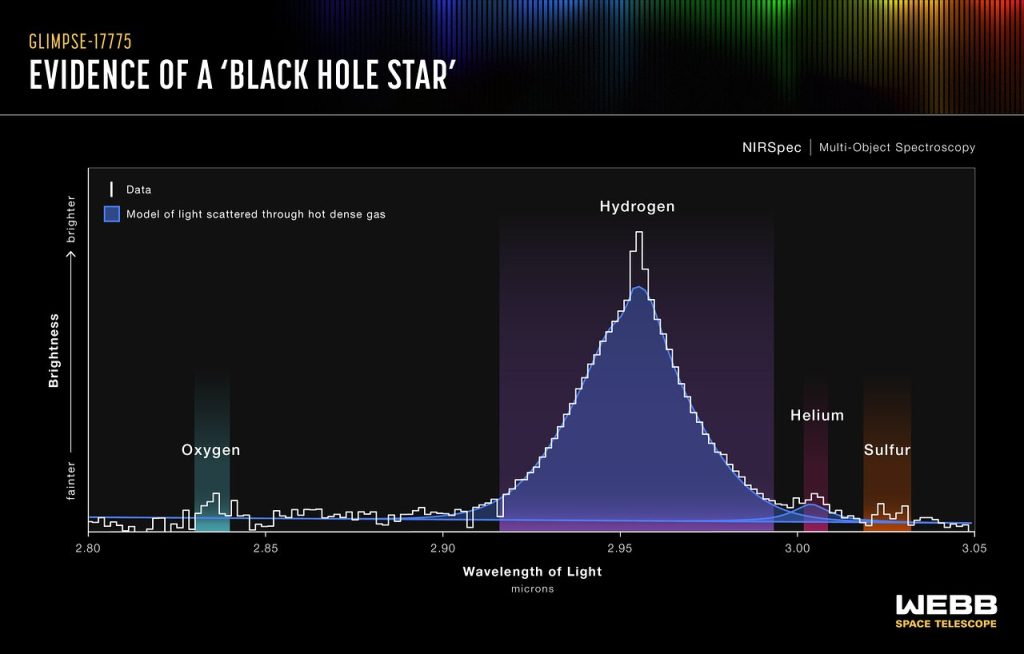
According to the researchers, the proof of a hyper-active black hole engine comes down to a classic astronomical smoking gun and some simple cosmic math. Kokorev points to a striking contrast in the spectrum’s gas signatures: the “permitted” lines of hydrogen, helium, and oxygen are deeply stretched and broadened, while the chemically “forbidden” lines like sulfur remain sharply narrow, which is a trademark fingerprint of an active, swirling black hole kicking up gas. But even without that chemical barcode, the sheer brightness of GLIMPSE-17775 gives the game away.
“The evidence from permitted lines all being broad, while the classically ‘forbidden’ transitions remain narrow is a pretty classic signature of a broad line active black hole. One can also invoke the luminosity argument. Simply put, this object is very very luminous in the rest-frame optical and near-infrared, so if this all came from stars that would imply a rather uncomfortable stellar mass at that cosmic epoch,” Kokorev told Universelost.com.
The Mystery of the Missing X-Rays
By proving that a highly efficient, tightly packed black hole engine is responsible for this intense light, the math of the early universe suddenly checks out. However, active black holes usually blast out massive amounts of X-rays, yet these little red dots have remained stubbornly silent in X-ray observations.
The “black hole star” model elegantly solves this riddle: the dense, multi-layered gas cocoon acts like a cosmic lead shield, absorbing the high-energy X-rays before they can escape into space, letting only the softened, reddened light pass through.
Can we ever peer through this shield to see the monster inside?
“Probably not, at least with current observations,” Kokorev admits. “The cocoon would have to dissipate for X-rays to emerge. There is some tentative observational evidence that it might happen down the line for some LRDs, but nothing definitive yet.”
Safe for Now: The Early Universe Isn’t Broken (Yet)
Despite the strong evidence for a shrouded cosmic monster, good science requires keeping an open mind, and astronomers are still weighing rival theories. While Kokorev’s team focused on the black hole engine, alternative models offer other mind-bending possibilities. One compelling idea suggests these LRDs aren’t black holes at all, but rather massive globular clusters caught in the middle of violent formation, where exotic, primitive populations of stars are generating the strange red signatures.
Yet, if the black hole model holds true, do we need to throw out our current cosmological history books? After all, objects this massive appearing just 1.8 billion years after the Big Bang have previously threatened to “break” physics.
Kokorev urges calm. “As exciting as that would be, I don’t believe so. There is nothing in our source that points towards any funny business; both the black hole mass and stellar mass appear to be rather tame for its redshift.”
He notes that while the ratio between the black hole and its host galaxy is slightly elevated, current calculation methods likely overestimate the black hole’s mass anyway. “You could absolutely grow an object like that in 1.8 billion years,” the astronomer claims.
“No textbook rewrites are warranted for LRDs,” Kokorev concludes. “However, as we further elucidate their nature, a couple more chapters on black hole or stellar physics will likely be added to the textbooks. Everything fits, nothing is broken, and I think that makes the puzzle that is our Universe even better.”




Leave a Reply