
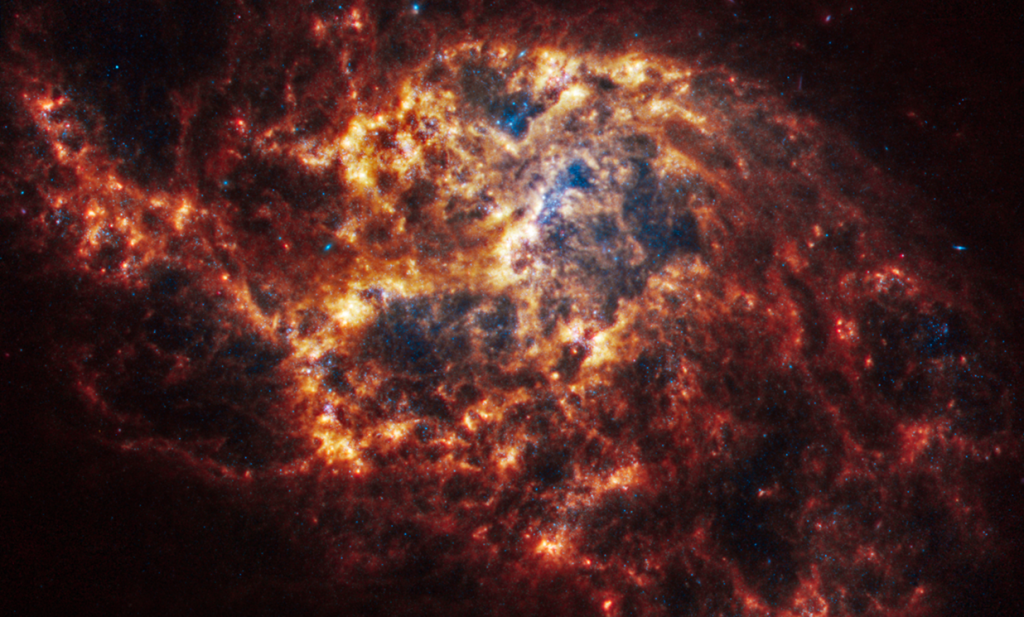
By tracking the chemical fingerprint of the interstellar gas and young stars across the disk of a nearby spiral galaxy known as NGC 1385, astronomers have revealed that rather than experiencing a short, bursty episode of star creation, this system has been sustained by continuous gas refueling over billions of years. It turned out that NGC 1385 is operating at double the typical star-forming efficiency of standard spiral galaxies, but how is that even possible?
Decoding NGC 1385’s Growth
To answer that question, a team of researchers led by Xiaoyu Kang of the International Centre of Supernovae (ICESUN) at the Yunnan Observatories in China combined ultra-detailed optical, radio, and submillimeter data from the PHANGS and WALLABY survey projects to map the fuel supply and stellar age structure of NGC 1385. Next, they fitted a detailed chemical evolution model to their observations, tracking gas infall, outflows, and internal radial movement across the disk.
Their analysis revealed that NGC 1385 underwent a classic “inside-out” disk formation process, but with a crucial twist: a steady stream of fresh, external gas continuously replenished the system while high internal star-formation efficiency drove the rapid conversion of raw gas into stars. This relentless, high-efficiency engine explains why the galaxy’s young stellar populations boast chemical enrichments up to 60 percent above solar levels and display an unusually uniform metallicity across the entire disk. It proves that NGC 1385 hasn’t just had a short burst of activity, but has mastered the art of prolonged growth over billions of years.
“The extra gas most likely comes from a recent gravitational interaction. WALLABY HI observations reveal that NGC 1385 has a severely distorted HI (neutral atomic hydrogen) morphology and a southern tidal debris field with no optical counterpart. The galaxy also lies only about 160,000 parsecs from a dark gas cloud (WALLABY J033723−235753) and about 230,000 parsecs from its group companion NGC 1371, suggesting that a weak interaction stripped cold gas from either a companion or the intergalactic medium, supplying external fuel,” Xiaoyu Kang told Universelost.com.
Inside NGC 1385’s High-Efficiency Star Factory
Explaining how this fuel reaches the center of NGC 1385, Kang underlined that pristine gas accreted from the halo does not initially share the disk’s angular momentum.
“This mismatch, by conservation of angular momentum, naturally drives a radial inflow across the disk. Chemical evolution models find that an inflow speed of about 0.15 km/s is required. However, this radial inflow alone brings gas only to the inner disk. Critically, NGC 1385’s stellar bar acts as a gravitational funnel, efficiently channeling the inward-migrating gas straight into the galactic nucleus,” Kang notes.
Therefore, the authors of the new study claim that external accretion, radial inflow driven by angular momentum, and bar‑driven funneling work together to continuously sustain the vigorous central starburst in NGC 1385.
“This process increases the proportion of dense, star-forming gas and promotes more rapid gravitational collapse of molecular clouds, resulting in a star formation rate approximately double that observed in typical, undisturbed spiral galaxies,” Kang explains.
The physical leftovers of this cosmic encounter are clearly visible in the galaxy’s neutral hydrogen gas disk. Radio observations reveal that the gas structure is severely warped and asymmetric, trailing a massive southern debris field made entirely of stripped gas without a single star in sight.
Moreover, given that NGC 1385 resides relatively close to a dark gas cloud and its galaxy group companion NGC 1371, the morphological disturbances may be a result of tidal forces from a companion or nearby object, which have significantly perturbed the galaxy’s gas reservoir.
According to the authors of the study, their findings make NGC 1385 a representative of a rare class of low-mass starburst galaxies in the local universe. They noted that while many galaxies show signs of interaction or gas accretion, NGC 1385 stands out for its specific combination of properties: an exceptionally high central gas surface density, a star formation efficiency roughly twice the normal rate, and a flat metallicity distribution.
What’s Next for NGC 1385?
With a star formation rate roughly three times higher than the average galaxy of its mass and double the usual efficiency, NGC 1385 is devouring its molecular gas reserves at a breakneck pace. Yet, this high-octane frenzy isn’t expected to end anytime soon.
“This refueling process may persist for a considerable amount of time,” Kang claims. “The chemical evolution model indicates that NGC 1385 has experienced sustained gas infall over gigayear timescales. The presence of the southern tidal debris field and the nearby dark gas cloud suggests that the external gas supply has not yet been completely cut off. As long as ongoing gravitational interactions continue to funnel fresh gas into the system, the starburst can be prolonged.”
Kang describes the fate of NGC 1385 as a “race between consumption and supply”, noting that once the external fuel source is exhausted, NGC 1385’s high consumption rate will quickly drain its remaining gas reserves, and the intense star formation will fade.
The team is now preparing a comprehensive, multi-observatory follow-up campaign to uncover the chapter of NGC 1385’s story. The researchers plan to conduct deeper, higher-resolution neutral hydrogen mapping to trace the precise trajectory of the southern tidal debris and confirm its physical bridge to the nearby dark gas cloud.
At the same time, they want to use high-resolution Atacama Large Millimeter/submillimeter Array (ALMA) observations to peer deep into the galaxy’s central starburst. By resolving the fine properties of the dense molecular gas at the core, they aim to pinpoint exactly where the most vigorous cloud collapses are occurring. Furthermore, by combining deep optical and near-infrared imagery from the Hubble Space Telescope (HST) and the James Webb Space Telescopes (JWST) they want to map how the central bar dynamically shapes the disk’s young stellar populations.
These targeted observations could tell us whether NGC 1385 is an extraordinary exception or if hidden cosmic supply lines are fueling similar “sleepless” stellar factories across the universe.




Leave a Reply