
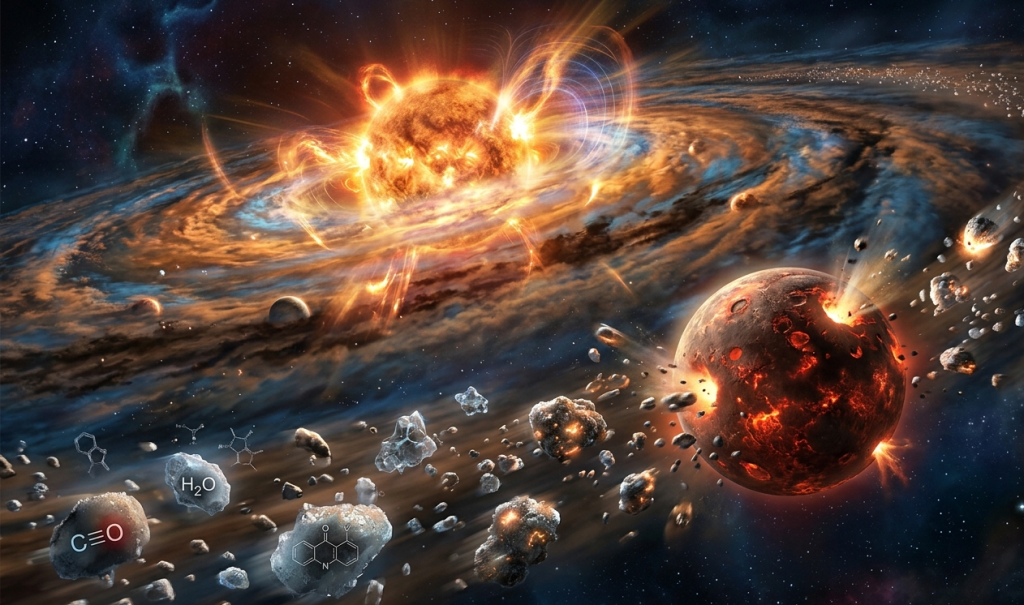
When our solar system was forming 4.5 billion years ago, Earth should have ended up as just another lifeless rock. The space around the young Sun was a chaotic zone of blinding light, intense heat, and dangerous radiation that was more likely to burn away the ingredients for life than create them. But then, luckily, one cosmic accident changed everything.
A team of astronomers led by Antígona Segura of the National Autonomous University of Mexico has recently published a research paper reviewing the early history of our solar system from an astrobiological perspective. By investigating evidence from meteorites and astronomical observations they aimed to trace the formation of key molecules that participated in the building blocks of life.
When the protosun became the Sun its core reached the pressure and temperature required to transform hydrogen into helium. During this process, the Sun emitted high-energy radiation and particles that impacted the chemistry in the disk and the early evolution of the terrestrial planets.
The authors of the new study claim that blast after blast, the high-energy solar radiation hit freezing bits of space dust covered in ice, forcing molecules to react and create the basic building blocks of life. These coated dust grains eventually collided and stuck together to form Earth, accidentally seeding our planet with everything it needed to support life.
To trace how these tiny particles became a living world, the team looked closely at meteorites that preserve a frozen snapshot of the solar system’s birth. Inside these meteorites, the scientists have found an unexpectedly rich variety of amino acids, sugars, and nucleobases. These aren’t remnants of ancient alien organisms but they are the direct products of chemistry taking place in the icy depths of the protoplanetary disk long before Earth was fully formed.
As the infant Sun blasted its surroundings with solar flares and energetic cosmic rays, the radiation penetrated deep into the disk. Usually, such intense rays would break chemical bonds apart and destroy complex molecules. But inside the dark, sub-zero outer regions of the disk, a buffer existed: frozen water, carbon monoxide, and ammonia coating microscopic dust grains.
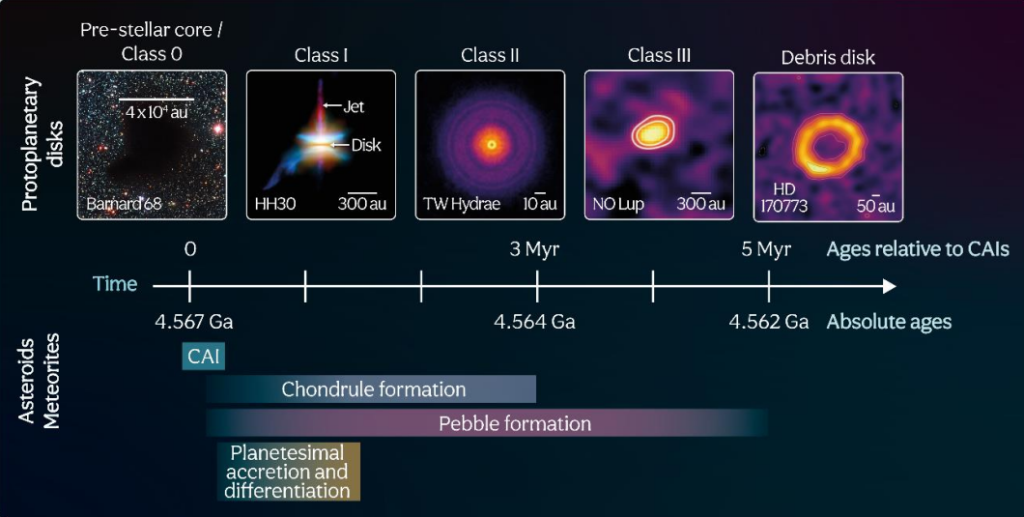
“Radiometric analyses of meteorites indicate that within the first few million years of solar system formation, chondritic components formed and planetesimals differentiated. Evidence from meteorites indicates that carbonaceous chondrites such as CI, CM, and CRs show substantial alteration from fluid derived from melting of ice, including H2O, CO2, and NH3, with large-scale mixing of dust and planetesimals between the inner and outer solar system reservoirs,” the researchers wrote in the paper.
Therefore, the radiation provided just enough energy to kick-start reactions without vaporizing the ice, synthesizing organic compounds that were then safely buried as dust clumped into larger pebbles and asteroid-sized planetesimals.
Moreover, inside early asteroids, radioactive elements like Aluminum-26 acted like internal heaters, melting the frozen water into liquid. Had the asteroids been too cold, the ice would have stayed frozen and dormant; had they been slightly hotter, the water would have boiled off into space. Instead, it stayed liquid just long enough to brew and enrich those organic molecules inside the rocks.
Afterward, chaotic gravitational pulls from giant gas planets like Jupiter shuffled these asteroid orbits, flinging organic-rich rocks inward directly toward Earth at the exact moment our planet’s surface was cooling down.
What strikes the most is that if any of these steps played out slightly differently, in the form of a stronger solar burst, a warmer orbit, or a missing gravitational push – the building blocks of life would have been burned to ash or trapped in deep space forever.


Leave a Reply