
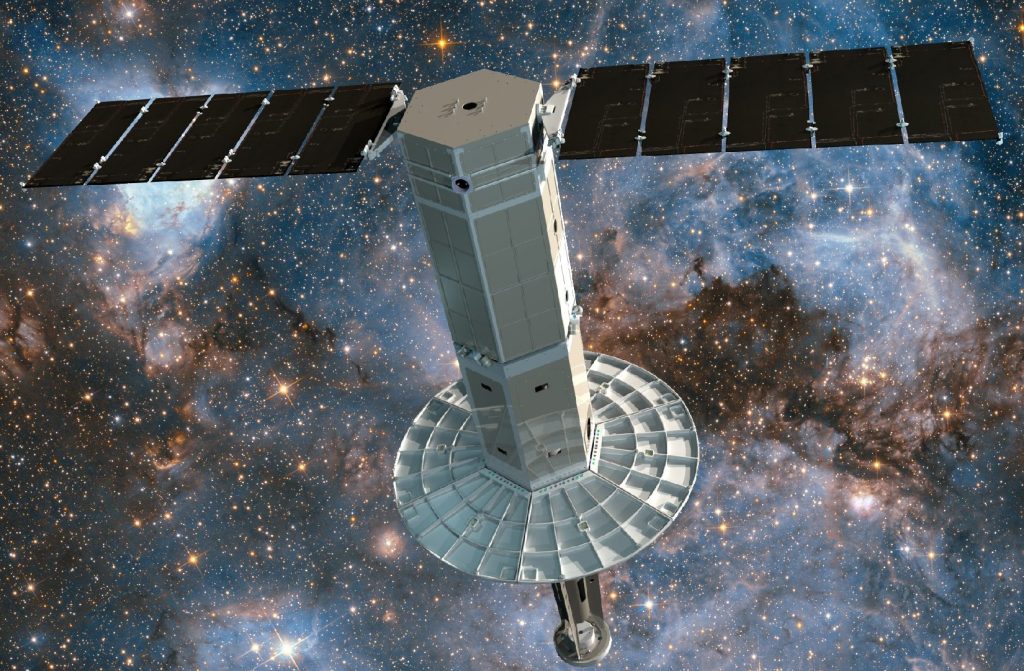
On its quest to find Earth’s twin, NASA is designing a next-generation space telescope that will focus on one specific, audacious goal: to directly image potentially habitable worlds and scan them for chemical signatures of life. Lockheed Martin was recently selected by the space agency to continue advancing next-gen technologies and architecture studies for this ambitious planet-hunting mission.
Forging the Architecture of Tomorrow’s Telescope
The Habitable Worlds Observatory (HWO) is planned to be a large aperture space telescope specifically engineered to identify Earth-like planets. NASA is working on the HWO concept using lessons learned from its predecessors like the James Webb Space Telescope (JWST). It will combine the large-stature segmented mirror philosophy of JWST with the optical wavelengths of the Hubble Space Telescope (HST), all while incorporating the coronagraph advancements being tested on the Nancy Grace Roman Space Telescope, slated for launch on August 30.
While a launch isn’t expected until the late 2030s or early 2040s, the rigorous groundwork being done today by NASA and industrial partners like Lockheed Martin represents the critical first steps. The North Bethesda-based aerospace giant is involved in the development of HWO under a study called Technology Maturation for Astrophysics Space Telescopes, or TechMAST.
“Lockheed Martin has steadily contributed to different phases of research and development for HWO, securing four different contracts for TechMAST maturation since 2018,” Tat’yana Berdan, Lockheed Martin spokesperson told Universelost.com.
Holding Steady for the “Dark Hole”
However, in order to build a stable space telescope capable of directly spotting potential Earth twins, the teams will need to overcome a staggering engineering bottleneck. It is estimated that HWO will require a structural and optical stability more than 100 times better than JWST. To put that in perspective, NASA’s Webb is currently the most stable and precise space instrument ever deployed. To surpass it by two orders of magnitude requires moving from the realm of nanometer-scale precision down to the picometer level, therefore subatomic distances.
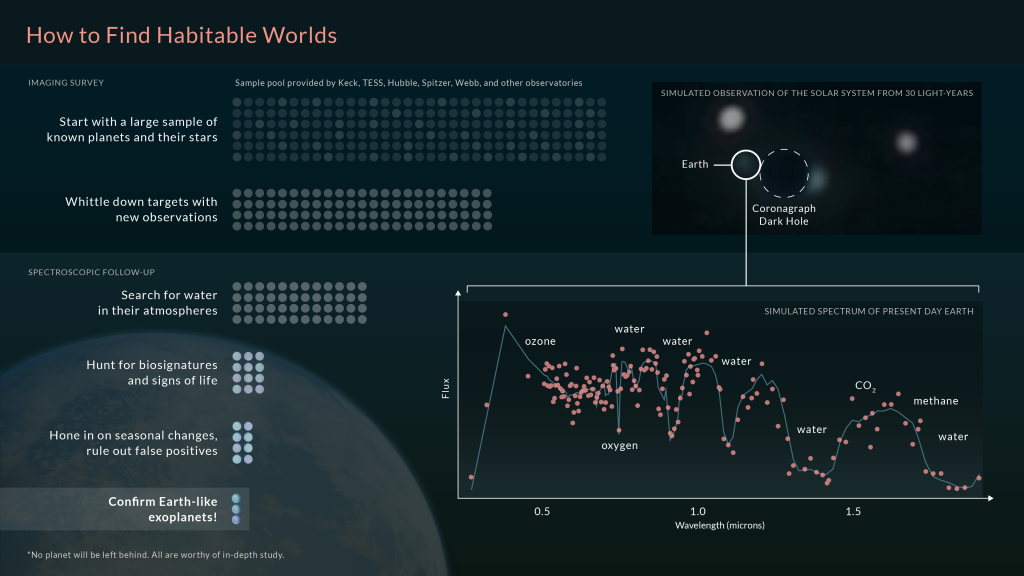
Ultra-stability is essential to block the bright light from a distant star and see the light of a nearby planet. The star’s blinding glare completely washes out the faint, reflected light of the alien world.
To overcome this, HWO will use an advanced internal starlight-blocking device known as a coronagraph. The goal is to manipulate the incoming light to create what engineers call a “dark hole” immediately surrounding the target star. With the light from the star blocked out, the HWO will then be able to investigate the planet’s characteristics like its atmosphere.
Breaking the Physical Link: Disturbance Free Payload
But the “dark hole” is fragile. If the telescope’s mirrors twitch by even the width of an atom due to thermal shifting or mechanical vibrations from the spacecraft, starlight will leak back into the dark zone, blinding the instruments.
That’s where the Disturbance Free Payload (DFP) technology comes in.
“Lockheed Martin’s DFP technology provides revolutionary payload pointing stability, orders of magnitude less jitter than standard passive isolation techniques. The noisy, high-jitter spacecraft is decoupled from the payload by a non-contact interface equipped with actuators and position sensors,” Berdan explained.
Standard space observatories rely on passive isolation to dampen the vibrations caused by a spacecraft’s onboard reaction wheels and thrusters. DFP throws out that playbook. Instead of dampening vibrations, it cuts the physical connection between the telescope and the spacecraft almost entirely.
“Fundamentally, DFP isolates the payload from spacecraft vibration by minimizing the mechanical connections between the two. Once activated in orbit, the cables across the interface are the only connection between the two sides. Payload precision pointing is controlled using six voice coil actuators that allow the payload to push off the spacecraft. The separation between the payload and spacecraft is monitored using six inductive position sensors and maintained using bus reaction wheels and thrusters,” Berdan said.
However, she noted that DFP is just one piece of a broader, complex puzzle to solve. A number of other technologies and advancements in ultra stable telescope systems must be matured along with DFP to provide the end-to-end performance needed for HWO’s science goals.
Built to Evolve: In-Space Servicing
Unlike JWST, which was sent to deep space with no way to repair or upgrade its instruments, NASA has stated that the “Habitable Worlds Observatory would be designed to allow servicing in space, to extend its lifetime and bolster its science over time.”
By equipping the HWO with modular components and robotic servicing interfaces, NASA can send future automated missions to refuel the observatory, replace aging parts, or swap out older cameras for advanced instruments that haven’t even been invented yet.
The message from NASA and Lockheed Martin is clear: they aren’t developing just another bigger eye on the sky, but they are engineering an instrument precise and durable enough to finally answer whether our blue marble is a cosmic anomaly, or just one of many vibrant homes in the universe.


Leave a Reply