
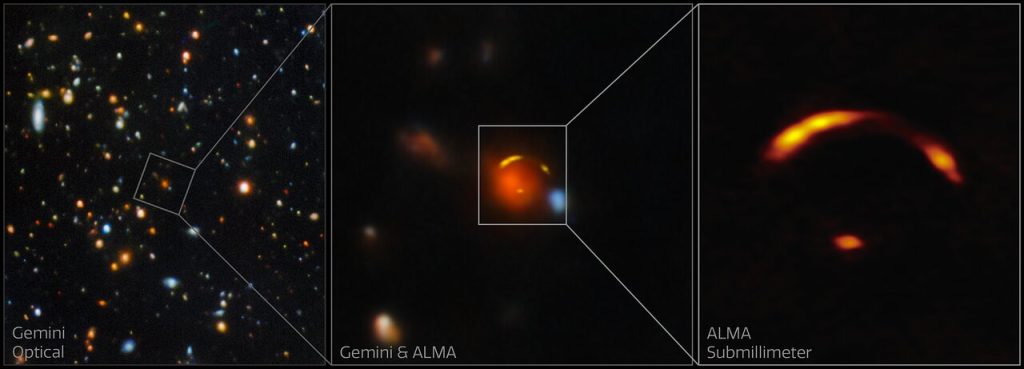
Astronomers have pulled off an incredible cosmic detective feat by tracing a single high-energy “ghost particle”—a neutrino—back to its source 11 billion light-years away. So who’s responsible for blasting away these elusive particles? An exceptionally bright, deeply dust-obscured galaxy designated JCMT0402−0424, dubbed the “Shadow Blaster”.
The new study, published in Nature Astronomy, marks the first time an individual, distant star-forming galaxy has been directly linked to a high-energy neutrino event. It also hints that a massive chunk of our energetic universe might be hidden in plain sight behind thick walls of cosmic dust.
Catching the Ghost
Neutrinos are fundamental particles living a ghostly existence with no electric charge, very little mass, and extremely few interactions with matter. This makes them perfect cosmic messengers: unlike light, they can escape dense, violent environments, and unlike charged cosmic rays, they aren’t bent by magnetic fields. They point straight back to their origins.
However, their ghostly nature makes them incredibly difficult to stop and detect.
In 2021, the IceCube Neutrino Observatory, which is a massive detector buried a mile deep under the Antarctic ice, caught a high-energy neutrino named IC 210922A coming from the direction of the constellation Eridanus. While space telescopes quickly swept the area, they found nothing. No flashes, no traditional supernovae, and no gamma-ray bursts. The source seemed entirely invisible to optical and X-ray instruments.
A Puzzling Cosmic Setup
Now, a team of astronomers led by Yuji Urata of MITOS Science Co., LTD. in Taiwan, continuing this search for ghost particles, turned submillimeter and radio telescopes toward the sky, embarking on a step-by-step hunt that would completely subvert their expectations.
“Our team has long worked on rapid follow-up observations of gamma-ray bursts and other explosive transients. Based on that experience, we originally expected that the counterpart to an IceCube neutrino alert… might be a transient source—something that brightened or faded with time,” Urata told Universelost.com.
Instead, observations from the James Clerk Maxwell Telescope (JCMT) on Maunakea, Hawai’i, flagged a highly unusual, remarkably steady submillimeter object right inside the neutrino’s path. Soon after, the Submillimeter Array (SMA) pinpointed its exact position. But rather than clarifying things, the data became deeply confusing. Optical and near-infrared images from telescopes like Gemini North showed a visible galaxy sitting precisely where this bright submillimeter source was located.
Exposing the Cosmic Imposter
The key data to resolve the puzzle came from the Atacama Large Millimeter/submillimeter Array (ALMA).
“The key was ALMA’s high-resolution imaging. ALMA resolved the submillimeter emission into four images around the foreground galaxy. That was the decisive evidence that the closer galaxy was acting as a gravitational lens, and that the real submillimeter source was a more distant, dust-obscured galaxy behind it.” Urata explains.
He noted that the discovery was surprising for the team in two ways. First, they did not find the transient source they originally expected. Second, the object that stood out instead was a hidden, gravitationally lensed dusty galaxy, therefore a very different kind of candidate neutrino source.
It then became clear that the foreground lens is a massive, closer elliptical galaxy bending the fabric of spacetime, while the background source is the Shadow Blaster – an ultra-distant, dust-enshrouded starburst galaxy sitting directly behind it. The gravitational lens warped its light into four distinct points and amplified its infrared brightness from an incredible 2.7 trillion to a staggering 33 trillion times the luminosity of our Sun.
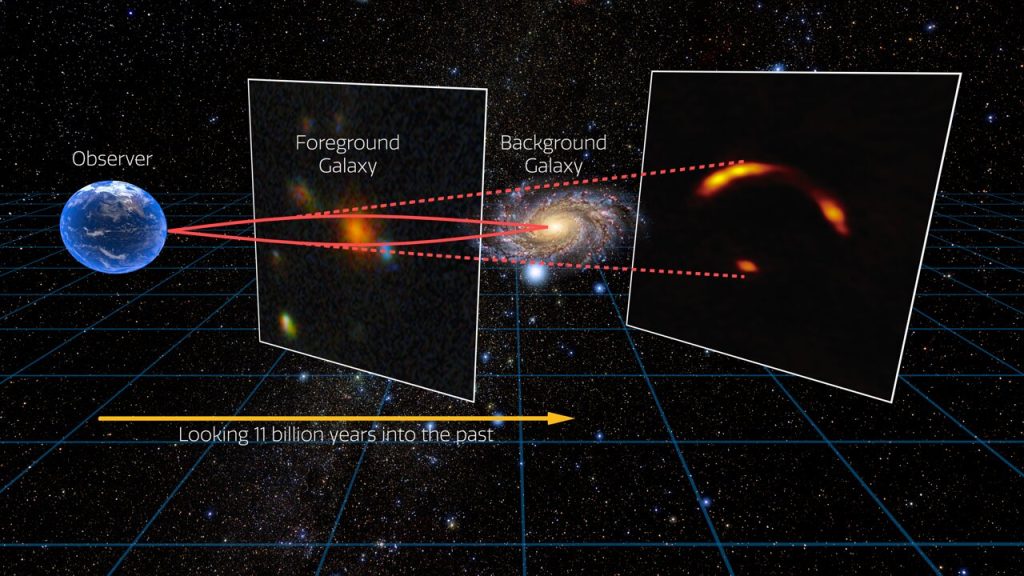
What was the hardest part in uncovering such a cosmic alignment?
“The hardest part was the angular resolution in the submillimeter observations. In optical and near-infrared images, the foreground galaxy is visible, but the distant dusty galaxy behind it is almost hidden because its light is strongly absorbed by dust. In the submillimeter, we can see the dust emission from the background galaxy, but the first observations did not have enough resolution to clearly separate the structure of the lensed images,” Urata said.
A New Roadmap for Astrophysics
By modeling the lens and isolating Shadow Blaster’s true structure, the team discovered a hyper-compact central core packed with thick cosmic dust. New stars are being forged here at a furious rate. Theoretical physics has long posited that these dense, gas-rich environments could trap cosmic rays, accelerating them until they collide with radiation or gas to churn out high-energy neutrinos.
Because Shadow Blaster lacks the hallmark jets of a supermassive black hole, it proves that intense, compact star formation alone is enough to drive the universe’s most powerful particle accelerators.
While dusty galaxies were incredibly common during the universe’s peak star-forming era roughly 10 billion years ago, Urata notes that a galaxy likely needs to be in a special, highly compact phase—perhaps during a violent merger or collision—to become a potent neutrino factory. The team estimates that these types of dense starburst galaxies could account for up to 20% of the cosmic diffuse neutrino background measured by IceCube.
“I would be cautious about saying that all dusty star-forming galaxies are strong neutrino sources. They may not all be actively producing high-energy neutrinos. What may be important is a particular phase of galaxy evolution — for example, when galaxies are colliding or merging, gas is driven into a compact central region, star formation becomes extremely intense, and magnetic fields become strong and turbulent. In such an environment, cosmic rays may be confined efficiently and interact with dense gas or radiation fields, producing high-energy neutrinos,” Urata stated.
He added that although hidden galaxies themselves may be common, the neutrino-bright phase may be more special. Hence, Shadow Blaster may be giving us a glimpse of such a phase: a deeply obscured, compact star-forming galaxy that would be very difficult to understand from optical observations alone.
“In that sense, yes, we may be missing a major part of the energetic Universe — not because these galaxies are absent, but because they are hidden behind dust and only become visible through submillimeter, infrared, radio, and now possibly neutrino observations,” Urata said.
What’s Next?
The team is already moving forward with low-frequency radio observations from the Giant Metrewave Radio Telescope (GMRT) to search for non-thermal synchrotron emission—the smoking-gun signature of energetic particles moving through intense magnetic fields. Armed with this new profile, astronomers hope Shadow Blaster will serve as a roadmap to uncover many more hidden particle accelerators lurking across the deep universe.
“If we can establish these observational signatures, then this discovery could become a roadmap. It may help us identify the second, the third, and eventually many more candidate neutrino sources hidden among dusty galaxies in the distant Universe,” Urata concluded.

Leave a Reply