
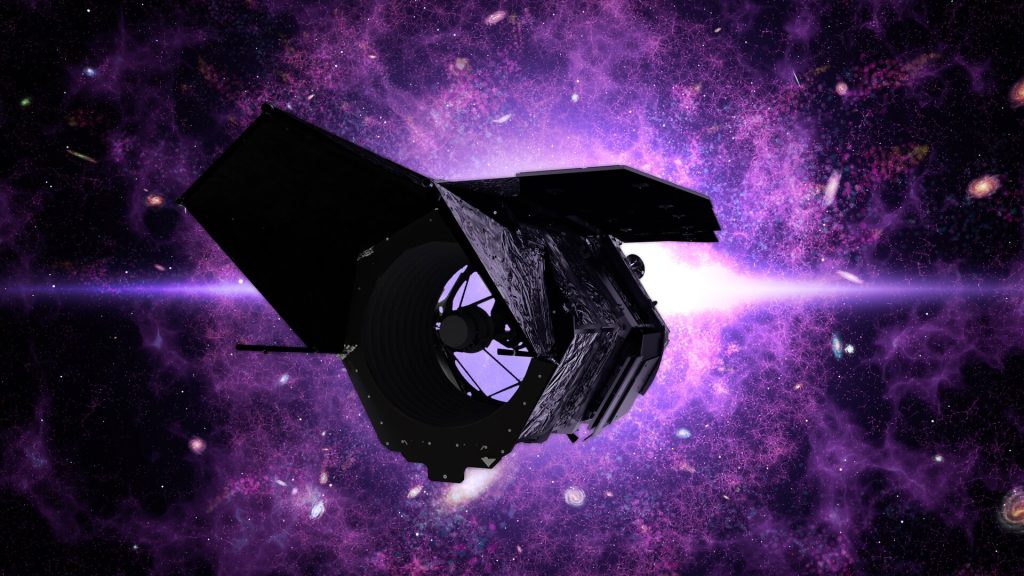
“Veni, Vidi, Vici” is a famous phrase attributed to Julius Caesar, dictator of the Roman Empire, describing his quick victory in his short war against Pharnaces II of Pontus at the Battle of Zela, 47 BC. But when NASA’s Nancy Grace Roman Space Telescope launches later this summer AD 2026, its mission won’t be to conquer territories, but to capture them on a cosmic scale. Armed with a field of view 100 times greater than that of the Hubble Space Telescope, this next-generation powerhouse is designed to see more of the universe in a single snapshot than ever before possible.
“Veni”
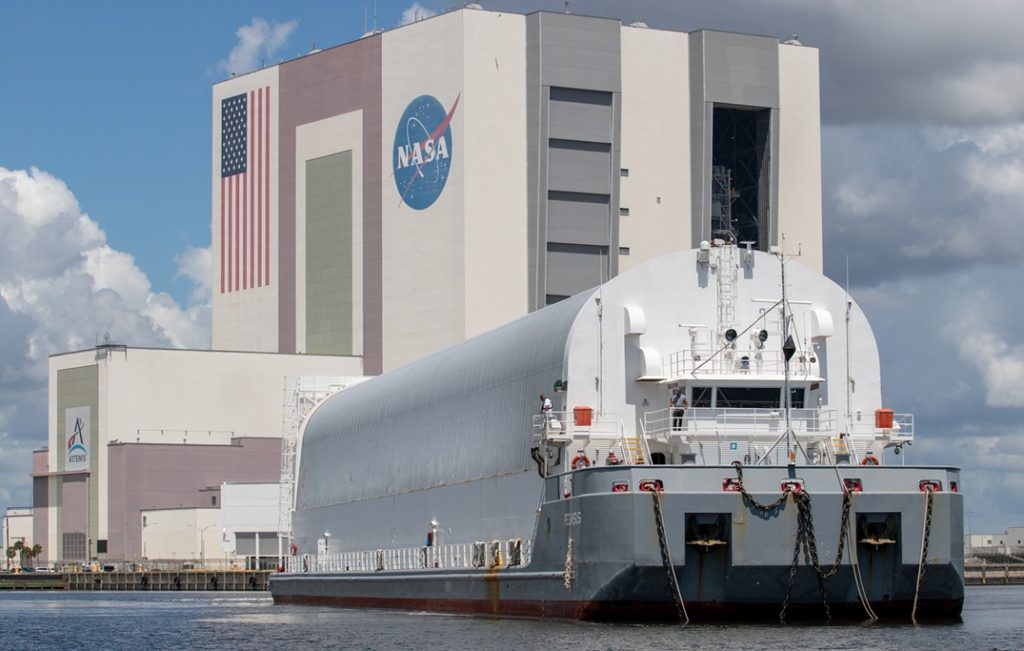
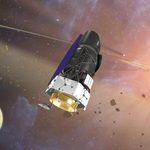
On June 21, 2026, the Roman Space Telescope, named after former NASA Chief of Astronomy Nancy Grace Roman, arrived at the Kennedy Space Center (KSC) in Florida. During its two-month stay at KSC it is poised to undergo processing ahead of launch, which is targeted no earlier than August 30, 2026.

The powerful infrared telescope builds on Roman’s legacy who was the first female executive at NASA and is perceived as one of the visionary founders of the US civilian space program. It is fitting, then, that an observatory named after a woman who propelled humanity into the future is moving with unprecedented velocity. When Caesar famously declared “Veni,” he wasn’t just noting his arrival in Pontus but he was announcing a military presence that moved so quickly his enemies barely had time to realize they were under siege. Caesar’s hallmark was blinding speed, a sudden and decisive arrival that guaranteed a swift path to victory.
In an industry where flagship space telescopes are notoriously famous for agonizing, multi-year delays, NASA’s modern Roman empire is echoing its ancient namesake’s rapid pace. By pulling into Florida this June, the observatory has accomplished a rare aerospace feat: it is tracking remarkably ahead of schedule, about eight months.
“Roman has been managed with an eye to performing on cost and schedule since the very beginning. Our team has had this pervading every level of the project, and the senior managers at NASA’s Goddard Space Flight Center have been excellent stewards of time and money. This began early on with being clear and intentional about designing an observatory that we understood how to build, and continued throughout the later phases of integration and testing where flexibility to adapt to challenges was being used every day to keep things on track,” Dominic Benford, Roman’s program scientist at NASA Headquarters told Universelost.com.
Just as Caesar’s legions marched with relentless momentum, the teams behind Roman have executed their preparations with flawless efficiency. The cosmic conqueror has officially arrived, and the countdown to its swift ascension has begun.
“Vidi”
If Caesar’s “Vidi” was about taking in the battlefield at a glance, the Roman Space Telescope is built to do the same for the entire cosmos. While the James Webb Space Telescope (JWST) peers deep into tiny needles of the cosmic haystack with incredible detail, Roman’s unique strength lies in its sweeping breadth. It will observe the universe in near-infrared light, capturing images with the same crisp clarity as Hubble, but with an unparalleled perspective.
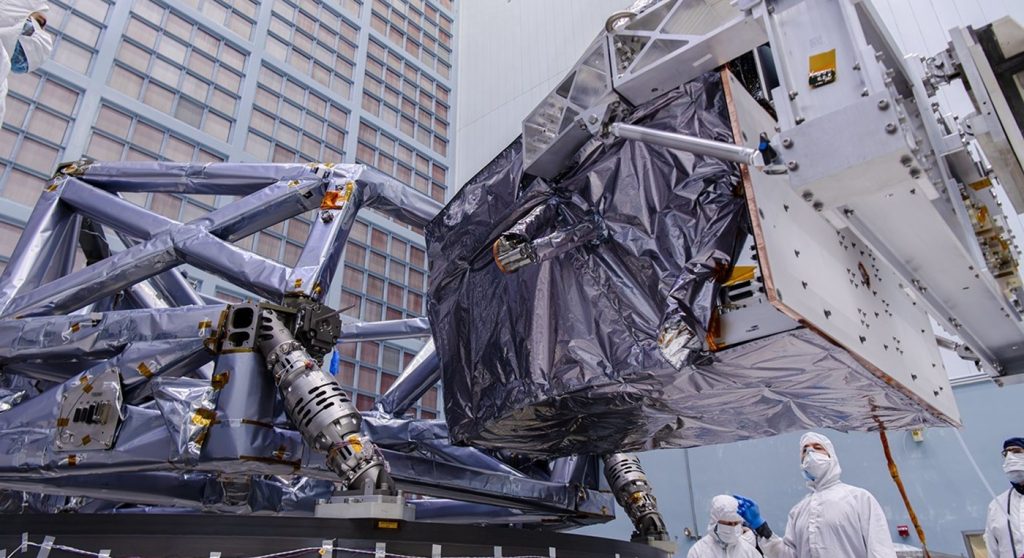
To achieve this ambitious cosmic survey, Roman relies on two advanced instruments integrated onto its frame:
The Wide Field Instrument (WFI): This 300-megapixel giant camera serves as the core engine of the mission. The WFI possesses a field of view 100 times greater than Hubble’s infrared eye, allowing it to capture a patch of the sky larger than the size of a full moon in a single snapshot. Over its first five years, it will map the sky 1,000 times faster than Hubble ever could. This massive survey capability will allow astronomers to trace the invisible scaffolding of dark matter, track how dark energy is driving the expansion of the universe, and statistically census thousands of distant worlds.
The Coronagraph Instrument (CGI): Acting as the vanguard for future exoplanet exploration, the CGI is an advanced technology demonstration designed to accomplish what was previously impossible from space. By utilizing a complex system of starlight-suppression masks, filters, and flexible, micro-adjusting deformable mirrors, the Coronagraph will actively block out the overwhelming glare of host stars. This will allow it to directly image and perform spectroscopy on planets 100 million times fainter than their suns—bringing us one step closer to characterizing true Jupiter analogs in reflected light and paving the way for future missions to hunt for Earth-like worlds.
However, actually processing what Roman sees will require a fundamental shift in how astronomy is done. The sheer volume of these wide-field visuals means human eyes alone won’t be enough to comb through the cosmic data deluge.
“Scientists can visually inspect large images, but Roman images aren’t just large, they’re enormous. Most data analysis will be automated and done by computer, often in a cloud-based processing environment. We expect to make use of machine learning, where human experts train AI processing, and citizen science, where volunteers help to analyze the data.” Benford noted.
“Vici”
For the Roman Space Telescope, the wide-field battle lines have been drawn, the instruments are prepared, and the prize is nothing less than the mastery of the cosmic dark sector. Roman is designed to conquer the tyranny of time and distance by mapping the wide-screen reality of our universe, transforming mysteries that once felt like science fiction into hard, verifiable data.
“The twin mysteries of dark energy and dark matter are a major focus of Roman. Our standard model of cosmology — a mathematical framework that describes how the universe evolves over time — can’t quite bridge the gap between how the universe was when it was very young and how it is now. What the mission will do is to produce the definitive observations of the universe – things like thousands of distant supernovae, hundreds of millions of precise galaxy measurements, and the probing of dozens of multiply-imaged lensed stellar explosions,” Benford explains.
He underlined that with these datasets in hand astronomers will be able to nail down how the model of cosmology can be made to fit Roman’s observations, noting that this is only one aspect of what Roman was built to do.
“It will also discover what planetary systems around other stars are like, and whether a solar system like our own is common or rare, or perhaps even unique. It will discover billions of stars in our own galaxy that are hidden from view by clouds of gas and dust. It will find small black holes that are otherwise undetectable,” Benford said.
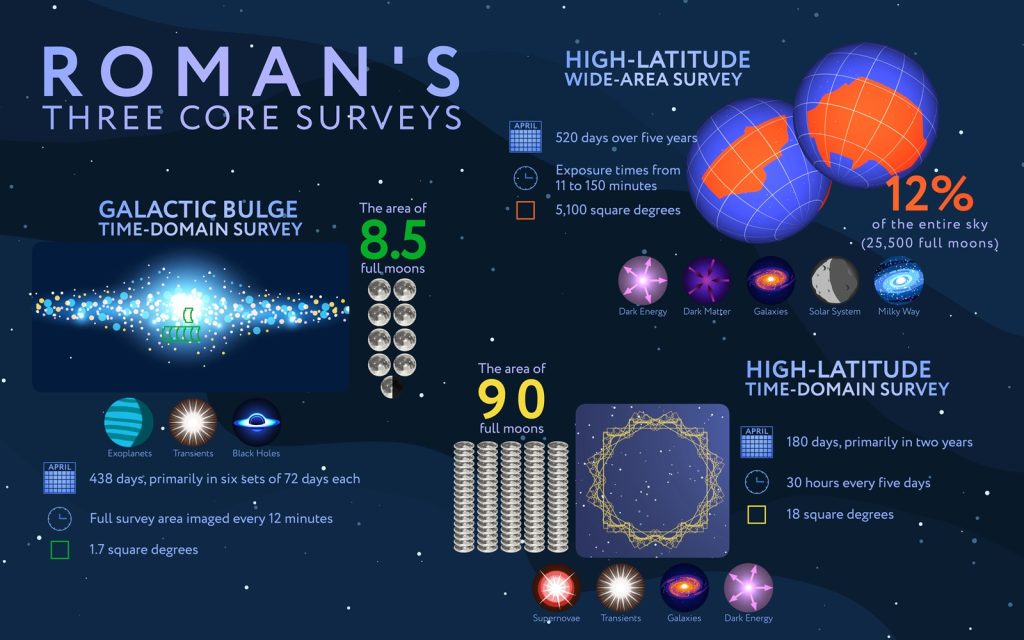
By looking inward toward the core of our galaxy, Roman is poised to completely upend our understanding of exoplanetary systems. This data-rich campaign will fundamentally alter the statistical landscape of known planets as the telescope is expected to identify a hundred thousand exoplanets. Many of these alien worlds detected by Roman in the upcoming years may be habitable, and we may even stumble upon Earth-like objects.
“Once Roman has established this catalog of exoplanetary systems, we’ll certainly find perhaps a hundred of relatively small planets that are the right distance from their star to have liquid water on their surface, so may be habitable. To know if a planet is Earth-like, we need to study its atmosphere. Roman’s Coronagraph Instrument will be proving the technologies necessary to be able to do this in the future.” Benford concluded.
Benford’s confidence in Roman’s capability of achieving its scientific goals lets us believe that NASA’s next-gen cosmic eye is poised to execute a swift, decisive campaign across the infrared sky. Caesar’s triumph fundamentally reshaped the ancient world, but as Roman prepares for its late-summer ascension, it is ready to conquer our understanding of the universe itself.


Leave a Reply