
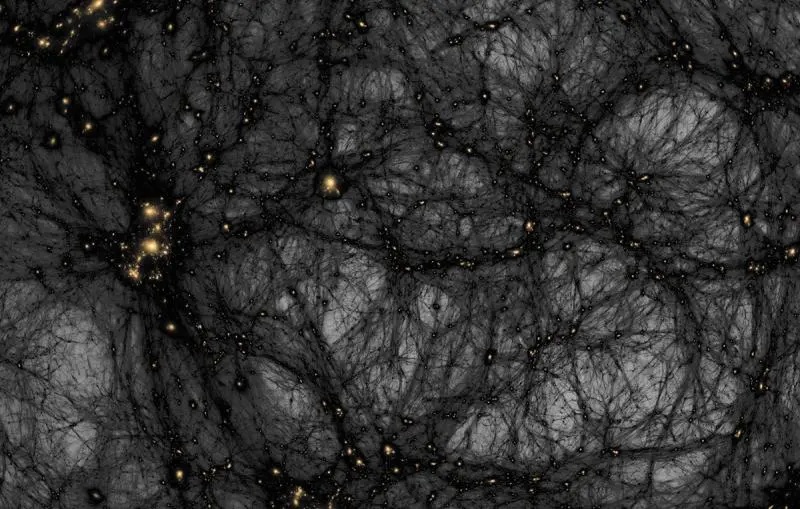
For decades, the standard model of cosmology has treated dark matter as an immutable, immortal scaffolding upon which galaxies are built. Yet, an intriguing question continues to whisper through the corridors of astrophysics: What if dark matter isn’t permanent? What if it is slowly decaying away?
In a new research paper submitted to the Journal of Cosmology and Astroparticle Physics (JCAP), astrophysicist Jeremy Mould of the Swinburne University of Technology in Australia tackles this profound question by performing a comprehensive “cosmic matter audit.” The paper, titled “Is dark matter decaying?”, explores whether the universe is losing weight over time, and what it means for our understanding of the cosmos.
The Cosmic Discrepancy
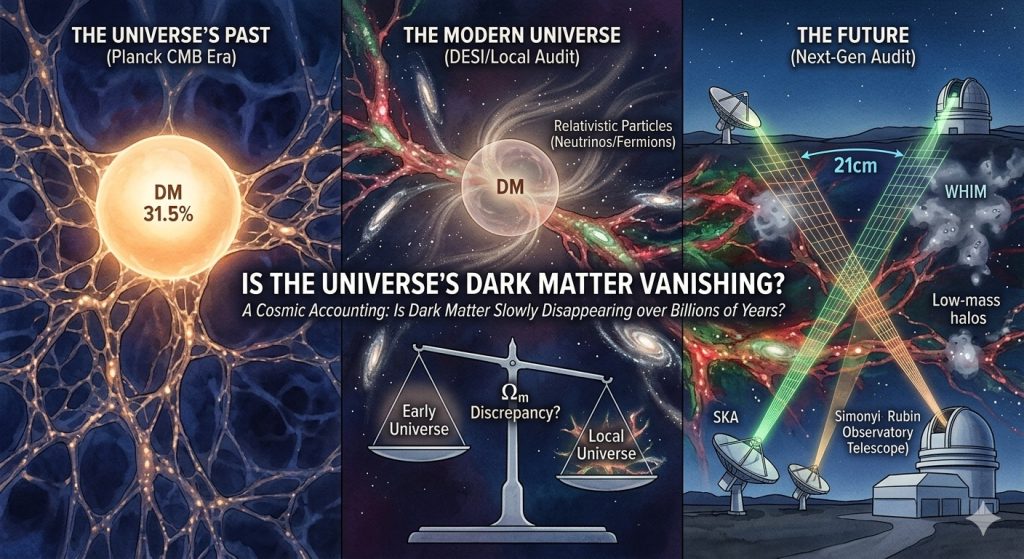
We have an incredibly precise snapshot of the early universe. Data from the Cosmic Microwave Background (CMB)—the Big Bang’s faded afterglow captured by the Planck satellite—reveals that the early matter budget was firmly fixed at around 31.5 percent.
But when we audit the modern, local universe, things get weird. Recent data from the Dark Energy Spectroscopic Instrument (DESI) hints that today’s matter density might be roughly 5 percent lower than what the early universe data predicted.
To find out if dark matter is actually vanishing, Mould attempted a local cosmic inventory by tracking the motions of galaxies to weigh their invisible “halos.”
The Problem: The Universe’s Books Don’t Balance
The local audit quickly hit a wall. Modern measurements of cosmic matter vary wildly, with some methods dropping significantly below the early universe baseline. While this looks like a smoking gun for disappearing dark matter, the paper concludes that we cannot make a definitive judgment yet due to three major “accounting gaps” in the local universe:
- The Hidden Web (WHIM): A massive chunk of normal atoms floats in an incredibly faint, diffuse web of hot gas between galaxies that is notoriously difficult to track.
- Cluster Outskirts: Massive galaxy clusters hold vast reservoirs of superheated gas, but measuring its exact weight at the very edges of these clusters introduces heavy uncertainties.
- Ghost Halos: Smaller galaxies sit inside lightweight dark matter halos, and our current models struggle to accurately calculate their exact masses.
What now?
Are we losing dark matter, or are we just bad at counting it? For now, we don’t know. However, next-generation tools like the Square Kilometre Array (SKA) radio telescope and the Vera C. Rubin Observatory are currently cleaning up these local accounting errors. Within the decade, these high-tech audits will definitively reveal whether dark matter is truly immortal, or caught in a multi-billion-year disappearing act.
“Upcoming high-resolution spectroscopic surveys, next-decade X-ray missions, and advanced weak lensing campaigns will drastically reduce baryon and mass-mapping uncertainties, transforming the late-time matter audit into a cleaner, more definitive test,” Mould concluded.





Leave a Reply