
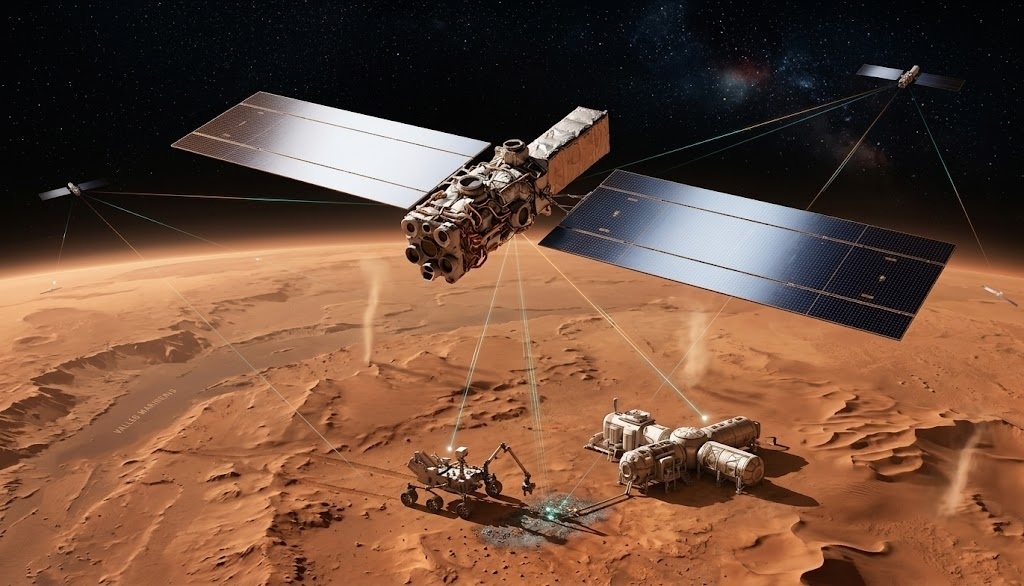
Following its successful IPO and in between of launching batches of Starlink satellites one by another, SpaceX has unveiled its most ambitious concept yet: Starmind, a planned constellation of up to one million AI-enabled satellites designed to turn Low Earth Orbit (LEO) into a massive, decentralized planetary supercomputer. The system may be the missing cognitive architecture required for SpaceX’s ultimate, long-term goal: sending to Mars and ensuring they survive there.
Cosmic Brain: Bypassing Earth’s Boundaries
If SpaceX’s Starlink is a global network of high-speed pipes moving data from point A to point B, Starmind is a swarm of floating brains. Each “AI1” satellite is envisioned as an orbital server rack, generating up to 150 kW of peak power via massive solar arrays. Instead of beaming raw data down to a terrestrial facility, Starmind will process complex artificial intelligence inference directly in orbit, utilizing inter-satellite laser links to form a unified neural mesh around the planet.
Terrestrial data centers are rapidly hitting physical walls: soaring energy demands, massive water consumption for cooling, and local zoning battles. Space offers an elegant, if brutal, alternative: infinite solar energy unfiltered by Earth’s atmosphere. Moreover, space is a natural vacuum environment, therefore ideal for certain thermal management strategies, paired with advanced liquid radiators. It also offers zero terrestrial footprint: no land acquisitions or local power grid strains.
With prototype launches slated for early 2027 out of a new facility dubbed “Gigasat,” SpaceX is positioning itself to become the ultimate landlord of off-world intelligence.
The Mastermind of Deep Space Logistics
But why build a literal mastermind in orbit? The answer becomes clear when looking at the staggering complexity of a multiplanetary migration. Sending a fleet of Starships to Mars every 26 months is a multi-variable optimization nightmare.
The average distance to Mars is roughly 140 million miles, resulting in radio signal delays ranging from 3 to 22 minutes. If a Starship encounters an anomaly mid-transit, waiting for a ground control team on Earth to troubleshoot could be fatal.
Starmind effectively decentralizes Earth’s collective intelligence. By exporting massive AI models into space-hardened nodes, SpaceX is building an infrastructure capable of guiding deep-space transport autonomously. A ship traveling to Mars can interface with an extension of this network, allowing localized, split-second AI inference to handle navigation, radiation shielding adjustments, and life-support anomalies without a terrestrial tether.
Musk’s vision calls for a self-sustaining city of one million people on Mars. To achieve this, automated factories must mine Martian ice, compress the carbon dioxide atmosphere, and synthesize liquid methane and oxygen propellants via the Sabatier process.
Operating these highly volatile, automated chemical plants on a barren world requires hyper-advanced robotics and continuous optimization. Starmind could provide the architectural blueprint for a theoretical “Marsmind”—an identical constellation deployed around the Red Planet to orchestrate autonomous mining rovers, regulate habitat life support, and manage local power grids. It is the intelligence layer that transforms raw automated machinery into a coordinated, thinking colony.
Overcoming the Void: The Engineering Nightmare
The grand vision of an interplanetary mastermind sounds flawless on paper, but executing it requires overcoming some of the harshest physics known to engineering. Operating high-performance AI hardware in the unforgiving void of space presents unique challenges that ground-based engineers never have to consider.
On Earth, keeping a data center cool is a matter of fans, chilled air, and thousands of gallons of water. In space, there is no air. This creates a dangerous paradox: while space is freezing, a vacuum is actually an excellent insulator. Without matter to conduct or convect heat away, the massive thermal energy generated by 150 kW AI processing units has nowhere to go.
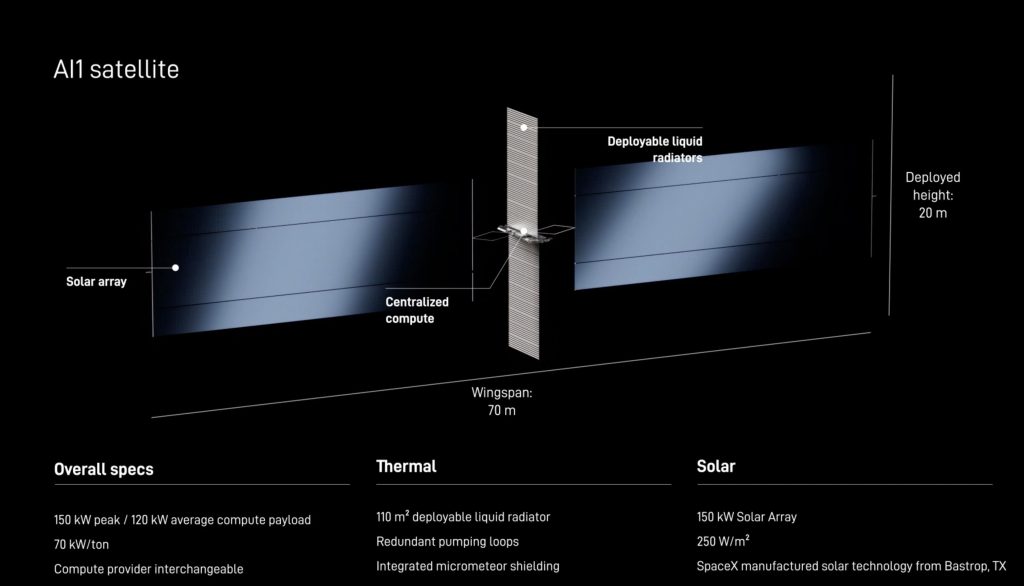
To prevent the AI1 satellites from literally cooking themselves, SpaceX is developing massive, deployable liquid-loop radiators. These systems pump specialized fluids through the satellite core to absorb heat, routing it out to giant, ultra-thin panels that radiate the energy away as infrared light. Balancing this thermal dissipation while maintaining a compact, launch-ready form factor inside a Starship payload bay is an unprecedented mechanical hurdle.
Radiation and the Ghost in the Machine
Beyond the heat, space is a shooting gallery of high-energy cosmic rays and solar particles. When these particles strike a traditional silicon chip, they can cause “single-event upsets”—essentially flipping a 0 to a 1 in the digital code. For an AI guiding a spacecraft or managing a nuclear reactor on Mars, a single corrupted bit could spell catastrophe.
To harden Starmind against this radiation, SpaceX is moving away from fragile, terrestrial chip designs. The AI1 architecture will rely on a mix of redundant, radiation-tolerant hardware and advanced “fault-tolerant” software algorithms. By running identical AI inferences across multiple isolated cores simultaneously, the system can continuously vote on the correct output. If one core suffers a radiation hit and produces an error, the other cores instantly override it, purging the “ghost in the machine” without interrupting deep-space operations.
Edge Computing at the Ultimate Edge
Ultimately, Starmind represents the realization of extreme edge computing. If SpaceX successfully leverages the mass-manufacturing capability of its Starship program to deploy these server-satellites by the thousands, it will do more than just reshape the economics of artificial intelligence on Earth. It will establish the cognitive bedrock of an interplanetary internet, ensuring that when the first pioneers step onto the red sands of Mars, they won’t just be bringing human grit—they will be bringing a cosmic mastermind to help them build a new civilization among the stars.


Leave a Reply