
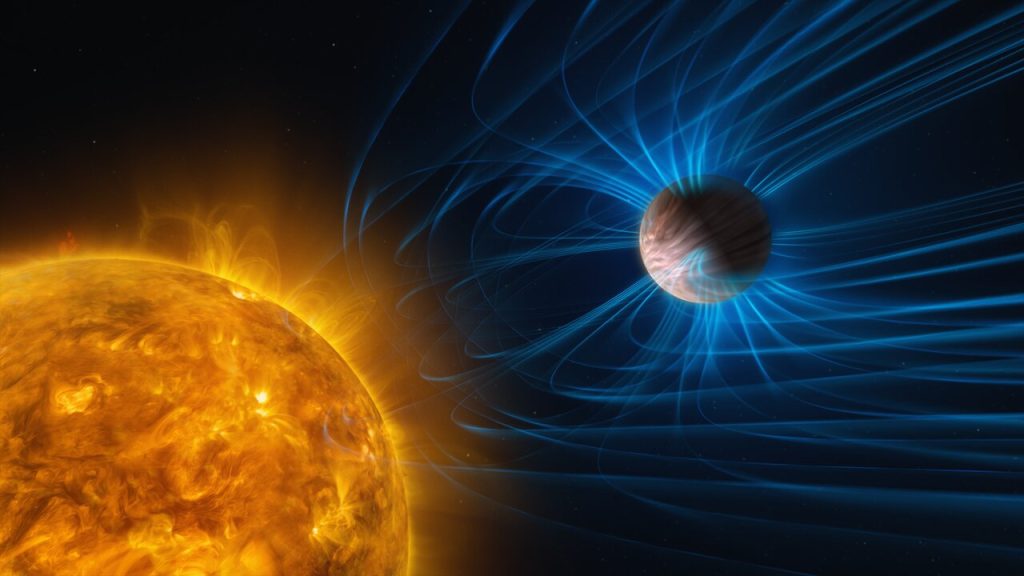
They were investigating winds on extrasolar worlds but found something else. In a major leap forward for exoplanetary science, an international team of astronomers has uncovered the strongest evidence to date that planets orbiting other stars possess global magnetic fields.
Decoding the Cosmic Weather
Astronomers turn their attention to exoplanetary winds because atmospheric dynamics serve as a visible, measurable proxy for the invisible forces shaping alien worlds. A group of researchers led by Julia V. Seidel and Vivien Parmentier of the Côte d’Azur Observatory in France, have recently focused on seven ultra-hot Jupiters–gas giants orbiting exceptionally close to their parent stars, resulting in scorching atmospheric temperatures and violently dynamic weather systems.
Investigating cosmic gales ultimately allows researchers to map the strength of alien magnetospheres, providing critical insights into how planets protect their atmospheres from being entirely stripped away by hostile stellar winds. However, proving that a magnetic field was responsible for slowing these winds down—rather than just chaotic alien weather—required looking at the bigger picture. Parmentier underlined that the team had been building toward this exact revelation for years.
“We had this idea from the start. The results from this research is a carefully planned observational program that we started a few years ago,” Parmentier told Universelost.com.
The Holy Grail of Exoplanet Science
Understanding whether exoplanets have magnetic fields has long been a holy grail for astronomers. In our own Solar System, magnetic fields act as vital shields, deflecting harmful solar radiation and helping to preserve planetary atmospheres. For worlds orbiting close to hostile stars, a magnetic field can mean the difference between a stable atmosphere and being completely stripped bare by stellar winds.
By measuring the extreme wind speeds across seven ultra-hot, Jupiter-like worlds, the researchers have now successfully used atmospheric data to infer the presence and strength of alien magnetospheres. The study, which utilized data from the European Southern Observatory’s Very Large Telescope (ESO’s VLT) in Chile and the Gemini North telescope in Hawaiʻi, marks the first robust and direct measurement of magnetism on planets outside our Solar System.
“Magnetic fields are notoriously difficult to measure on planets outside the solar system. Direct measurements are in principle possible, through the radio emissions coming from the electron being accelerated along the field lines, like we can measure in Jupiter. However, such emission can only be detected from Earth if the magnetic fields are larger than Jupiter, otherwise, the emission is filtered out by Earth ionosphere,” Parmentier explained.
Stepping on the Electromagnetic Brake
When gas giants are subjected to the intense heat of a nearby star, the atoms in their upper atmospheres become heavily ionized, separating into a soup of charged particles. As these charged winds blast across the planet, they interact with any underlying magnetic field.
The team concluded that the most consistent explanation for the slower-than-expected wind speeds is a planet-wide magnetic field acting as a cosmic “brake.” The invisible lines of magnetic force drag against the rushing flow of ions, slowing down the atmospheric motion. By calculating exactly how much braking force was required to slow the winds to their observed speeds, the astronomers were able to calculate the strengths of the magnetic fields on all seven planets.
The results revealed magnetic fields that are remarkably familiar. They turned out to be comparable in scale to the gas giants in our own backyard—measuring roughly four times stronger than Saturn’s magnetic field, and about half the strength of Jupiter’s immense magnetosphere.
“Our work uses a very different idea to deduce the magnetic fields. Wind on these very hot planets can directly interact with the magnetic field because atoms are hot enough to be ionised. Whereas strong, 10 km/s winds can be expected to blow on these strange objects, magnetic fields can significantly lower these winds. Measuring wind speeds directly can therefore tell us about the presence and strength of magnetic fields in these objects,” Parmentier noted.
The Smoking Gun in the Atomic Data
In science, extraordinary claims require ironclad data, and the team knew they had to rule out ordinary atmospheric chaos before claiming a magnetic breakthrough. When asked about alternative atmospheric dynamics—and how confident the team is that magnetism is the only explanation for the slowed gales—Parmentier acknowledged the inherent caution of the scientific process while pointing to a definitive clue in the data.
“As usual in science we cannot be 100 percent sure,” Parmentier noted. “The clue here is how fast the winds decrease with temperature. Over a temperature range of a few hundred degrees, the winds go from about 8 to less than 1 km/s. That is a very large change.”
To explain a drop that drastic, the team had to look at atomic physics.
“When thinking about it, there is only one physical law that we knew that can change things so drastically: the ionization,” Parmentier explained. “Indeed, the Saha equation shows that ionisation is exponentially growing with the temperature. These planets happen to be in the regime where there is a very fast ionisation of sodium and potassium atoms that provide a lot of free electrons that can couple with the magnetic field.”
The Saha equation is a fundamental mathematical expression used in astrophysics to determine how ionized a gas becomes based on its temperature and pressure.
Large, Very Large, Extremely Large
Having successfully tested this methodology on the Very Large Telescope, the astronomical community is now looking eagerly toward the future, specifically the arrival of ESO’s Extremely Large Telescope (ELT), which is currently under construction in Chile’s Atacama Desert. With the immense light-gathering power of the ELT, scientists plan to scale down this technique from giant gas planets to smaller, rocky, Earth-like worlds.
If successful, future observations could detect the magnetic shields of potentially habitable planets, bringing us one step closer to finding a truly Earth-like world among the stars.
“The ELT will be amazing in so many ways. First, for these ultra-hot objects, it will be able to measure the winds more precisely for a larger number of objects, and that will confirm (or not) our current understanding. But the ELT won’t be limited to the very hot objects as we are now, it will be able to measure the winds and chemical species of much cooler objects, even, possibly, rocky exoplanets,” Parmentier concluded.


Leave a Reply