
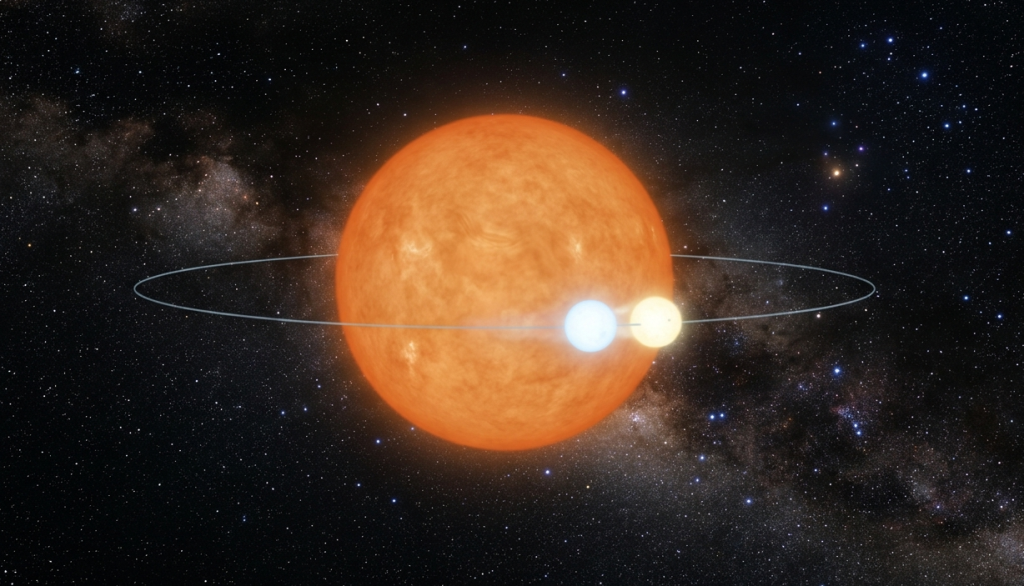
It may be a cosmic double-triple as astronomers have just announced the discovery of a peculiar stellar trio exhibiting triple-eclipses, consisting of a binary star orbited by a giant tertiary companion. Thanks to an impeccable line-of-sight alignment with Earth, this newfound system is offering scientists a front-row seat to the future dynamics of stellar evolution.
Hunting Multiple Stellar Systems
In the vast expanse of our galaxy, stars rarely live in total isolation. Many are locked in binary pairs, circling each other in perpetuity. Far more elusive, however, are hierarchical triple systems—stellar trios where two stars dance closely together while a more distant third star loops around them both.
Now, a team of researchers led by Brian P. Powell of NASA’s Goddard Space Flight Center reports the discovery of a spectacular and incredibly rare addition to this cosmic family: TIC 295741342. The system was identified using data from the Transiting Exoplanet Survey Satellite (TESS). While TESS is primarily tasked with hunting for exoplanets by looking for the tiny dips in light caused by a planet crossing a star, it also routinely catches dramatic stellar phenomena.
“TESS has observed tens of millions of stars from which we can extract viable lightcurves. We use machine learning as an initial step to reduce the size of the data set by approximately 99 percent, leaving only those lightcurves likely to show the shape of an eclipse,” Powell told Universelost.com.
“Head and Shoulders”
Because in the case of TIC 295741342 the stars are aligned precisely with our line of sight from Earth, they regularly pass in front of and behind one another, casting sharp shadows across space. When TESS observed the system, it captured a spectacular event: the twin binary stars passed directly behind the giant outer star, creating what the astronomers called a “head-and-shoulders” light curve.
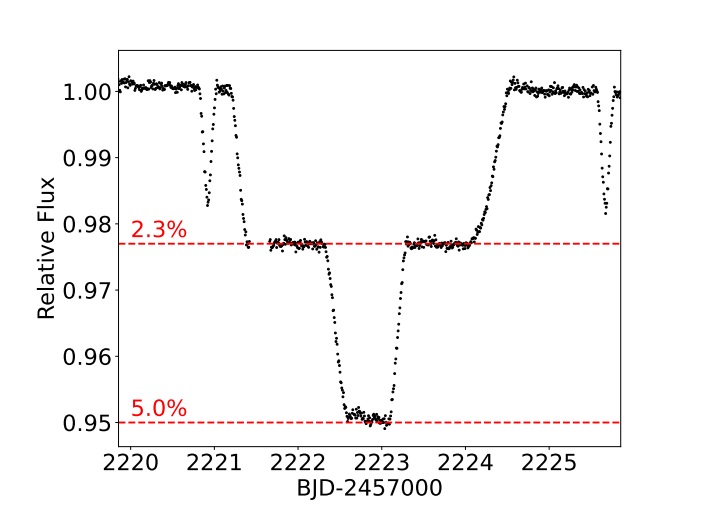
of the ‘shoulders’ and ‘head’ of the outer body eclipse, which substantially constrains the relative fluxes of the stars in the system
in the TESS band. Credit: Brian P. Powell et al.
When the first small twin star slips behind the massive giant, the system’s total light drops slightly, forming the first “shoulder.” Then, as the second twin follows it into the shadow, both small stars are entirely blocked by the giant. This plunges the light curve into its deepest point, dubbed the “head.”
The geometric precision of the “head-and-shoulders” dip allowed Powell’s team to calculate the parameters of the stars with unprecedented accuracy.
“TIC 295741342 is unique among the known triply-eclipsing triples with giant tertiaries in that it has both a very wide and very flat orbit. The shape of the outer eclipse event very nicely reveals structural clues about the system,” Powell explains.
Anatomy of the System
According to the new study, TIC 295741342 is composed of two main-sequence stars, about the size and mass of our Sun, locked in a tight, fast-paced dance, whirling around each other every 4.75 days. Wrapped around this central duo is the heavyweight of the system: a giant tertiary star, boasting a radius more than ten times larger than the Sun and holding about 1.7 times its mass. This aging giant completes a wider orbit around the central pair every 412.8 days.
What makes TIC 295741342 an absolute goldmine for astrophysicists is its architecture. The orbits of all three stars are near-perfectly coplanar, which means that they sit on the exact same flat plane. Their mutual orbital tilt is misaligned by less than a third of a degree.
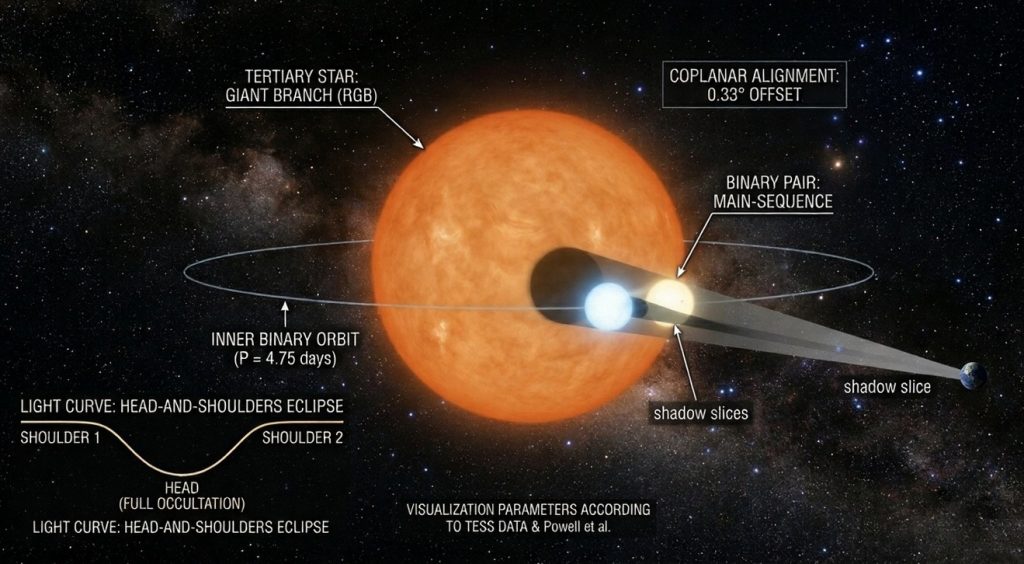
“Triply-eclipsing triples are a subset of triple star systems that are much less likely to exist simply because they are a function of geometry in that all three stars in the system must be aligned as viewed from Earth. When you consider geometric and evolutionary constraints together, systems like TIC 295741342 (wide, flat, with a giant tertiary) are a tiny fraction of a percent of star systems,” Powell noted.
An Urgent Call to Skygazers
The astronomers also predicted the exact timing of the next outer eclipse. The midpoint of the next “head-and-shoulders” event is calculated to occur on September 1, 2026. Powell’s team is now actively calling on observatories and amateur astronomers worldwide to point their telescopes toward the system during a 3-day window around September 1 as capturing this upcoming eclipse in high definition will provide more insights into the nature of this peculiar system.




Leave a Reply