
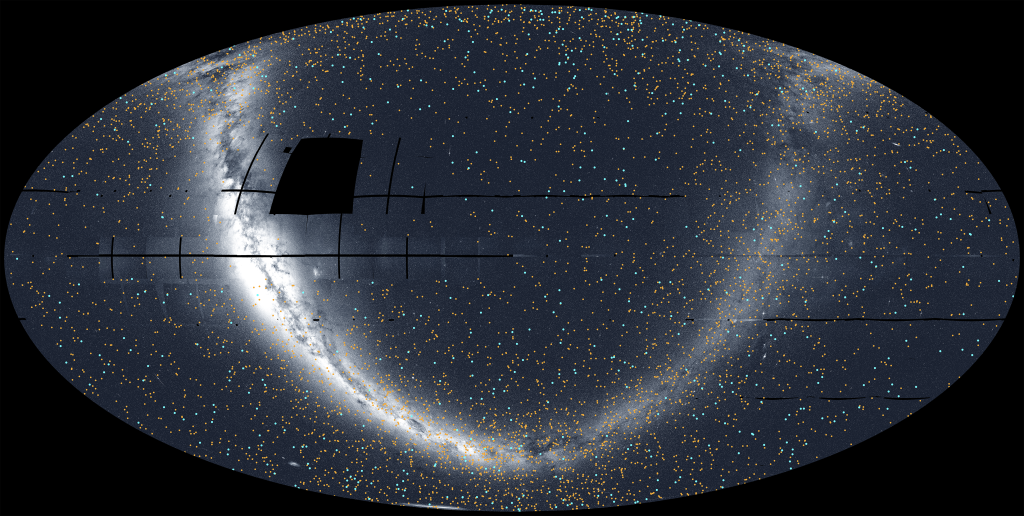
NASA has just published the most complete view yet of the night sky captured by its Transiting Exoplanet Survey Satellite (TESS), unveiling a dazzling cosmic mosaic filled with thousands of potential alien worlds. The newly released image combines years of observations into a massive all-sky map that highlights nearly 6,000 exoplanets and exoplanet candidates discovered or identified by TESS since the spacecraft began operations in 2018.
55 GB of Cosmic Data
The spectacular mosaic was assembled from 96 separate sky sectors observed between April 2018 and September 2025. Using four wide-field cameras, TESS scans enormous portions of the sky for weeks at a time, carefully monitoring the brightness of hundreds of thousands of stars. Tiny dips in a star’s light can reveal the presence of an orbiting planet passing in front of it — a method known as the transit technique.
“The computational time required to assemble the mosaic is nontrivial. A standard laptop needs about an hour to process the full image due to the large amount of data. As an example, the full mosaic is based on about 1,500 individual images that altogether take about 55 GB of disk space,” Veselin Kostov, one of the TESS scientists based at NASA’s Goddard Space Flight Center, who was involved in developing the mosaics, told Universelost.com.
Mapping Nearby Worlds Amid Dense Galactic Fields
Scattered across the image are thousands of colored markers representing distant worlds. Blue dots indicate 679 confirmed exoplanets, while orange dots mark more than 5,100 candidate planets still awaiting verification. According to NASA scientists, these worlds range from scorched volcanic planets to bizarre systems orbiting two suns simultaneously. Some may even lie within the habitable zones of their stars, where temperatures could allow liquid water to exist.
The bright glowing arc stretching across the center of the mosaic marks the plane of the Milky Way — the dense, disk-shaped region where most of our galaxy’s stars, gas, and dust are concentrated. The region is so densely packed with stars that it creates one of the most visually dramatic features in the entire mosaic, emphasizing both the enormous scale of our galaxy and the staggering number of worlds that could exist within it.
“Thanks to significant advances in both tools/methods/algorithms and computational power over the last two decades, finding transit-like signals in photometric time-series like TESS data is not extremely challenging. In general, confirming these signals as genuine planet transits — whether from TESS or another telescope — is more difficult for stars in crowded fields compared to stars in isolation,” Kostov said.
Beyond the Local Neighborhood
Also visible in the mosaic are the Large and Small Magellanic Clouds — two dwarf galaxies orbiting the Milky Way that appear as glowing patches near the lower portion of the image. Located roughly 160,000 and 200,000 light-years from Earth, these neighboring galaxies contain billions of stars and active regions of star formation. Because they are relatively close to the Milky Way, astronomers often use them as natural laboratories to study stellar evolution, supernovae, and the formation of planetary systems under different galactic conditions. However, we may not find out very soon if there are alien worlds in these two galaxies.
“Finding planets in the Small and Large Magellanic Cloud is extremely challenging. As far as I know, there are no confirmed planets from TESS in either galaxy. TESS is designed to search for transiting planets in the ‘local neighborhood’ of the sun, that is on the order of tens to hundreds of lightyears away — not hundreds of thousands,” Kostov said.
Although TESS was primarily designed to search for planets orbiting nearby stars, the spacecraft has evolved into a versatile observatory for a wide range of cosmic phenomena. In addition to exoplanets, TESS has monitored supernovae, pulsating stars, asteroids, stellar streams, and even interstellar comets moving through the Solar System.
The scale of the project is enormous. TESS continuously surveys the sky in month-long observing campaigns, generating vast quantities of astronomical data. To date, TESS has identified nearly 7,900 potential extrasolar worlds and 893 of those discoveries have been officially confirmed.


Leave a Reply