
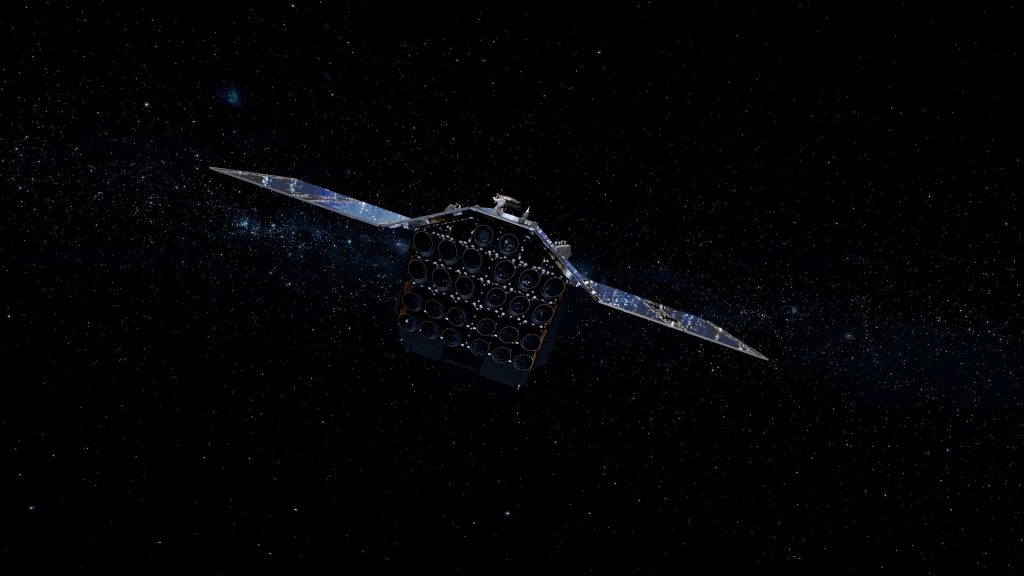
Plato wrote his famous Allegory of the Cave, describing prisoners who could only perceive reality through the flickering shadows cast upon a wall. Now, the European Space Agency (ESA) is turning that ancient philosophy into cutting-edge science with its upcoming PLAnetary Transits and Oscillations of stars (PLATO) mission. The state-of-the-art space telescope will hunt for “ideal” Earth-like worlds by looking at the literal shadows—the minuscule dips in starlight—cast as planets transit distant stars.
Finding Earth 2.0
PLATO is an M-class (medium-class) mission under ESA’s Cosmic Vision programme. While previous space telescopes like Kepler and TESS have discovered thousands of exoplanets, PLATO’s specific objective is highly refined: it is hunting for Earth twins.
Specifically, it will focus on rocky, terrestrial planets orbiting within the “Goldilocks” or habitable zone of yellow dwarf stars (sun-like stars). This is the precise orbital region where temperatures are moderate enough to allow liquid water to exist on a planet’s surface – a fundamental prerequisite for life as we know it.
To achieve this, PLATO will monitor up to one million stars across the sky, utilizing the “transit method” to detect the minuscule dip in a star’s brightness that occurs when a planet passes in front of it. Simultaneously, PLATO will perform asteroseismology—the study of “starquakes”—to measure the host stars’ mass, radius, and age with unprecedented precision. By combining space data with ground-based radial velocity observations, scientists will calculate the exact size, density, and composition of these distant worlds.
26 Eyes on the Cosmos
Unlike traditional space telescopes that rely on a single massive mirror, PLATO features a unique, multi-telescope design. It boasts an array of 26 separate optical cameras mounted together on a single platform: 24 “normal” and 2 “fast” cameras.
Normal cameras read out data every 25 seconds, focusing on stars fainter than magnitude 8. They are arranged in four staggered groups to maximize the telescope’s field of view, covering about 5 percent of the entire sky.
When it comes to fast cameras, these read out data every 2.5 seconds, monitoring the brightest stars (magnitudes 4 to 8) and doubling as highly precise navigation systems to keep the spacecraft perfectly aligned.
Combined, these cameras will capture massive 81.4-megapixel images, generating a staggering two-billion-pixel composite image – the largest ever for a space science mission.
PLATO Aces “Space-Like” Tests
To ensure its ultra-sensitive components can withstand the extreme realities of space, the fully assembled spacecraft was recently sent to ESA’s technical heart—the ESTEC Test Centre in Noordwijk, Netherlands. There, it underwent a grueling gauntlet of environmental trials.
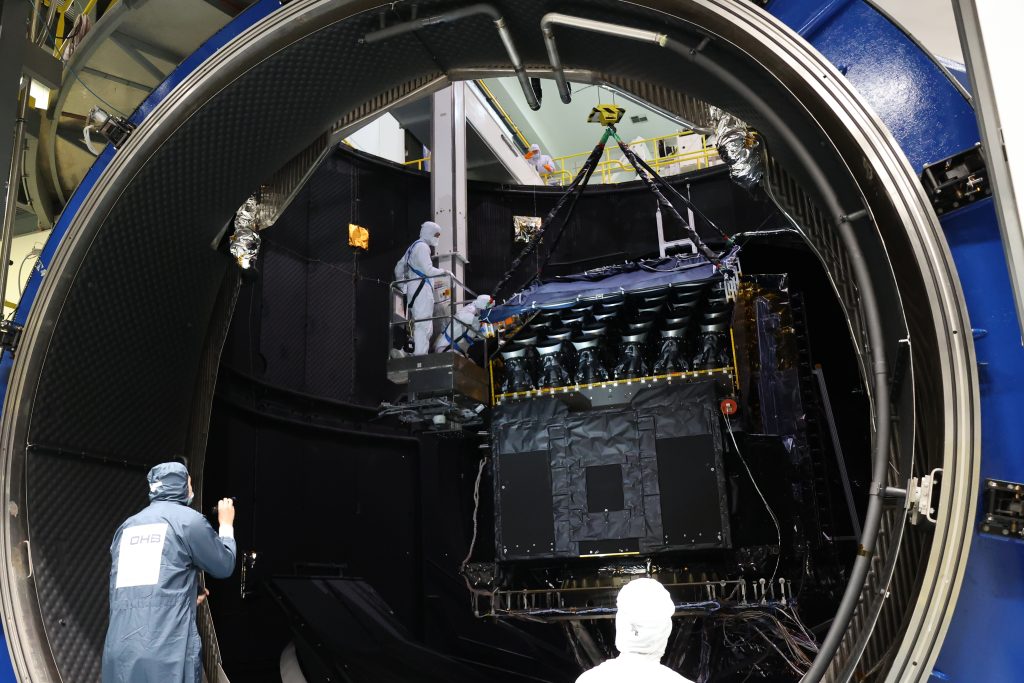
ESA announced in a recent press release that the spacecraft has successfully emerged from the Large Space Simulator (LSS) chamber. The LSS is Europe’s largest vacuum chamber, engineered to simulate the precise conditions of the void.
During the multi-week test campaign, engineers subjected PLATO to the ultimate thermal rollercoaster. The spacecraft was blasted with searing temperatures reaching up to 150 °C to mimic direct solar radiation, and then plunged into a deep freeze of –90 °C to simulate the shadow of deep space.
This test was vital because PLATO’s cameras must remain naturally cooled to around -80°C to maintain their incredible precision, relying on a newly integrated combined sunshield and solar array module to block out the sun’s blinding glare. Passing this trial by vacuum and temperature confirms that the spacecraft’s structure, thermal coating, and sensitive electronics can handle the thermal shocks of space without losing alignment or breaking.
The Final Stretch to Launch
Having already passed its intense vibration and acoustic tests (which simulated the intense shaking of a rocket launch) earlier in the year, this successful thermal-vacuum test clears the final major environmental hurdle for the spacecraft.
With these accomplishments safely under its belt, PLATO is officially on track for its highly anticipated liftoff in early 2027. The spacecraft will launch aboard an Ariane 6 rocket and travel to its final destination: a smooth, stable orbit around the Sun-Earth Lagrangian point 2 (L2), located roughly 1.5 million kilometers from Earth.
Once operational, PLATO will spend at least four years staring deeply into the dark, scanning bright stars, and compiling a definitive catalog of rocky worlds. Thanks to its successfully proven ruggedness, humanity is now one step closer to finding out if there is another blue marble out there waiting to be discovered.





Leave a Reply