
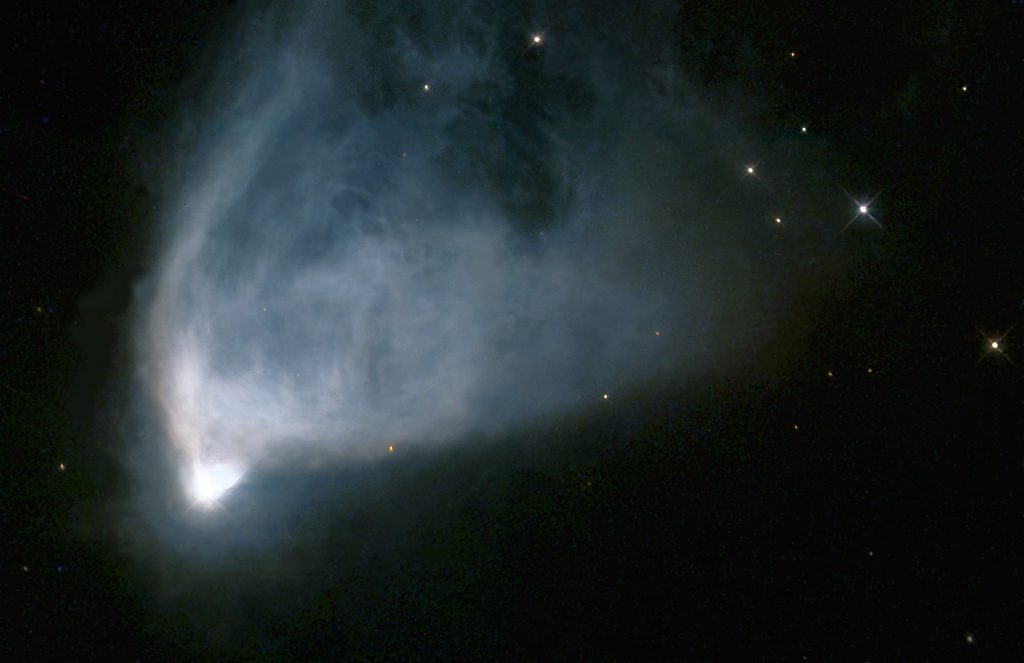
A new Chandra study finds extremely hot plasma and cold gas glowing under powerful X-ray irradiation around the massive young star R Monocerotis (or R Mon for short). Together with infrared evidence, the observations suggest this familiar nebula’s hidden illuminator is still an embedded protostar.
The star that lights Hubble’s Variable Nebula (NGC 2261) is surprisingly difficult to see. Its light reaches surrounding dust and illuminates the nebula, but the star itself, R Mon, is concealed from direct optical view. What astronomers detect at visible wavelengths is scattered light.
That makes a basic question harder than it sounds: what kind of young star is hiding there?
A new study by Stephen L. Skinner of the University of Colorado Boulder and Manuel Güdel of the University of Vienna approaches the problem with X-rays. Their observations reveal intensely hot gas, substantial obscuring material and a distinctive signal from relatively cold iron exposed to high-energy radiation.
The combination points toward a star at an earlier evolutionary stage than its familiar classification might suggest. The authors argue that R Mon is a Class I protostar: a young stellar object still surrounded by a dusty envelope as well as a disk.
Their newly published paper also leaves an intriguing puzzle. One iron signal appears unusually strong, perhaps because part of the X-ray source is hidden even from Chandra’s view.
An unexpected signal from a familiar young star
R Mon has historically been classified as a Herbig Be star. Herbig stars are young, intermediate-mass stars that have not yet settled into the long-lived, stable phase of stellar evolution. They often sit near gas and dust and can illuminate reflection nebulae.
But membership in that broad family doesn’t establish exactly how far a particular star has progressed.
R Mon is especially complicated. It is surrounded by a thick disk or torus and additional material. It drives outflows and a narrow jet. Its stellar properties, including its mass and precise spectral type, remain uncertain because the central source is so heavily obscured.
A short observation in 2018 with NASA’s Chandra X-ray Observatory supplied the clue that prompted the new investigation. R Mon’s X-rays were unusually energetic, or “hard,” and included a possible fluorescent iron signal. Its spectrum looked very different from those of well-studied Herbig stars dominated by lower-energy, “soft” X-rays.
Skinner and Güdel wanted a better spectrum to confirm that signal and investigate what was producing the emission.
Collecting the hidden star’s X-rays
Chandra observed R Mon seven times between December 2023 and January 2024, accumulating approximately 25 hours of exposure.
The researchers used Chandra’s Advanced CCD Imaging Spectrometer, ACIS-S, which records both where X-ray photons arrive and their energies. Sorting those photons by energy produces a spectrum, allowing astronomers to investigate the temperatures and composition of emitting material and the absorption occurring along the way.
This was a faint source. Individual new observations yielded only about 20 to 114 detected source counts. Nevertheless, the background contribution was negligible, and the combined evidence exposed several distinctive features.
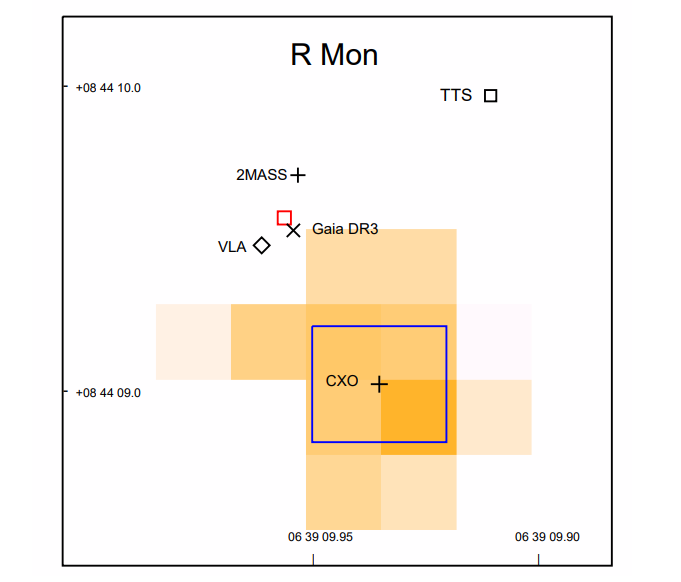
The source’s position was consistent with R Mon. The authors also excluded the known nearby companion, R Mon B, as the origin of the detected X-rays.
The brightness changed between visits. On one day, the earlier observation recorded a count rate 2.2 times higher than a later observation. Across the campaign, the highest measured rate was 5.4 times the lowest.
Yet Chandra detected no large, impulsive flares during its exposures. The changes establish variability on timescales of half a day or less, without showing the dramatic outbursts sometimes seen in young stars.
Hot iron, cold iron
Two nearby features in the spectrum tell very different stories.
One lies around 6.7 kiloelectronvolts, or keV, a unit used to describe individual X-ray photon energies. It comes from iron atoms stripped of nearly all their electrons, leaving only two.
Producing this emission requires extremely hot plasma: gas energetic enough for electrons to separate from atomic nuclei. The iron emission reaches its greatest strength at approximately 63 million kelvin, providing evidence for plasma at temperatures of tens of millions of degrees.
The second feature, near 6.4 keV, comes from neutral or nearly neutral iron in much colder material.
Here the process is fluorescence. An incoming high-energy X-ray knocks an electron out of an iron atom’s innermost shell. Another electron drops into the vacancy, and the atom can release an X-ray at a characteristic energy.
Together, the two features reveal hot, X-ray-emitting plasma and cooler surrounding gas being irradiated by it.
Much of the lower-energy radiation never reaches us. There was no significant emission detected below approximately 3 keV, and spectral models require a large intervening gas column. That supports earlier observations showing dense gas around R Mon.
Why ordinary shocks fall short
Young stars have several ways to generate X-rays. Gas can heat when it falls onto a star, or when material in a jet or wind encounters a shock. For R Mon, however, the calculated temperatures fall well below those needed to explain the hard emission.
Using previously measured outflow and jet speeds no greater than about 300 kilometres per second, the authors estimate a maximum shock temperature of roughly 1.3 million kelvin.
For material falling onto the star, adopting one published set of stellar parameters gives an estimated shock temperature of 5.6 million kelvin. That is hotter, but still insufficient.
The researchers therefore infer very hot plasma confined by magnetic fields. The observed variability is consistent with magnetic activity, although the observations do not directly measure the field itself.
Softer X-rays from shocks could still exist. The surrounding gas might simply absorb them before they reach Chandra.
An iron signal that looks too strong
The fluorescent iron feature presents a separate problem.
Astronomers measure its prominence using its “equivalent width”: the amount of underlying background spectrum needed to match the energy carried by the line. This measures the line’s strength relative to its surroundings, rather than simply how broad it looks.
In R Mon’s brightest observation, the equivalent width was 0.65 keV, with a reported one-standard-deviation range of 0.38-1.09 keV.
Standard models of a centrally illuminated disk with solar chemical abundances typically predict about 0.1-0.2 keV for nearly face-on views, and smaller values for edge-on views. R Mon’s disk or torus is thought to be seen close to edge-on, making its prominent line particularly difficult to explain.
The authors of the study examine several possibilities, including enhanced iron abundance and uneven illumination. Their preferred explanation is that we see less of the direct X-ray emission than the surrounding fluorescent material receives.
The star itself could block an active region near its edge or far side, while that region continues illuminating nearby gas. The fluorescent signal would then appear unusually strong against the reduced direct emission reaching us.
This remains a qualitative explanation. Confirming it would require more detailed modeling and higher-resolution spectra.
Evidence for an earlier stage of stellar life
The broader argument rests on combining the X-rays with infrared observations.
R Mon’s X-ray spectrum resembles that of the embedded protostar NGC 2071-IRS 1 much more closely than that of the prototypical Herbig star AB Aur. Both R Mon and NGC 2071-IRS 1 show strong absorption, very hot plasma and prominent fluorescent iron without large observed flares.
Existing infrared measurements also support an embedded object surrounded by more than a disk. Class I protostars retain dusty envelopes, whereas the more evolved Class II systems are primarily stars with disks.
There is an important qualification. One relevant Spitzer infrared channel was saturated, so Skinner and Güdel estimated its brightness from neighbouring measurements. The resulting infrared colours favour a Class I identification, but could also describe a heavily reddened Class II object in rare cases.
The authors conclude that the combined evidence supports the protostar interpretation. That is a case for reassessing R Mon’s evolutionary state, rather than an exact measurement of its age.
The observations make the hidden source of Hubble’s Variable Nebula more tangible: an emerging star surrounded by dense material, with extraordinarily hot plasma illuminating colder gas nearby. Its visible light reveals the nebula. Its X-rays are beginning to reveal the conditions around the star itself.




Leave a Reply