
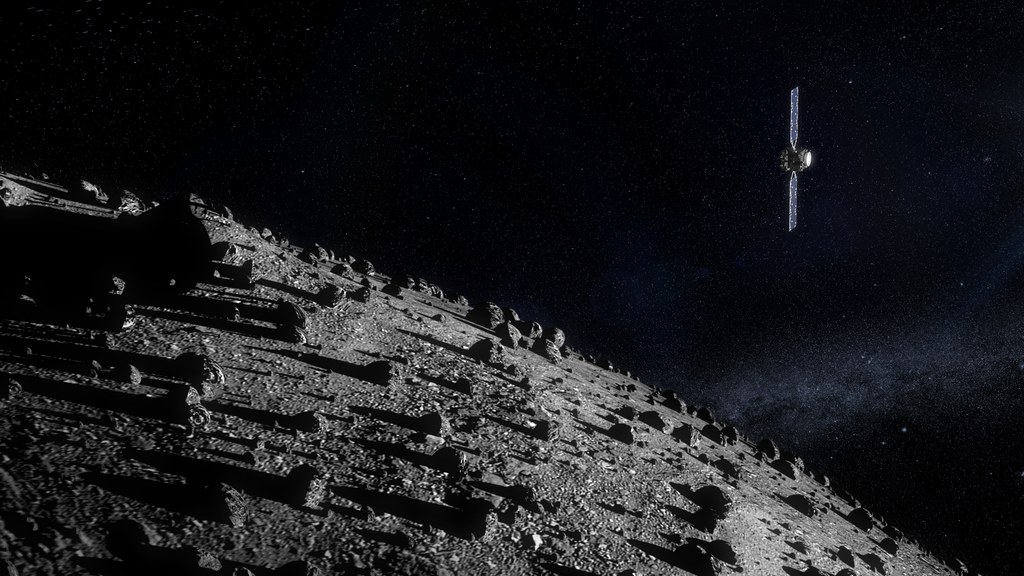
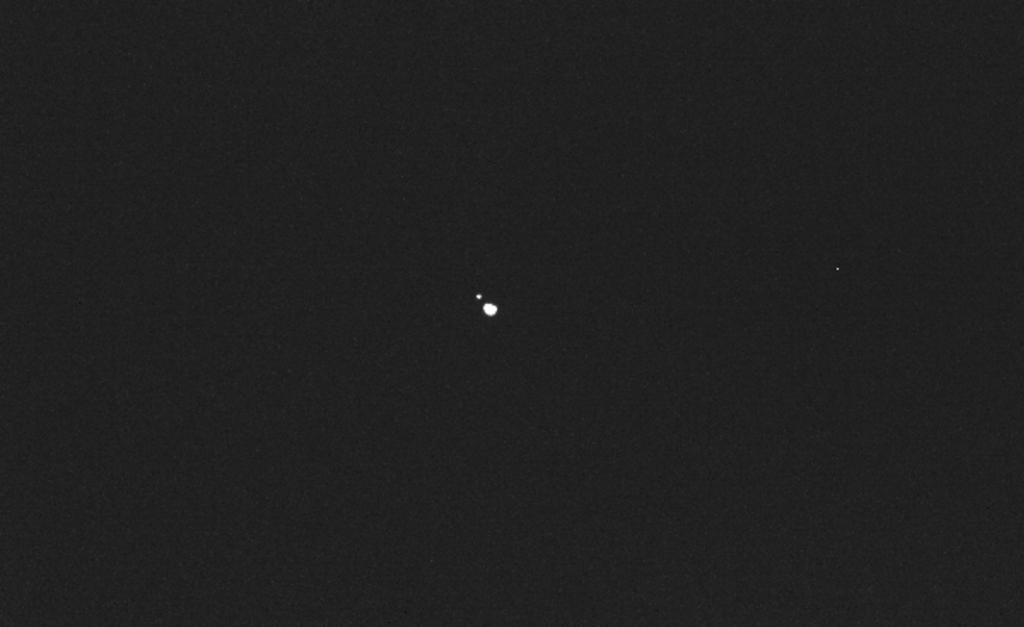
As the European Space Agency’s (ESA) Hera spacecraft barrels closer to its target, it has officially transitioned from a distant traveler into an active investigator. Following its braking maneuvers, Hera captured its critical “first-light” images on October 18, resolving the binary asteroid system Didymos and Dimorphos as two distinct bodies for the very first time.
To get an exclusive look behind the scenes, we spoke with Dr. Patrick Michel of the Côte d’Azur University, Hera Principal Investigator, and Dr. Michael Küppers, Hera Project Scientist at the European Space Astronomy Centre (ESAC), who shared insider perspectives on what those first pixels mean, what to expect on November 25, and how this mission will redefine planetary defense.
From a distance of roughly 1,280 kilometers, the smaller moonlet Dimorphos registered on Hera’s sensors as a single pixel. While this visual separation marks an exciting aesthetic milestone for the public, mission scientists are looking far deeper into what that lone pixel signifies. According to Dr. Michael Küppers, the immediate image does not heavily impact the flight trajectory.
“It does not significantly affect the timeline, as during the early mission phases Hera will be much further away from Didymos than Dimorphos, so we are not that sensitive to the orbital position of Dimorphos,” Küppers told Universelost.com.
However, he points out that this early vantage point carries crucial diagnostic value: “It allows us to assess if the orbital period still changed later than a few months after the DART impact, as a constant orbital period implies a specific orbital phase. The analysis is not yet finished.”
While preliminary evaluations of distance and brightness are under way, the science team cautions against drawing premature conclusions from far-field imaging. As Küppers notes, “The punchline here is that we will reach 30 kilometers next week, so any results based on images from about 1000 kilometers will be improved by a large factor soon. In this context, the images are continuously being ‘quick look’ analyzed, but we have determined no results yet on, e.g. distance, although it could be derived from the images to an accuracy of 100 meters or so.”
The systematic work will truly ignite during the early characterization phase, where Hera flies dedicated arcs around Didymos at distances of 25 to 30 kilometers. This phase will provide the first resolved shapes of both bodies, reveal global structural shifts, and determine Dimorphos’s dynamical state, specifically whether it remains tidally locked to Didymos or has been knocked into a chaotic tumble.
All eyes are now turned toward November 25, when ESA will unveil the first high-resolution global images of Dimorphos during its official arrival event. Hera Principal Investigator, Dr. Patrick Michel stresses the extraordinary scientific precedent of this reveal.
“On November 25, we will reveal what Dimorphos looks like globally, which will tell us how its properties were transformed by the impact of the NASA DART mission,” Michel told Universelost.com. “Did the impact leave a crater or did it reshape entirely Dimorphos? Both solutions are possible, which depend on how weak or how strong is the material composing Dimorphos, which we do not know yet! This is the first time that we already have images of a celestial body (provided by the DRACO Camera onboard DART) and that we will have new images which, as we already know, will be very different from the previous ones because meantime, something big happened: an hypervelocity impact!”
The initial global view is merely the threshold of a much deeper, multi-layered investigation. As Hera closes in, scientists will gather the high-resolution metrics required to measure the moonlet’s mass – the single vital variable governing deflection efficiency.
“We will also refine the shape, the detailed physical compositional and dynamical properties, like which boulders have been destroyed or moved by the impact, what is the rotational state, are there regions with different mineralogies or exposure time to solar radiations and micrometeorites,” Michel notes.
Beyond the main probe, the mission architecture introduces an unprecedented orbital dynamic starting early next year, as for the first time, a mission carries not only a main spacecraft but also two cubesats for deep space exploration of a small body.
“Those two cubesats will be deployed in January, and what is extraordinary is that during the following months, we will have a five body problem: a double asteroid surrounded by 3 artificial probes (Hera and its two cubesats called Juventas and Milani), which will eventually land on the asteroid! This is amazing and one can measure how much we will learn both scientifically and technically!” Michel explains.
Juventas, in particular, will deploy a low-frequency radar to peer directly inside an asteroid’s interior for the first time in history.
The ultimate objective of this complex orbital ballet extends beyond pure planetary science; it forms the backbone of future planetary defense strategies. NASA’s 2022 DART mission proved that humanity could autonomously target a distant asteroid and alter its orbit, shortening Dimorphos’s period by 33 minutes.
Yet without long-term proximity monitoring, essential physics remained unverified. Michel places Hera’s post-impact survey into stark perspective.
“DART was extremely successful and showed that we are able to autonomously guide a spacecraft at high speed on a small asteroid… But because there was no spacecraft there observing for long enough (the Italian LICIACube took images for the first few minutes after the impact only), we don’t know what is the final outcome of the DART impact.”
Validating predictive impact physics requires a fully documented collision experiment at real asteroid scale.
“DART gives the initial conditions: impact speed and angle, projectile mass and geometry; LICIACube offer early ejecta characteristics; Hera measures the outcome in great details as well as the physical characteristics of the target, including its mass, its surface and internal properties,” Michel explains. “With this information, numerical models of the impact have everything they need to be checked and hopefully validated or refined. Once they are validated, they can then be used for other scenarios and address other properties of the asteroid to determine the outcome of an impact and the corresponding deflection efficiency. That is why Hera is so important!”
As Hera advances closer each day, Küppers points out that the true thrill of deep-space exploration lies in the unexpected.
“The later mission phase will bring us much closer, allowing us to see the changes from the DART impact in great detail, to understand the surface properties on a microscopic level, to investigate the interior structure with a radar on a cubesat, and discoveries are awaiting us that we cannot even imagine now!”
Therefore, as Hera sweeps into its close-range orbits, the team is ready for the unexpected. They are aware that whatever the probe finds in the shadow of Dimorphos will forever change how we look at asteroids and our ability to protect Earth.



Leave a Reply