
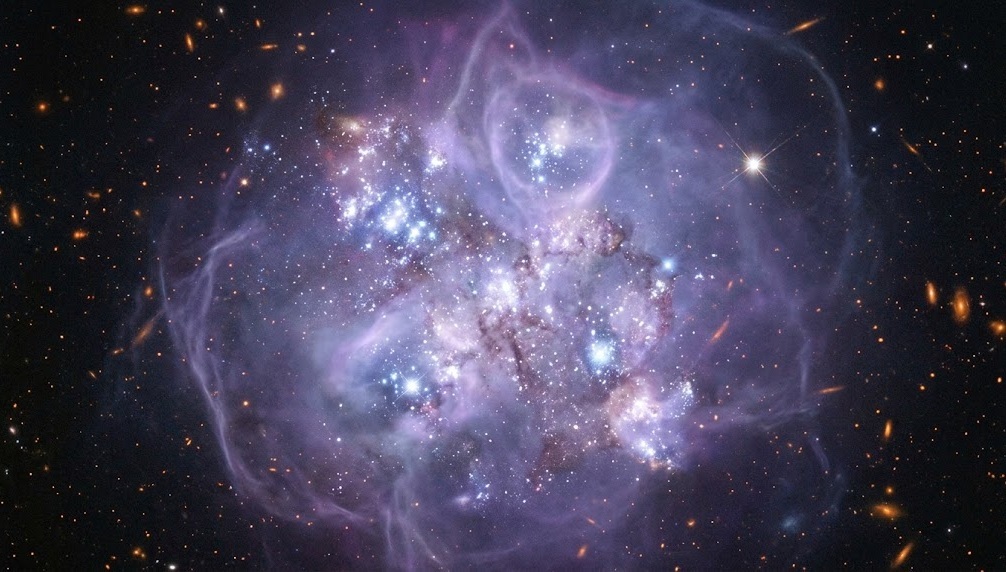
For the first time, researchers have detected active star formation in the immediate vicinity of a nearly unpolluted pocket of the early universe, proving a clever new method for hunting down the cosmos’s most elusive stars.
Since the dawn of modern astrophysics, scientists have been hunting for the elusive “Population III” stars, the very first generation of stellar bodies born after the Big Bang. Forged purely from primordial hydrogen and helium without a trace of heavier metals, these early beacons have never been observed directly.
While the James Webb Space Telescope (JWST) is currently straining to see these first stars at the very edge of the observable universe, a new study suggests we might be able to find their immediate descendants much closer to home.
In a recent paper, an international team of astronomers led by Louise Welsh at Durham University reports the successful detection of two primitive, star-forming galaxies located about two billion years after the Big Bang (redshift ~ 3). The discovery wasn’t an accident. The team found them by using a clever new cosmic treasure map: chemically near-pristine gas clouds.
X Marks the Spot
Normally, finding primitive, metal-poor galaxies is like looking for a needle in a cosmic haystack. To narrow the search, Welsh and her colleagues used a specific type of celestial phenomenon known as a Damped Lyman-alpha system (DLA).
A DLA is essentially a dense, cold cloud of neutral hydrogen gas that happens to sit between Earth and a distant, brilliantly bright quasar. As the quasar’s light passes through the cloud on its way to our telescopes, the gas absorbs specific wavelengths of light. By analyzing the “fingerprints” of this absorption, astronomers can measure exactly what the cloud is made of.
The team specifically targeted a DLA known to be “extremely metal-poor,” meaning its iron abundance is strictly less than 1/1,000th that of our Sun. According to recent cosmological simulations, these unpolluted pockets of gas can survive surprisingly late into the universe’s history.
Instead of just looking at the gas cloud itself, the researchers designed a program to search the spatial environment around it. The working theory? These pristine gas clouds could serve as cosmic signposts, pointing the way to nearby primitive galaxies that might still be actively churning out the universe’s earliest generations of stars.
Striking Cosmic Gold in Hawaii
To test this theory, the team turned to the W. M. Keck Observatory in Hawaii, utilizing the Keck Cosmic Web Imager (KCWI) and the newly commissioned Keck Cosmic Reionization Mapper (KCRM).
By staring at the region surrounding a highly pristine DLA (located in the direction of the quasar SDSS J0903+2628), they struck gold. The instruments picked up the faint, telltale glow of hydrogen Lyman-alpha emission coming from two distinct sources, dubbed LAE1 and LAE2.
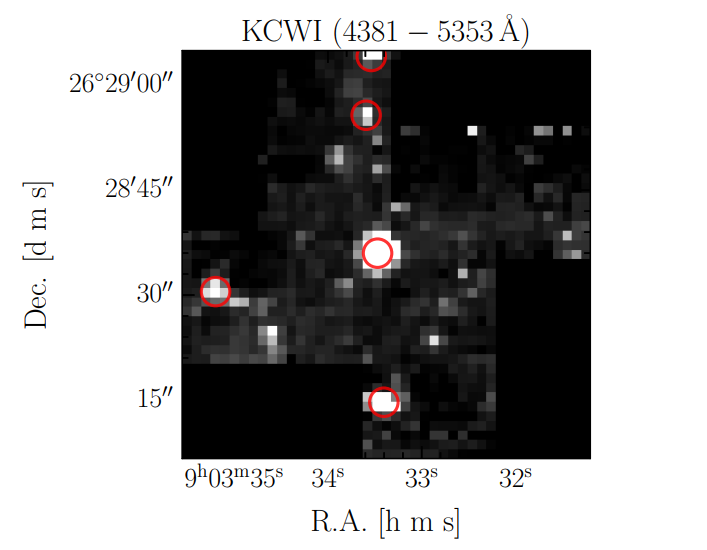
These two star-forming galaxies are located roughly 200,000 and 440,000 light-years away from the pristine gas cloud, therefore close enough to be part of the same unpolluted galactic neighborhood, yet distinct entities.
“This marks the first detection of star formation in the environment of a chemically near-pristine DLA,” the authors report.
A New Way to Hunt for the First Stars
While detecting the galaxies is a major victory, analyzing their exact chemical makeup is the next big hurdle. The team used the KCRM instrument’s red channel to look for specific helium emissions (He II 1640Å), which serve as a powerful diagnostic tool for figuring out just how metal-poor a galaxy is. While they only placed upper limits on the helium signal, the remarkably weak and narrow nature of the hydrogen emission, combined with mass-metallicity estimates, strongly suggests these galaxies are deeply impoverished of heavy metals.
The discovery is a powerful proof-of-concept for the field of extragalactic astronomy. It proves that scientists don’t have to rely entirely on luck or rare gravitational lensing at the farthest reaches of time to find primitive galaxies. By using pristine gas clouds as signposts, they can systematically hunt for the universe’s most ancient building blocks during an epoch where telescopes can observe them far more easily.
To definitively prove whether LAE1 and LAE2 harbor true Population III stars or extreme Population II (second-generation) stars, astronomers will need follow-up observations in the rest-frame optical wavelengths.

Leave a Reply