
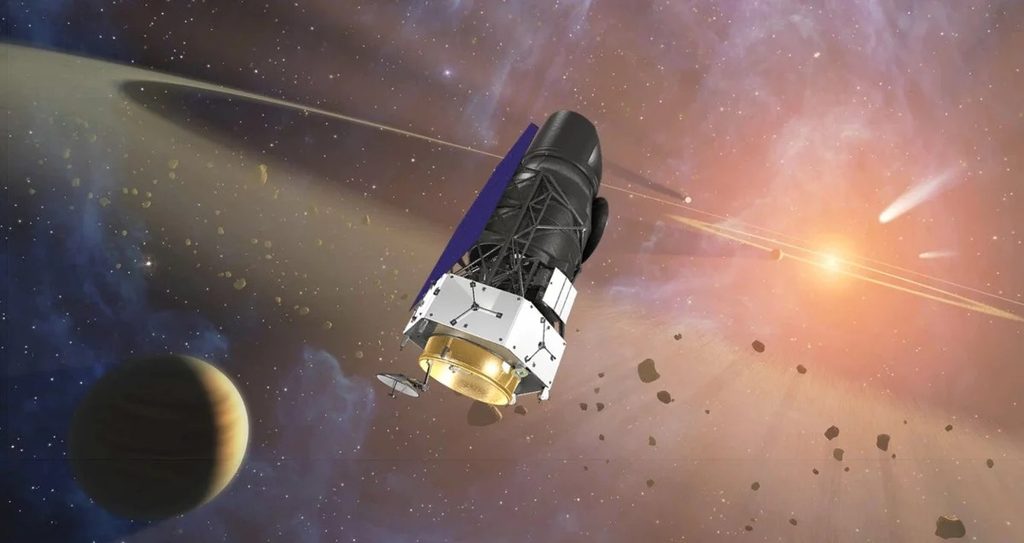
Despite discovering thousands of exoplanets across the galaxy, finding alien worlds orbiting white dwarfs has proven extraordinarily elusive: to date, astronomers have confirmed only one such planet – known as WD 1856+534 b. Now, with the launch of NASA’s Nancy Grace Roman Space Telescope, researchers are expecting to dramatically rewrite those odds, hoping to hunt down many extrasolar worlds transiting the survivors of stellar death.
When Sun-like stars exhaust their fuel, they balloon into red giants before stripping down to white dwarfs (WDs) that are cool, dense cores compressed to roughly the size of Earth. Because these stellar remnants are so small, a transiting planet passing in front of one blocks a massive percentage of its light, causing an unmistakable plunge in brightness.
However, given that WDs are notoriously faint and have compact sizes, transits occur in a rapid flash lasting just minutes rather than several hours. Therefore, ground-based telescopes and past space missions simply lacked the combination of wide field-of-view, continuous sensitivity, and rapid monitoring speed needed to catch these fleeting events.
That observational hurdle is about to disappear with the Roman Space Telescope’s Galactic Bulge Time-Domain Survey (GBTDS). Designed to stare into the dense center of the Milky Way, Roman will monitor millions of stars simultaneously with a high-frequency imaging cadence of just 12.1 minutes.
By continuously scanning deep space at infrared wavelengths, Roman will not only capture these brief transit blinks but will also gather enough data to establish the cosmic abundance of white dwarf exoplanets, but it will offer scientists an unprecedented look into how planetary systems evolve, adapt, and ultimately endure long after their host stars die.

“The Roman Space Telescope will monitor 16,000 white dwarfs in the Galactic bulge and center at 12.1-minute cadence during six high-cadence GBTDS seasons over the 5-year mission baseline. This combination of short cadence and long baseline provides the ideal configuration to capture the brief transits and weak phase-curve amplitudes of WD planetary systems,” Zifan Lin and Tansu Daylan of the Washington University in Saint Louis wrote in a recently published research paper.
To evaluate how effectively Roman can detect these elusive worlds, Lin and Daylan performed rigorous simulations using advanced photometric noise models. They analyzed both primary transits and subtle phase curves, which track variations in reflected light and thermal radiation as a planet completes its orbit. Their findings demonstrate that Roman’s high-frequency observations will be exceptionally sensitive to short-period planets.
For instance, they predict that if short-period planets around WDs turn out to be more widespread than it is expected, GBTDS could detect between 10-20 of these alien worlds, most of them Jupiter-sized. This will be a huge advancement in our understanding of white dwarf planetary systems, given that so far WD 1856+534 is still the only such system detected.
Even if Roman uncovers fewer planets than it is assumed, the data gathered will still mark a monumental step forward for astronomy. By establishing tight statistical constraints on the abundance of planets orbiting white dwarfs, the survey will allow scientists to determine how frequently planetary orbits survive the violent red-giant mass loss phase or migrate inward afterward.




Leave a Reply