
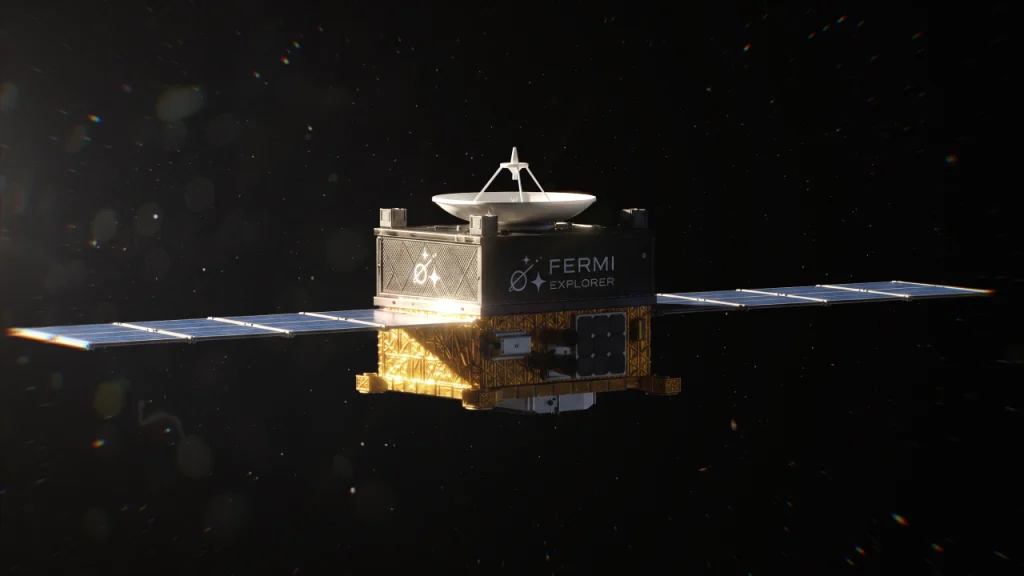
In Christopher Nolan’s Interstellar, sending a spacecraft beyond our Solar System relied on Hollywood physics and world-ending desperation. Garrett Jameson, co-founder and program manager of the newly announced Fermi Explorer Mission, is taking a more grounded approach: no wormholes, no gravity-defying drives, and no blockbuster budget, but just $15 million, off-the-shelf hardware, and an 80,000-year cruise.
Designed around flight-proven electric propulsion and clever orbital mechanics, the ambitious project aims to launch a tiny, solar-powered spacecraft toward the Alpha Centauri system by 2029. Alpha Centauri is the closest stellar system to the Sun, approximately 4.4 light years away. Fermi Explorer may need 77,500 years at best to get there.
The spacecraft is expected to have a wet mass of approximately 100 kg (most of it xenon propellant). It will use solar-electric propulsion to build up the required departure energy and carry a 10x10x10 cm payload with a mass of around 1kg. During its initial journey, the probe will execute a series of solar-slingshot “perihelion pump” maneuvers to gain the required escape velocity of about 23.6 km/s.
But how will basic, off-the-shelf electronics survive that heat and radiation during solar fly-bys?
“At our closest pass the Fermi Explorer will be 0.42 AU from the Sun, which is not extremely close. We have good data and we expect our components to survive just fine,” Jameson told Universelost.com.
In order to successfully send Fermi Explorer on the path to Alpha Centauri, the mission managers envision securing a rideshare into a Geostationary Transfer Orbit (GTO), rather than the Low-Earth Orbit (LEO). By starting higher up in Earth’s gravitational well, the required velocity change to overcome the Earth’s pull drops by nearly half (from 7.6 km/s down to 4.24 km/s), keeping the tiny craft light enough to carry its 1 kg cargo.
Once the spacecraft’s solar-electric thrusters finish their 12-year “perihelion pumping” phase around the Sun and lock in its final escape trajectory, its propulsion turns off forever. The Fermi Explorer will then drift through the interstellar void, relying on simple inertia to carry its time capsule to its destination 4 light years away.
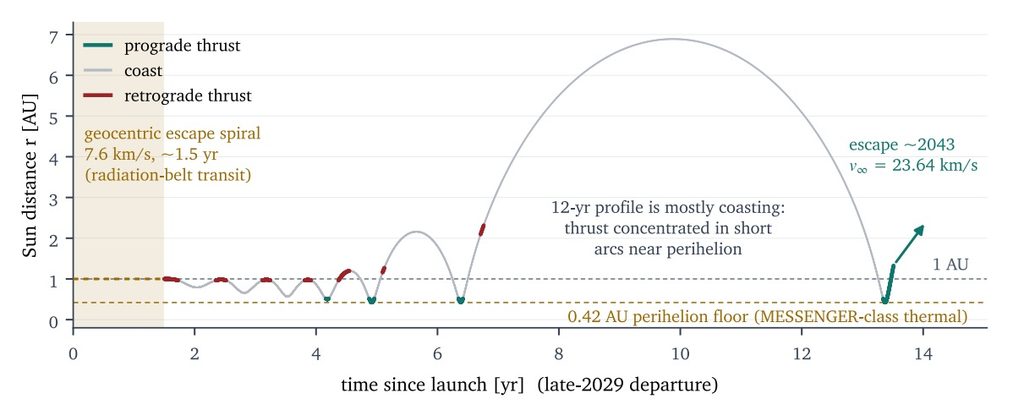
the 0.42 AU perihelion floor. Credit: Fermi Explorer Mission.
“We have data from the Voyager missions suggesting we will not go off course and we also have a wide target to aim for,” Jameson says.
To be more specific, the Fermi Explorer Mission is an attempt to pass within 2,600 AU, therefore roughly 240 billion miles away from the Alpha Centauri system’s gravitational balance point. The spacecraft is not aiming at where the stellar triplet shines in the sky today, but where it will drift nearly 800 centuries from now (in the region of the sky currently occupied by the constellation Cancer).
The mission doubles down on a human cultural legacy. Beyond scientific instruments that are yet to be chosen, the 1-kilogram payload cube will carry a modern copy of the Voyager Golden Record, alongside an international archive featuring 300-character messages written by children from around the world.
To make sure that the payload survives the longlasting voyage into deep space, messages and records are planned to be directly engraved into the durable metallic frame of the craft.
“We plan to engrave the messages directly into durable metal parts of the spacecraft. Interstellar space is dry and empty, which supports long-term preservation,” Jameson explains.
While deep space missions usually cost billions of dollars, the mission managers of Fermi Explorer aim to launch and operate its ambitious project for less than $15 million. Instead of spending tens of millions of dollars to produce components specifically for this mission, they are buying existing, pre-tested parts off the shelf.
Moreover, Fermi Explorer will piggyback on a commercial launch to space, drastically cutting launch expenses down to a fraction of traditional costs. After the initial phase of the flight, resting in a power-free ballistic cruise for millennia, the probe also eliminates the need for expensive mission control centers, decades of ground crew salaries, or continuous monitoring infrastructure.
“We will use heritage components and a LEO rideshare launch and automated operations. This avoids the major research and development, dedicated-launch, and operating costs of larger space missions,” Jameson says.
To cross the finish line by its planned 2029 launch target, the mission executives are actively seeking private sponsors, donors, and creative partners to fund the required budget, offering a chance to buy literal space aboard humanity’s first interstellar probe.



Leave a Reply