
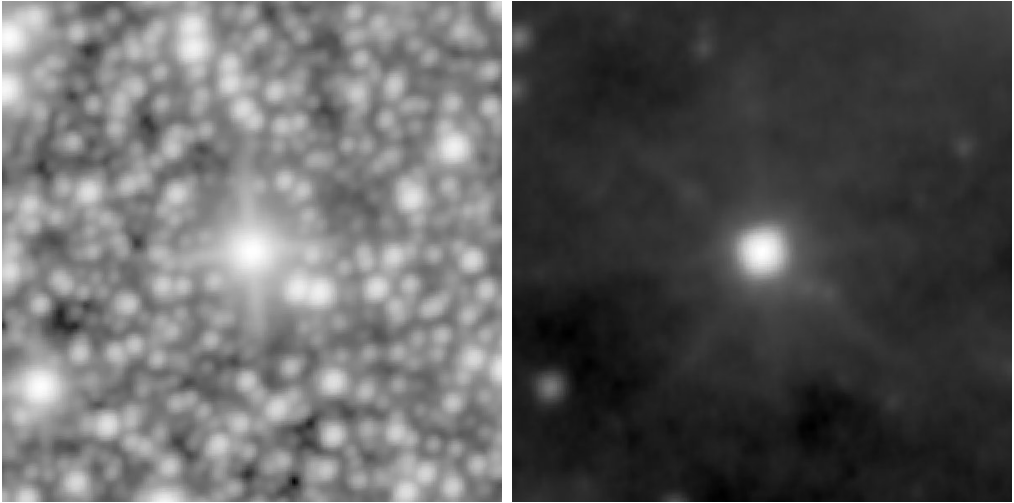
For decades, astronomers believed that the hydrogen-deficient R Coronae Borealis (RCB) stars were strictly solitary survivors of catastrophic mergers of two dead white dwarfs. But one of such RCBs, designated WISE J005128.08+645651.7, is turning that textbook hypothesis on its head. A newly published research paper suggests that this star is not alone after all, but rather locked in an unprecedented orbital dance with a dust-shrouded companion.
To find the potential first binary RCB, a team of astronomers led by Jan Budaj of the Astronomical Institute of Slovak Academy of Sciences was originally searching for peculiar eclipses in a different class of giant stars, known as F supergiants. One of such luminous F-type supergiants, named Epsilon Aurigae, is known for undergoing massive, years-long eclipses caused by a giant, opaque disk of dust surrounding an unseen companion.
Because evolved F supergiants and cool RCB stars can share similar stellar temperatures, high luminosities, and dusty circumstellar environments, the researchers set out to look for similar Epsilon Aurigae-like eclipse events across F supergiants to hunt for undiscovered disk-bearing binary systems. This search led them to WISE J005128.08+645651.7.
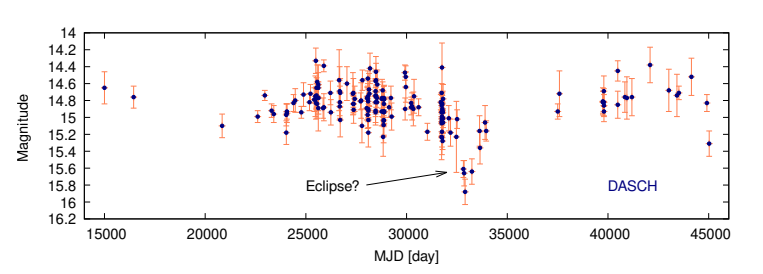
“Many of them turned out to be RCB stars, so we decided to concentrate systematically only on RCB stars since they are very exotic. We found one eclipse-like dimming event in the Gaia data of this star. So we dug deeper and further into the past and found another event, which phased well with the Gaia [data],” Budaj told Universelost.com.
That deep dive into the past meant combing through archival astronomical records, including digitized glass plates housed in the Harvard College Observatory archives that date back to the late 19th century. What those historical records revealed was a striking, predictable pattern: every 66 years, WISE J005128.08+645651.7 experiences an extraordinary drop in brightness lasting roughly three and a half years. The next eclipse of this star is predicted for 2080.
While RCB stars are notorious for erratic, unpredictable dimming as they puff out thick clouds of carbon soot, this regular 66-year cycle points directly to a massive, dust-shrouded object passing in front of the star. But what do we know about the newly identified potential companion of WISE J005128.08+645651.7?
The authors of the paper admit that the nature of this mysterious object is not known as it could be a star or even a brown dwarf.
“At present, this is only an RCB binary candidate. Definite confirmation would come when we observe the third eclipse in 2080. In the meantime, we keep gathering the data on the star and hope to learn more once the new Gaia data become available,” Budaj says.
This discovery made by Budaj’s team may force astronomers to rethink how R Coronae Borealis stars form. For years, it was assumed that they are single objects formed when two white dwarfs in a close binary collide and merge into one supergiant. But finding an RCB star with an orbiting companion introduces a fascinating twist: it suggests these systems may actually originate from triple-star configurations.
“First of all, if this RCB star is confirmed to be a binary star, i.e. it has a companion, it does not mean that the merger scenario is wrong,” Budaj explains. “If the merger scenario is correct, then it would mean that this was a triple star before. It may sound strange since we were used to single RCB stars and now we talk about the triple RCB progenitors. However, it may not be anything unusual or accidental.”
In fact, a third star might be the very catalyst required to create an RCB star in the first place. Two white dwarfs in orbit around each other do not simply collide without a push as they need to lose orbital angular momentum to draw close enough to merge. The gravitational influence of a third, outer star can act as a dynamical brake.
“The third star may have its own role to play,” Budaj notes. “The two white dwarfs do not merge accidentally and on their own easily. One needs to remove their angular momentum before, and this might be arranged by the third star. So, in fact, the merger scenario does not imply that RCB stars will be single as expected before. On the contrary, one might expect to find more RCB stars in long period binaries.”
If these assumptions hold true, WISE J005128.08+645651.7 may be only the first of many discovered “survivors” of ancient triple systems. As sky surveys grow increasingly sensitive and archival datasets are combed for long-period variations, astronomers may soon find that many of these soot-puffing giants have previously undisclosed companions.



Leave a Reply