
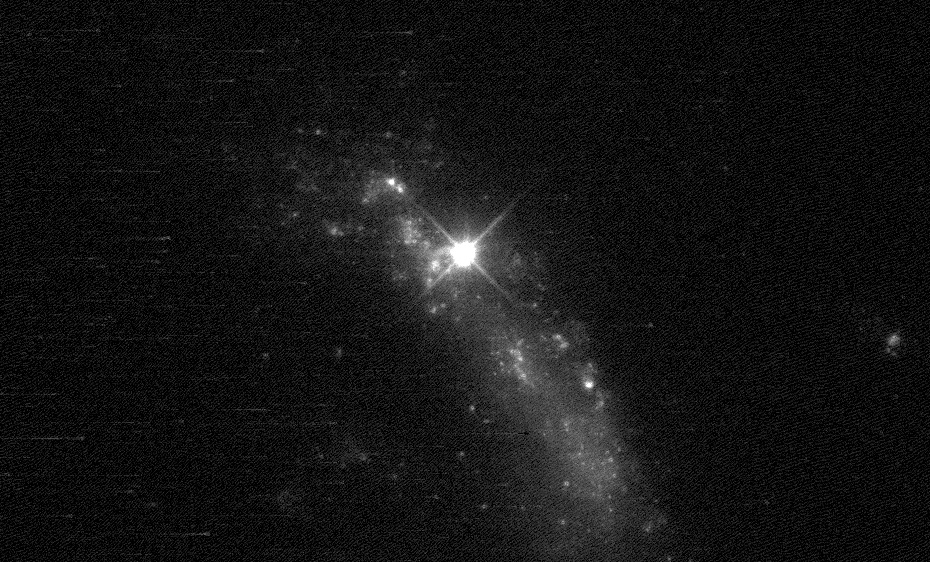
When stars die in violent supernova explosions, astronomers expect them to leave behind chaos. But new observations from the James Webb Space Telescope (JWST) reveal that 13 years after a stellar explosion in the galaxy UGC 5189A, shockwaves interacting with circumstellar gas create ideal conditions for long-lasting cosmic dust. This “dust factory” produces massive quantities of the microscopic dust grains essential for building planets, moons, and future generations of stars.
A team of astronomers led by Nathan Smith of the University of Arizona has analyzed mid-infrared spectra from SN 2010jl, which is a superluminous Type IIn supernova (SLSN IIn) located about 150 million light years away in the irregular galaxy UGC 5189A. It turned out that thirteen years after the initial flash of the explosion was detected in late 2010, JWST’s Mid-Infrared Instrument (MIRI) detected a powerful glow from warm dust grains, uncovering a dust yield far larger than anyone had previously measured in this type of remnant.
How Post-Shock Environments Protect Dust
SN 2010jl is classified as a Type IIn supernova, a rare class of explosions characterized by dense circumstellar material (CSM), therefore gas and dust shed by the progenitor star in massive eruptions prior to its final collapse.
When the supernova blast wave slammed into this dense pre-existing gas cloud, it produced a dense, cool post-shock layer. As the shockwave plowed through the surrounding material, conditions in this dense layer became cool and dense enough for heavy elements to condense into fresh dust grains.
Crucially, because this post-shock dust forms behind the blast wave, it is shielded from the most destructive energetic shocks. Instead of being vaporized, the newly formed dust survives intact and is gradually swept out into space.
“Dust Factory” Unveiled
In the case of SN 2010jl JWST revealed a minimum dust mass of 0.11 solar masses, with a realistic estimate exceeding 0.2 solar masses due to the dust layer being optically thick. This is among the largest masses of supernova-produced dust ever detected without needing far-infrared or submillimeter observations.
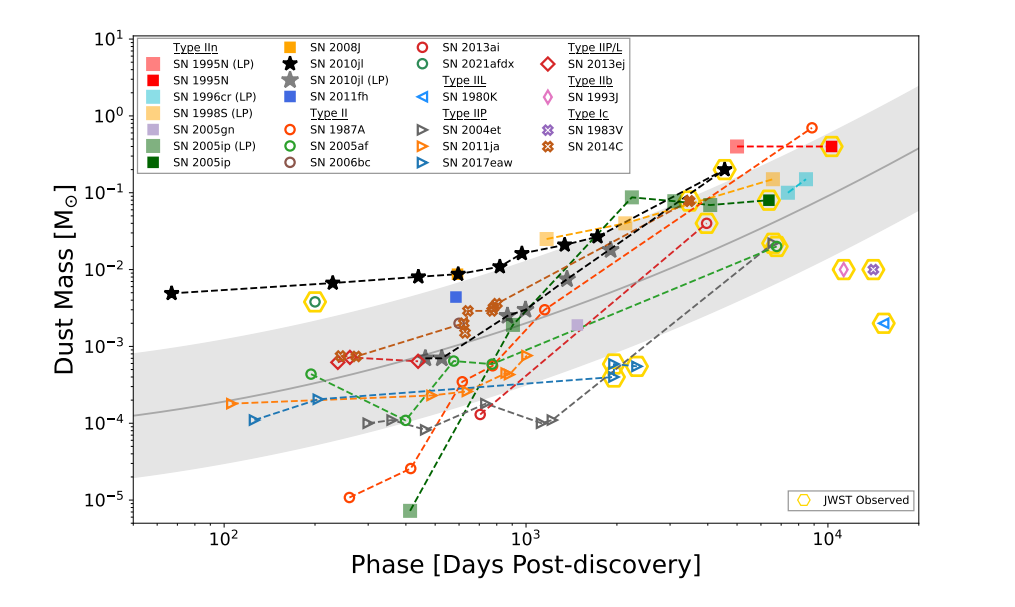
dust masses in the literature. Credit: Nathan Smith et al., 2026.
The JWST spectra also exhibited broad emission and silicate absorption features between 10-15 micrometers, pointing to a mix of warm post-shock dust and cooler silicate grains along the line of sight.
Moreover, ground-based optical spectra collected alongside JWST data showed persistent blueshifted emission lines. This physical asymmetry occurs because newly formed dust inside the remnant blocks light from the receding, far side of the explosion, confirming that the dust is actively embedded in the post-shock region.
Implications for Astronomy
Though Type IIn supernovae account for less than 10 percent of core-collapse supernovae (CCSne) in the modern Universe, they were likely far more common in the early Universe, when massive, short-lived stars underwent heavy mass-loss episodes before exploding.
If interacting supernovae like SN 2010jl efficiently produce and preserve tenths of a solar mass of dust per event, they may have served as the primary “dust factories” seeding the very first cosmic structures—providing the raw building blocks for rocky worlds early in cosmic history.


Leave a Reply