
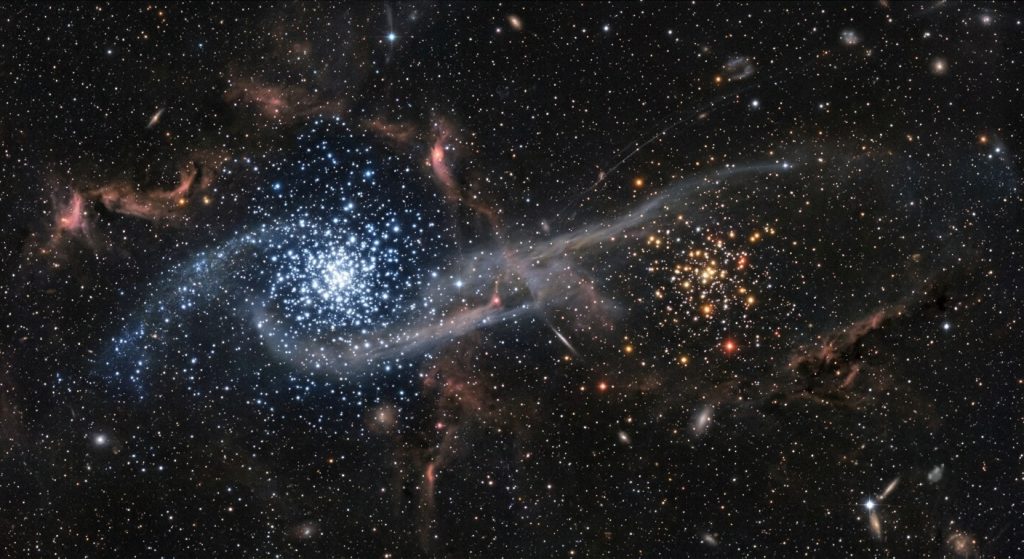
What was thought to be a single group of stars known as UBC 63 has turned out to be the crime scene of a gravitational hit-and-run on a cosmic scale. By analyzing the data from ESA’s Gaia satellite, astronomers found that UBC 63 is actually two distinct star clusters that recently sideswiped one another in deep space.
Located some 4,800-5,000 light years away from the Earth, UBC 63 is a poorly populated Galactic open cluster estimated to be 21 million years old, with a mass of about 291 solar masses.
Very little is known about the properties of UBC 63 given that it has not been the subject of a dedicated, in-depth investigation. However, this may change now as a new study recently published by astronomers led by Samrat Biswas of the Gauhati University in India, rewrites what we have known about this youthful stellar grouping.
A Double Star Cluster with a Huge Age Difference
According to the new research, UBC 63, rather than being a single cluster as previously thought, is most likely a double cluster undergoing an unbound flyby interaction.
The team uncovered this by applying advanced statistical techniques to the latest Gaia Data Release 3 (DR3) astrometric data, revealing two star groups with dramatically different origins. The first component, dubbed UBC 63A, contains 98 stars, while its sibling, UBC 63B, has 148 members with a far more advanced age of 562 million years.
This massive 541-million-year age gap completely rules out the idea that they were born at the exact same time. Yet, tracing their paths backward shows they were separated by only about 195 light-years when the younger cluster was born, hinting that both may have originally formed within the same massive molecular cloud complex before taking vastly different evolutionary paths.
“Observing two interacting star clusters with an age difference exceeding 500 million years is relatively uncommon, though not entirely unprecedented.To give a sense of scale, a 2025 study by L. Liu and colleagues (Liu et. al. A&A, 702, A48 (2025)) examined over 4,000 high quality star clusters from the catalog: Hunt & Reffert 2024, one of the most comprehensive catalog of milky way star clusters till date. They identified 400 interacting pairs, yet only four of those had an age gap exceeding 500 million years,” Biswas told Universelost.com.
When Stellar Clusters Collide
The researchers reconstructed the trajectory of the UBC 63 cosmic encounter, discovering that the pair reached a remarkably close separation of just 23 light-years roughly six million years ago. The clusters are hurtling past each other at 3.6 kilometers per second, far exceeding their mutual escape velocity of just 0.51 kilometers per second. This speed guarantees they will never pull into a stable orbit or merge. Instead, their brief, high-speed collision left behind subtle clues.
“The gravitational forces during such a close flyby may tidally distort both clusters, often stripping away stars to form elongated structures. We have explicitly identified these loosely bound features of stripped stars around the UBC 63A and UBC 63B system. At the stellar level, while inner planetary systems remain largely unaffected due to the dominant gravitational pull of their host stars, the gravitational perturbation from the flyby can destabilize wide-orbit planets,” Biswas explains.
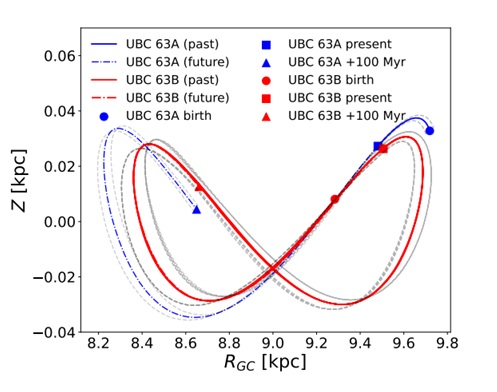
While gravitational interactions are a key feature of galactic dynamics, true “hit-and-run” flybys like in the case of UBC 63 represent a minor fraction of stellar interactions.
“Drawing on the statistics from Liu et al. (2025), only 22 out of 400 candidate interacting systems were identified as hyperbolic encounter pairs, which is a kinematic configuration analogous to a flyby,” Biswas noted, pointing to other known examples like ASCC 71/ESO 064-05 and NGC 2129/UBC 437. “So, again, these flybys are relatively uncommon, but not extremely rare.”
Once Neighbors, Now Parting Away
To explain how two stellar groups with such a vast age gap could still originate from the same neighborhood, the researchers point to a multi-stage process of star birth within a single, long-lived gas environment.
“A possible scenario is as follows: 562 million years ago, UBC 63B formed from a large gas reservoir. While the immediate localized gas was blown away, a larger co-moving reservoir of star-forming material remained on the same epicyclic orbit,” Biswas explains.
He noted that the leftover gas drifted alongside the older cluster for over half a billion years before something triggered a second burst of star birth.
“About 21 million years ago, this co-moving gas stream suffered a collapse which could be initiated due to a variety of processes such as external shockwaves or cloud-cloud collisions. Because the gas and UBC 63B were traveling on similar orbits, the new starburst (UBC 63A) occurred right next to the older cluster,” Biswas claims.
This shared evolutionary heritage led to the dramatic flyby witnessed today. The two clusters spawned by the same parent gas structure, reunited hundreds of millions of years later for a single encounter before parting ways forever.
What Now for UBC 63?
The team plans further investigation of the UBC 63 encounter. Their next goal is to look beyond the motion of the stars to study the environmental conditions left behind in the wake of the collision.
“We indeed plan to study the dust, magnetic fields, and star formation towards the region of UBC 63,” Biswas revealed. “We have already conducted polarimetric observations towards the region, using the ARIES Imaging Polarimeter (AIMPOL) at the backend of the 104 cm Sampurnanand Telescope at ARIES, Nainital, India.”
These observations will help map the magnetic structures and interstellar dust, offering a clearer picture of how a high-speed cosmic flyby shapes and potentially disrupts the surrounding vastness of space.



Leave a Reply