
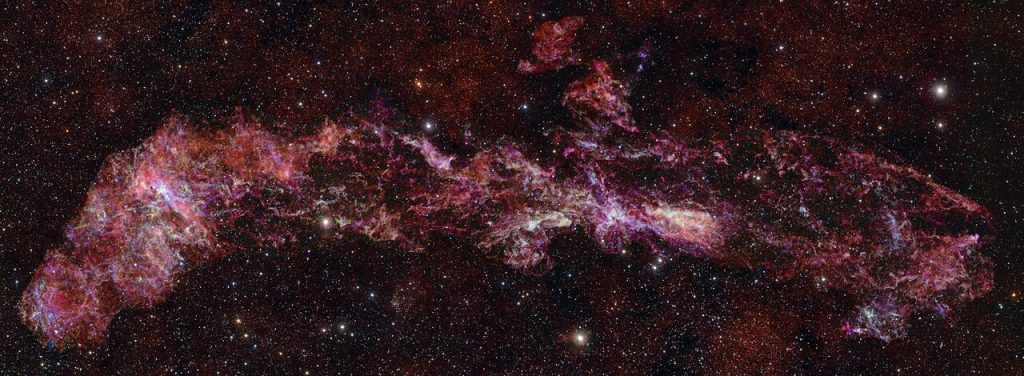
For decades, the center of our Milky Way galaxy has remained hidden behind thick clouds of dust — a dark, violent region that only a few telescopes could truly penetrate. Now, an international team of astronomers using the Atacama Large Millimeter/submillimeter Array (ALMA) have produced the largest and most detailed image ever captured of the Galactic core, unveiling a nightmarish landscape of shock waves, twisted gas filaments, and turbulent molecular storms surrounding the supermassive black hole Sagittarius A*. The colossal map uncovers a real galactic nightmare – a chaotic environment where stars struggle to form, clouds collide at enormous speeds, and exotic chemicals swirl through one of the most extreme regions in the known universe.
Mapping the Galactic Core
At the core of the Milky Way lies the Central Molecular Zone (CMZ), a chaotic region full of dense clouds of gas and dust. Although this area contains vast quantities of raw material for star formation, astronomers have long puzzled over why stars form there at a slower rate than expected. The new ALMA survey, known as the ALMA CMZ Exploration Survey (ACES), was designed to investigate this mystery by tracing the distribution of dozens of molecules across the galactic center.
According to the European Southern Observatory (ESO), the newly published map from the ACES survey spans an area of sky equivalent to three full moons placed side by side, making it the largest ALMA image ever produced. The astronomers obtained the record-breaking image by stitching together many individual observations. In this image, different molecules appear in different colors, allowing scientists to distinguish the physical processes shaping the gas clouds. Some molecules reveal regions compressed by shock waves, while others trace colder, denser structures where new stars may eventually emerge.
“It was a huge technical challenge involving a concerted effort from tens of scientists from around the world for several years to produce these images. The resolution of the ACES survey is enough to pinpoint the locations of the densest, coldest gas that are the sites of current protoplanetary disk formation,” ACES leader Steve Longmore, a professor of astrophysics at Liverpool John Moores University told Universelost.com.
Adam Ginsburg, an associate professor of astronomy at the University of Florida’s Department of Astronomy and the coordinator of the ALMA data reduction working group within ACES, noted that it took the team of ten people roughly three years to get all the data assembled, processed and quality-controlled.
“We had a supercomputer running pretty constantly that whole time, and the final data products use about half a petabyte of storage space. It took the ALMA telescopes a lot of time: 120 hours on the big array of about fifty 12-meter telescopes, 400 hours on the smaller array of sixteen 7-meter telescopes, and another 750 hours on the small group of four 12-meter telescopes,” Ginsburg told Universelost.com
Decoding the Chemistry and Turbulent Interactions
Among the molecules identified in the image are carbon monosulfide, silicon monoxide, sulfur monoxide, isocyanic acid, and cyanoacetylene. Each is for astronomers like a chemical fingerprint, helping them reconstruct the violent environment near the Galactic center. Silicon monoxide, for example, often signals powerful shocks caused by collisions between clouds of gas, while cyanoacetylene can highlight especially dense regions. By comparing these molecular tracers, researchers can better understand how turbulence, magnetic fields, and radiation influence star formation.
The observations highlight the influence of Sagittarius A* on its surroundings. Even though the black hole itself is relatively quiet at present, its environment remains highly energetic. Massive clouds twist and stretch under intense gravitational forces, while energetic events stir the interstellar medium into a constantly changing network of filaments and knots. The new ALMA data gives astronomers an unprecedented opportunity to study these interactions in detail.
From Galactic Chaos to Planet Formation: Clues Hidden in the Data
Besides investigating the chaotic clouds at the Milky Way’s center, the new image could also help astronomers to explore protoplanetary disks – vast, rotating disks of gas and dust surrounding young stars. Over time, tiny dust grains within these disks collide and stick together, gradually building up into pebbles, boulders, and eventually full-sized planets.
“We see the surrounding envelopes that comprise the material that will form new stars. However, some of the related projects led by part of our team (e.g., https://arxiv.org/abs/2605.03883) have indeed resolved what may be protoplanetary disks: they are more massive and mixed up than the disks we are used to seeing, and they are around bigger stars, so we can’t say for sure they are actually forming planets yet, but they may be!” Ginsburg said.
“We are now zooming with ALMA in much higher resolution mode in many areas of interest, including regions we suspect must have protoplanetary disks,” Longmore added.
Researchers believe the ACES dataset will remain valuable for years to come. Because the survey captures such a broad range of molecules and structures, astronomers worldwide can use it to investigate everything from stellar nurseries to the dynamics of galactic nuclei. The data may even help scientists understand star formation in distant galaxies, whose turbulent centers resemble the Milky Way’s core.
“We are going to use ALMA more – ALMA in different configurations can teach us a ton of different things, like resolving disks as above, but also measuring things like the temperature and mass of disks, young stars, and other poorly-understood objects. ALMA can also be retuned to measure different molecules, so we’re doing a lot of followup work to measure the chemistry of the clouds and protostars,” Ginsburg concluded.




Leave a Reply