
In the era of growing exploitation of AI, astronomy can truly benefit from it too. A Brazilian astronomer proposes a multiple machine learning method (MMLM) that became an essential tool in finding and investigating star clusters.
Machine learning (ML) is a branch of artificial intelligence (AI) focused on building systems that autonomously learn from data. Therefore, ML systems use algorithms to identify patterns and make decisions based on experience.
In astronomy, ML can be implemented, for instance, to classify and analyze galaxies or stars. The algorithms can learn from sets of images classified by humans and once they are trained, they can categorize millions of new astronomical objects in seconds with higher consistency than a tired human eye.
Denilso Camargo, a Brazilian astronomer and discoverer of more than 1,000 star clusters, in a research paper published in June 2025, proves that employing a combination of ML algorithms can be more effective when it comes to finding and analyzing stellar groupings.
“There are several machine learning available for astronomy exploration, and each approach has its own advantages and limitations, so I’m applying a multiple machine learning method for star cluster analysis. The combination of these algorithms leads to more robust results, since the limitations of one of them may be covered by the others,” Camargo told Universelost.com
A Revolution in the Search for Star Clusters
According to Camargo, the power of MMLM lies in its ability to comb through the massive data structures provided by ESA’s Gaia satellite. By clustering stars based on complex similarities in their motion and position, these algorithms can reveal groupings that were previously indistinguishable from the cosmic background.
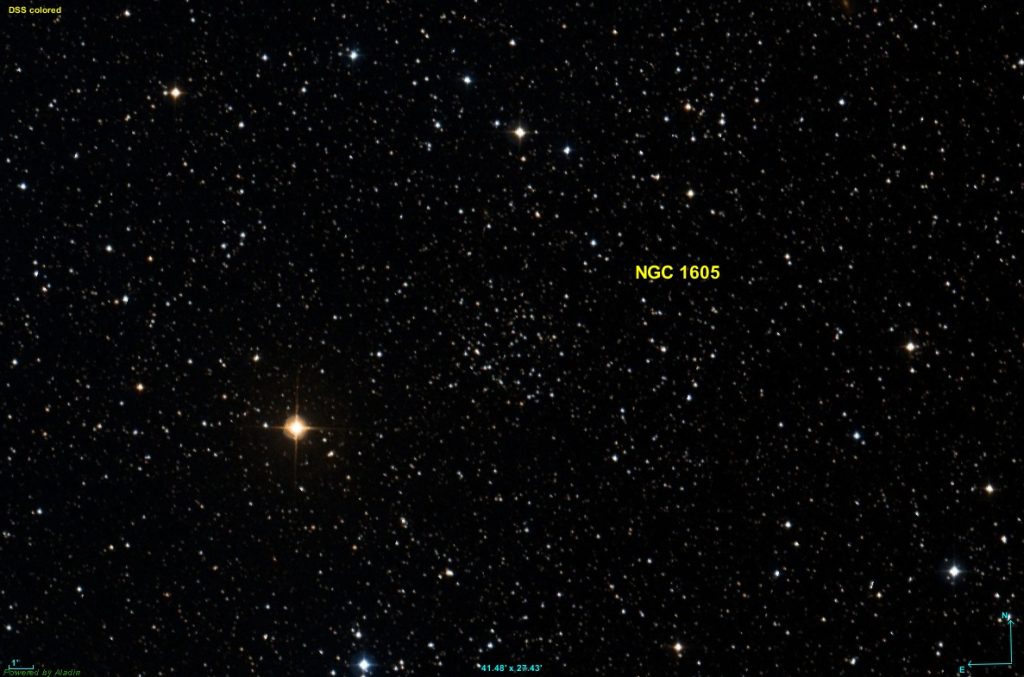
“It could revolutionize the search for star clusters. The multiple machine learning method aims to improve the accuracy and robustness of the analysis. The MMLM performance was evaluated by applying it to the analysis of the old binary cluster comprised of NGC 1605a and NGC 1605b and has proven to be highly effective in uncovering hidden clusters and their substructures,” Camargo said.
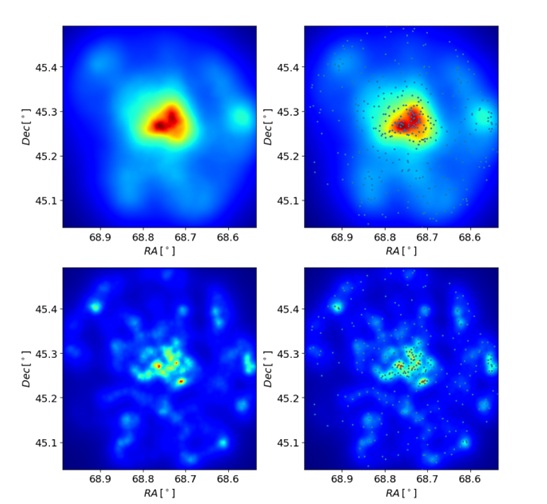
The right panels display the schematic distribution of the cluster probable member-stars
as black circles overlaid on the heatmaps. Credit: Denilso Camargo.
Bright Future of MMLM in Astronomy
The successful analysis of the NGC 1605 binary cluster is only the beginning. Camargo confirmed that MMLM is now a permanent fixture in his research toolkit, with plans to expand its capabilities even further.
“MMLM was incorporated into our research method,” he explained. Looking ahead, the system is designed to be modular and scalable. “Furthermore, in the future, other machine learning algorithms may be incorporated to the MMLM to improve performance and achieve specific objectives.”
As AI continues to evolve, the partnership between human intuition and machine processing power promises to pull more secrets from the dark reaches of the Universe. With astronomers like Camargo leading the charge, the next thousand star clusters may be uncovered faster than we ever imagined.
Denilso Camargo is a Brazilian astronomer and researcher working in star clusters, Galactic structure, data science, and computational astronomy. He is known for the discovery of more than 1,100 star clusters in the Milky Way, including open and globular clusters identified through surveys such as NASA’s WISE mission, ESA’s Gaia mission, and the VISTA Variables in the Via Lactea Survey (VVV Survey).
His work applies multiple machine-learning techniques to star cluster detection and Galactic structure studies. Camargo discovered the high-latitude embedded clusters Camargo 438 and 439, among the first known examples of star formation far from the Galactic disk plane, and contributed to tracing the Milky Way’s spiral arms through embedded clusters. He also contributed to studies of binary clusters, including NGC 1605a and NGC 1605b, and discovered eight globular clusters in the Galactic bulge.
His research has been featured by international media including NASA JPL, Phys.org, The Washington Post, National Geographic, Sky & Telescope, Forbes, Astronomy Magazine, and Revista Galileu. He was also quoted by The New York Times and Nature as an independent expert on studies of the Milky Way’s spiral structure.




Leave a Reply