
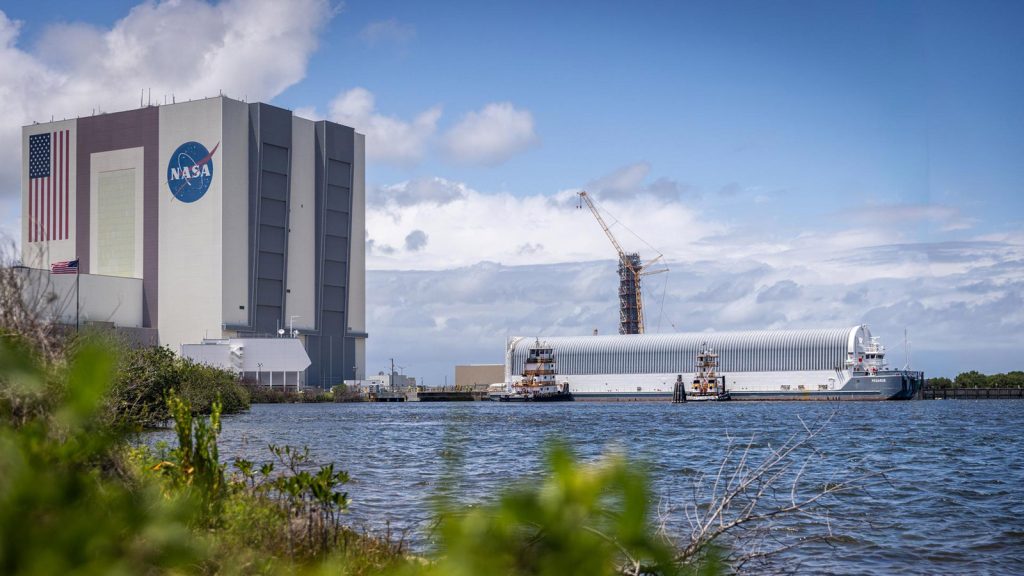
The Boeing-built Core Stage 3 (CS3) serves as the literal backbone of the entire Space Launch System (SLS), as it is designed to support the immense weight of the upper stage, the Orion crew capsule, and the crushing force of liftoff. It has recently arrived at its launch site, bringing with it a radical shift in how the massive rocket is built.
Shaving Six Months Off the Moonshot
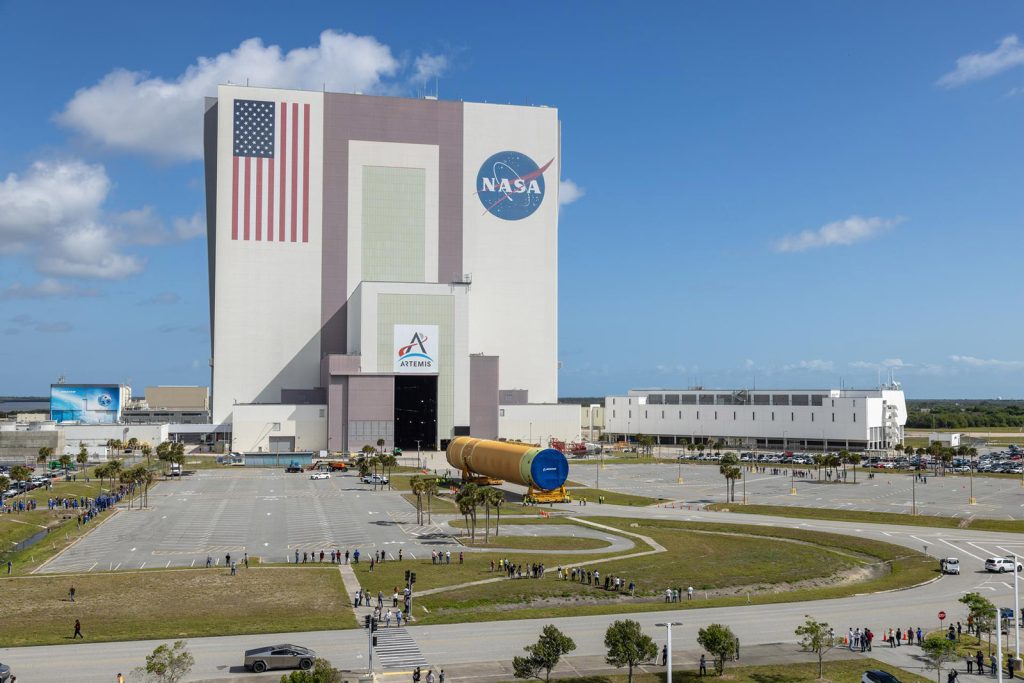
Following a 900-mile journey aboard NASA’s Pegasus barge from the historic Michoud Assembly Facility in New Orleans, the massive “top four-fifths” of CS3 pulled into the Kennedy Space Center (KSC) at Cape Canaveral, Florida on April 28. The towering orange cylinder is slated to power the highly anticipated Artemis III mission to the Moon.
Historically, rocket stages built at Michoud are shipped to Florida fully completed, with their massive liquid-fueled engines pre-integrated. For CS3, however, Boeing and NASA are throwing out the old playbook.
By shipping the upper four-fifths of the core stage prior to attaching the engine section, the teams are pioneering a decentralized integration workflow. Final assembly will now occur directly at the launch site inside KSC’s newly upgraded Core Stage Vertical Integration Center (CSVIC).
Moving the final integration to KSC allows engineers 360-degree access to the complex engine components. Supported by a new subassembly cleanroom and a massive engine section support stand, this optimization is expected to shave up to six months off the vehicle’s manufacturing cycle time.
No News Is Good News
With Artemis I successfully executed and data from the crewed Artemis II flight under intense scrutiny, many may wonder if structural modifications or software updates would find their way into Core Stage 3. However, according to Joshua Roth, Senior Communications and Brand Specialist at Boeing, the data suggests that the hardware design is exactly where it needs to be.
The SLS program reviews its inflight data to confirm performance. Based on the data analyzed to date, we are not envisioning any planned updates for Core Stage 3,” Roth told Universelost.com.
For a rocket as fundamentally complex as the SLS, no news is incredibly good news. The lack of required design patches highlights the baseline stability of Boeing’s heavy-lift engineering.
The Artemis III crewed mission, targeted for 2027, is slated to be a high-stakes demonstration of deep-space infrastructure, requiring intricate rendezvous and docking maneuvers with specialized lunar landing systems in space. All with the aim of preparing for the Artemis IV moon landing in 2028.
Inside Boeing’s New KSC Playbook
Roth underlined the strict division of labor between Boeing and NASA as they work toward launching America’s next moonshot.
“As the prime contractor for the core stage of the Space Launch System rocket, we defer to NASA to speak to the configuration, fuel usage, and build timeline for the integrated vehicle,” Roth said.
For now, Boeing’s immediate focus remains locked on outfitting the cavernous fuel tanks and mating the final engine section in Florida. Moving this final, precision-heavy phase to KSC turns the historic launch site into a living laboratory for streamlined deep-space manufacturing.





Leave a Reply