
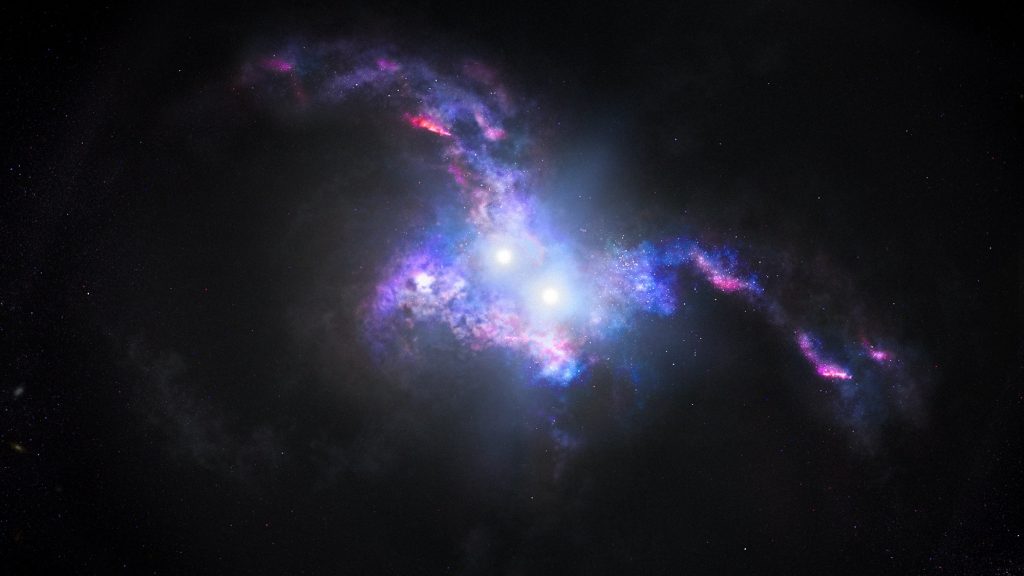
We’re used to thinking of Black Holes as cosmic vacuums—invisible voids that just trap light and devour everything. But the most powerful monsters in our universe, Quasars or Quasi-Stellar Objects (QSOs), actually do the exact opposite: they blast out enough light to blind entire galaxies.
Quasar is the chaotic feeding frenzy happening around a supermassive black hole at the center of a young galaxy. As gravity pulls gas, dust, and entire stars toward the abyss, the material forms a swirling cosmic whirlpool called an accretion disk.
The friction in this disk is so violent that it heats the material up to millions of degrees and before the matter crosses the event horizon, it glows with a blinding intensity.
A single quasar can shine 1,000 to 100,000 times brighter than our entire Milky Way galaxy combined. Therefore, they are the brightest sustained beacons in the universe.
Quasars are so energetic that they actually choke their host galaxies to death. The intense radiation pressure and magnetic fields create massive jets of plasma that blast out of the galaxy at near the speed of light. This blows away the cold gas reservoirs needed to form new stars—a process astronomers call “quenching.”
Circling back to the G-HAT method (hunting for alien civilizations by looking for mid-infrared waste heat)—distant quasars and active galactic nuclei are the ultimate cosmic red herrings. Their massive dust rings absorb starlight and glow intensely in the mid-infrared, mimicking the heat signature of a galaxy completely colonized by a super-civilization.
Because quasars are so bright, we can see them from billions of light-years away. Hence, when we look at a quasar, we are literally looking back in time, seeing the chaotic, violent adolescence of the early universe. Our own Milky Way likely had a quasar phase billions of years ago before its central monster went dormant.
When astronomers think about mysterious quasars, they often bring up SDSS J1106+1939 as an example. It is a peculiar case because its “leaf-blower” cosmic wind is turned up to a level that physicists didn’t think was mechanically possible. The supermassive black hole powering this quasar is estimated to be several billion times the mass of our Sun.
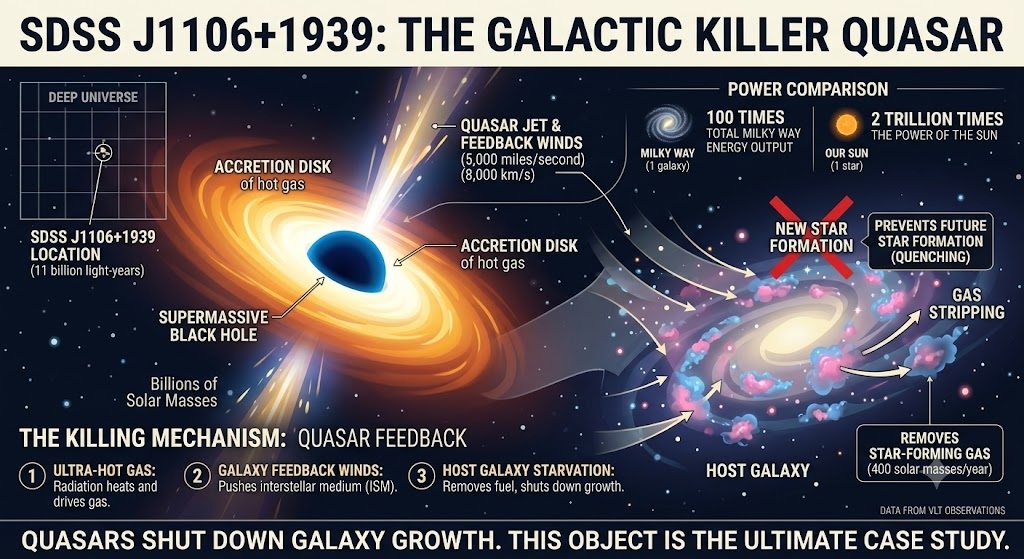
In 2012, astronomers using the Very Large Telescope (VLT) in Chile calculated that the energy output of the gas being blasted away from SDSS J1106+1939 is equal to two trillion times the power of our Sun. That is roughly 100 times higher than the total energy output of the entire Milky Way galaxy combined.
It is blasting out roughly 400 times the mass of the Sun in gas every single year, traveling at 5,000 miles per second (8,000 km/s). This wind is so violent that it is actively stripping the host galaxy of all its raw material, effectively killing the galaxy’s ability to create new stars.
Scientists use SDSS J1106+1939 as the ultimate case study for “quasar feedback”—the process by which a black hole can grow so violent that it completely shuts down the growth of its own home galaxy.
The universe isn’t just quiet stars—it’s driven by titanic, thermodynamic engines.
Leave a Reply