
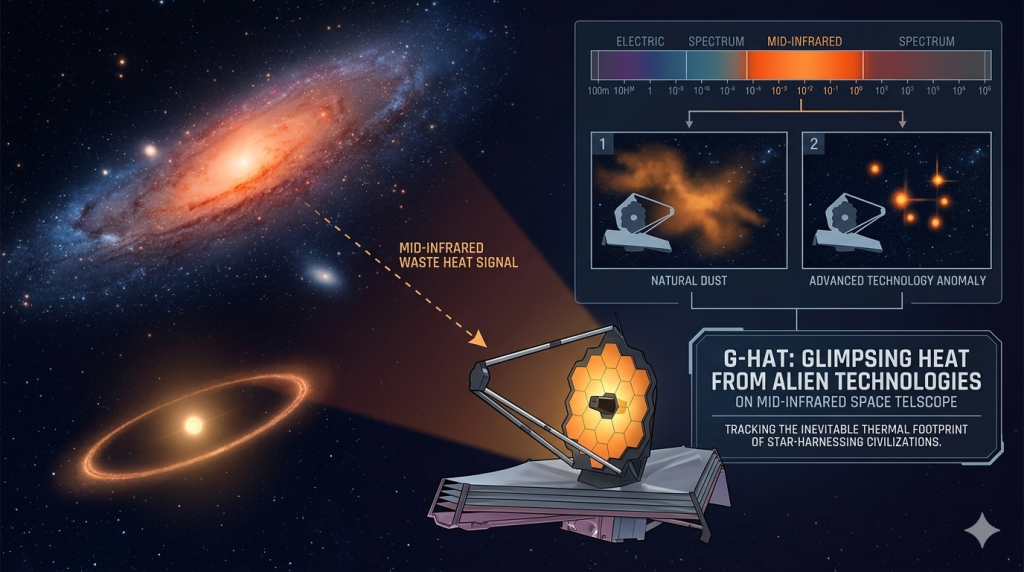
The Search for Extraterrestrial Intelligence (SETI) has largely operated on a single, fragile assumption: that if advanced aliens are out there, they want to talk to us. Traditional SETI programs spend millions of hours listening for deliberate radio broadcasts or scanning the skies for flashing laser beams. So maybe instead of waiting to catch a radio signal, we should look for the heat produced by advanced alien civilizations?
Glimpsing Heat from Alien Technologies
Jason T. Wright, a professor of astronomy and astrophysics at the Pennsylvania State University (PSU) started over a decade ago the G-HAT (Glimpsing Heat from Alien Technologies) project. Rather than trying to eavesdrop on alien conversations, this innovative “Dysonian” SETI method relies on a much more reliable metric: the unbending laws of thermodynamics. It suggests that no matter how secretive or advanced an alien civilization becomes, it cannot hide its waste heat.

When an intelligence uses energy to perform work—whether that is fueling a starship, running a planetary grid, or processing massive amounts of data—entropy increases. That energy inevitably degrades into high-entropy, useless energy: waste heat. For an immensely advanced civilization—specifically a Kardashev Type II or III civilization capable of harnessing the energy of an entire star or galaxy—this accumulated waste heat would glow conspicuously in the mid-infrared spectrum.
“Waste heat is an unavoidable consequence of energy use, required by conservation of energy and the second law of thermodynamics. Just about any technology you can think of generates waste heat at some level, it’s just a matter of scale. So while any technological alien species will produce waste heat with its technology, only some will do so on such a scale that they will be observable,” Wright told Universelost.com.
The premise of G-HAT—pioneered conceptually by physicist Freeman Dyson in 1960—rests on a fundamental rule of physics: energy cannot be destroyed, only transformed. However, a common counterargument to hunting for alien technology is that an advanced society would possess hyper-efficient machines that produce zero waste.
Can They Hide from Us?
Furthermore, could an alien super-civilization simply build massive refrigerators to mask their heat signature? Theoretically, yes, but the engineering required to hide from the laws of physics is staggering. Astronomers therefore assume that advanced technology will always leave a warm, mid-infrared footprint in the cosmos.
“Hiding waste heat emissions is almost synonymous with not having much waste heat. In principle, waste heat could be directed away from Earth, or deposited in a sink like a black hole or star. In practice, this will always make the technology less efficient, since thermodynamic efficiency is maximized when waste heat is emitted isotropically into a cold sink like space. It’s also unclear why a species would hide its emissions from us specifically, or even generally, outside of contrived science fiction scenarios,” Wright explains.
Major Obstacles
While the G-HAT project is promising, the ongoing search by Wright and his team armed with data from NASA’s Wide-field Infrared Survey Explorer (WISE) faces a major astronomical obstacle: space dust. The universe is naturally littered with a fine “smoke” of organic molecules left behind by dying stars and planetary formation. This interstellar dust absorbs ordinary starlight and re-radiates it as mid-infrared heat, perfectly mimicking the thermal signature of an artificial alien megastructure.
“Waste heat searches have a lot of confounders, principally astrophysical dust, since any material orbiting a star or other source of power will absorb that power and re-emit it as thermal infrared emission. In order to stand out in a search it needs to be at a level or in a place where we don’t expect to find much dust. It’s also ambiguous: even if we find something suspicious, we’ll need some sort of other indication that it’s technological to prove the case,” Wright said.
He added that radio signals in traditional SETI searches have the benefit that they can be obviously technological, with no possible natural source, for instance if they are narrowband.
Please Stay “Calm”, They Can See Us: Could Earth Be Detected By Alien Astronomers?
This thermodynamic tracking method naturally raises a fascinating question: If an advanced alien civilization were looking at Earth from dozens or hundreds of light-years away right now, would our own industrial waste heat betray our presence?
According to Wright, detecting 21st-century humanity through our thermal footprint would be an immense challenge for outside observers.
“It would be very challenging. The most obvious sign is probably our urban heat islands, which might be detectable to a species that can image the Earth at mid infrared wavelengths at which the atmosphere is transparent, but these might be hard to distinguish from natural hotspots.” Wright said.
What Happens If We Find It?
If a telescope actually flags a genuine, promising flash of mid-infrared waste heat, the scientific community wouldn’t just declare a historic discovery overnight. Confirming that a cosmic hot spot is a product of alien engineering requires a rigorous, multi-layered verification process.
Wright underlined that we need to be cautious and the very first step would be a massive astronomical process of elimination.
“First, we’d need to rule out obvious natural causes like circumstellar dust or a background infrared source, likely using high resolution imagery and low resolution infrared spectroscopy. At that point we’d have an interesting anomaly that should be studied regardless of its true nature,” Wright noted.
At that point, the heavy artillery of SETI research would be called in. Scientists would pivot to intense, targeted follow-up observations using a vast array of instruments.
“SETI researchers could then follow up with intense radio, optical and other studies for other signs of technology. The details of the follow-up would depend on the nature of the infrared detection,” he added.





Leave a Reply