
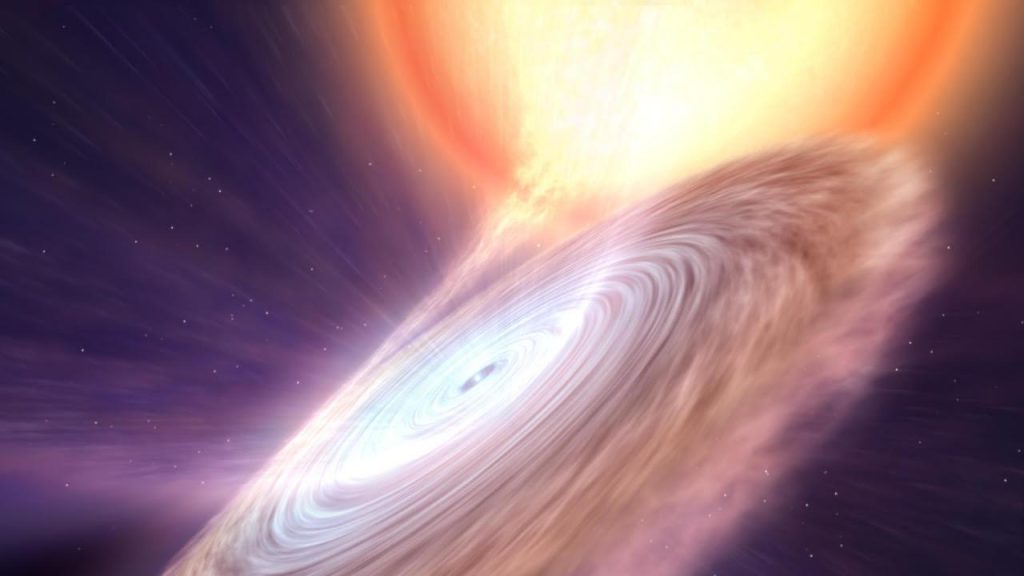
In the vast expanse of the cosmos, some of the most extreme physics occurs in complete obscurity. Among these hidden giants are low-mass X-ray binaries (LMXBs)—stellar pairs where a dense remnant of a dead star systematically devours its living companion. Recently, using the Neutron Star Interior Composition Explorer’s (NICER) and AstroSat satellite, a team of astrophysicists has shed new light on one of the most enigmatic and faint members of this celestial family: 1A 1246-588.
Published in the Journal of High Energy Astrophysics, a comprehensive study has provided the first quantitative, multi-epoch blueprint of this ultra-compact system, revealing how matter behaves under the crushing grip of extreme gravity.
An Ultra-Compact Stellar Dance
1A 1246-588 is not your run-of-the-mill binary system. It is classified as an ultra-compact X-ray binary (UCXB). In this configuration, a neutron star orbits incredibly close to a companion star.
Because the orbit is so small, the companion star cannot be a normal hydrogen star like our sun. Instead, the donor star is a helium-rich white dwarf (WD). Swirling away from the white dwarf, a stream of matter falls toward the neutron star, creating a glowing accretion disk that radiates intensely in X-rays.
Because 1A 1246-588 is exceptionally faint and buried in the cosmic background, it had long been neglected. To decode its secrets, the research team gathered a massive dataset combining long-term tracking with hyper-focused, targeted observations.
Observed from the Orbit
The researchers led by Vaidehi Poojyam of the University of Alabama reconstructed the behavior of 1A 1246-588 by orchestrating data from NICER’s X-ray Timing Instrument (XTI) and AstroSat’s Soft X-ray Telescope (SXT) and the Large Area X-ray Proportional Counter (LAXPC). The study was complemented by data from the Monitor of All-sky X-ray Image (MAXI) instrument onboard the International Space Station (ISS).
Installed on the ISS, NICER targeted the binary system in 2019. NICER tracked the source as its brightness fluctuated wildly, revealing a distinct “atoll-like” pattern when charting its X-ray hardness against its overall intensity. India’s dedicated astronomy satellite AstroSat observed the system in 2017, providing a wide-band spectral look at the system’s steady state at a specific flux level. When it comes to MAXI, it captured modest, recurring, outburst-like enhancements over the years, giving scientists the baseline context of how the system’s brightness fluctuates over time.
Shifting Power: The Spectral Breakthrough
By modeling the broadband X-ray spectrum, the astrophysicists discovered that the system’s emission boils down to two core components: a soft blackbody component and a hard comptonized component. In the first one, thermal radiation originates directly from the “boundary layer”—the turbulent region where the infalling matter finally slams onto the surface of the neutron star, while in the second one the high-energy X-rays are produced when lower-energy photons are violently energized by a cloud of superheated plasma surrounding the star, known as the corona.
Intriguingly, the data showed no statistical need for a traditional multicolor accretion disk component, meaning the emission is heavily dominated by the interaction right at the neutron star’s surface and its immediate atmosphere.
As NICER watched the system evolve, the team witnessed a fascinating cosmic thermodynamic dance. The blackbody temperature climbed from 0.28 to 0.39 keV (kiloelectronvolts), while the calculated size of the emitting region stayed tight and consistent between roughly 6.9 and 13.8 kilometers—precisely the expected radius of a neutron star.
The authors of the study assume that the structural redistribution of accretion energy is the driver behind these changes.
“We find that the observed spectral-state evolution is driven by a redistribution of accretion power between thermal emission from the neutron star boundary layer and Comptonized emission, consistent with atoll-type behavior. These results provide the first quantitative, multi-epoch view of accretion-state evolution in 1A 1246−588, revealing systematic changes in the thermal boundary-layer emission and the Comptonizing region in this UCXB system,” the astronomers concluded.





Leave a Reply