
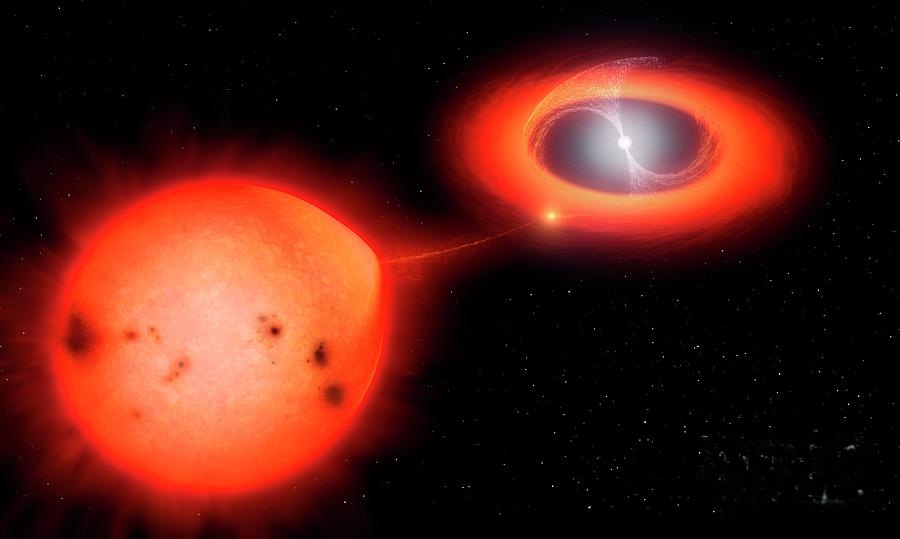
For years, the star system V844 Herculis was considered a perfectly normal, well-behaved dwarf nova. But a recent study has unveiled a stellar wolf in sheep’s clothing: an exceptional “intermediate polar” hiding inside what astronomers long thought was an ordinary system.
Led by University of Notre Dame’s astronomers Anousha Greiveldinger and Peter Garnavich, a new research paper recently published on arXiv.org turns what we knew about this star on its head.
By observing the system’s spectroscopic emission features, the team discovered that the white dwarf at its center is highly magnetic and spinning rapidly, completing a rotation every 29.3 minutes. With a remarkably tight orbital period of just 1.31 hours, V844 Herculis (or V844 Her for short) now holds the record for the shortest binary period and also one of the smallest orbit-to-spin ratios among confirmed intermediate polars (IPs). In general, IPs are a type of cataclysmic variable (CV) containing a white dwarf with a moderate magnetic field and a companion donor star.
But the real mystery isn’t just what V844 Her is, but how it managed to hide its true nature for so long.
“V844 Her was a well-studied dwarf nova that did not show any sign of having a strongly magnetic white dwarf,” Garnavich told Universelost.com.
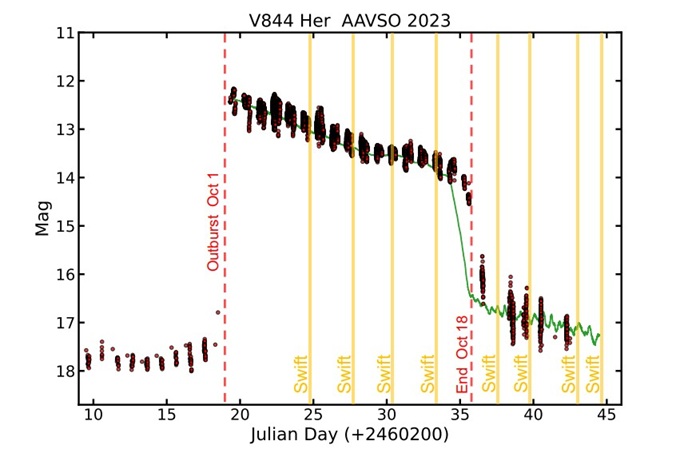
He notes that even extensive observations by NASA’s Transiting Exoplanet Sky Survey (TESS) satellite and long X-ray scans failed to detect a rotation signal while the system was in its low state. “It was only luck that Anousha looked at data during a dwarf nova outburst and saw a periodicity that did not match up with the large dynamical instability that develops during outbursts.”
So how does a powerful magnetic white dwarf conceal a 29.3-minute pulse? The answer lies in the system’s extreme diet. V844 Her is a short-period SU-UMa type dwarf nova. During its quiet phases, known as quiescence, the mass transfer rate between the companion star and the white dwarf is remarkably low.
“This may be why there is not a clear photometric signal in quiescence,” Garnavich explains. “The only evidence of magnetic accretion in quiescence is the varying emission line wings with no continuum being generated as seen in most [intermediate polars].”
The white dwarf is therefore actively pulling in matter, but it does so far too quietly to be easily noticed. When the system goes into an outburst, however, the disguise slips.
“During an outburst, the mass transfer rate through the disk shoots up several orders of magnitude and likely creates a standard shock near the white dwarf surface that looks like a typical magnetic accretor,” Garnavich says. The signal only emerged thanks to diligent data collection during one of these chaotic events, aided by amateur astronomers from the American Association of Variable Star Observers (AAVSO). Even then, Garnavich points out, teasing the true spin out of the data was immensely difficult because it was buried among massive “superhump” oscillations rocking the accretion disk.
The mechanics of V844 Her are also an oddity. While most intermediate polars have white dwarf spins that settle in an equilibrium at about 10 percent of their orbital period, V844 Her is spinning at nearly 40 percent of its orbital period, which is a bizarre ratio for longer-period systems, though less so for extremely compact ones like this.
The revelation of V844 Her’s true identity now raises a question for astronomers: Are there other magnetic white dwarfs masquerading as standard cataclysmic variables? Garnavich firmly believes there are. “The best place to find them is probably at short orbital periods where the mass transfer rate is low,” he says, noting that searching during rare disk outbursts is currently the most effective strategy to catch them in the act.
As for what comes next, the team hopes to capture more high-cadence data of V844 Her in action, though it will require a bit of cosmic serendipity. The massive “superoutbursts” that make the magnetic signal visible only happen about once a year.
Future TESS observations could shed light on how the disk dynamics regulate accretion through the magnetic field. Existing data shows odd variations in the spin signal over just a few days, hinting at a surprising interplay: the instability happening far out in the outer disk seems to dictate the amount of accretion navigating the magnetic field on the inside.
Beyond optical telescopes, the team is also looking toward the ultraviolet spectrum to finally spot the system effectively during its quiet phases.
“Ultraviolet observations during quiescence might be better than optical at spotting the spinning white dwarf. If there is not a hot shock at the white dwarf surface, there still should be some heating that would peak in the near-UV,” Garnavich says, before adding a wry nod to NASA’s aging Swift Observatory: “Too bad Swift is going to burn up pretty soon!”
Until the next major outburst, V844 Her remains a fascinating puzzle, like a spinning magnet in deep space that is furiously eating matter, yet doing it just quietly enough to keep astronomers guessing.




Leave a Reply