
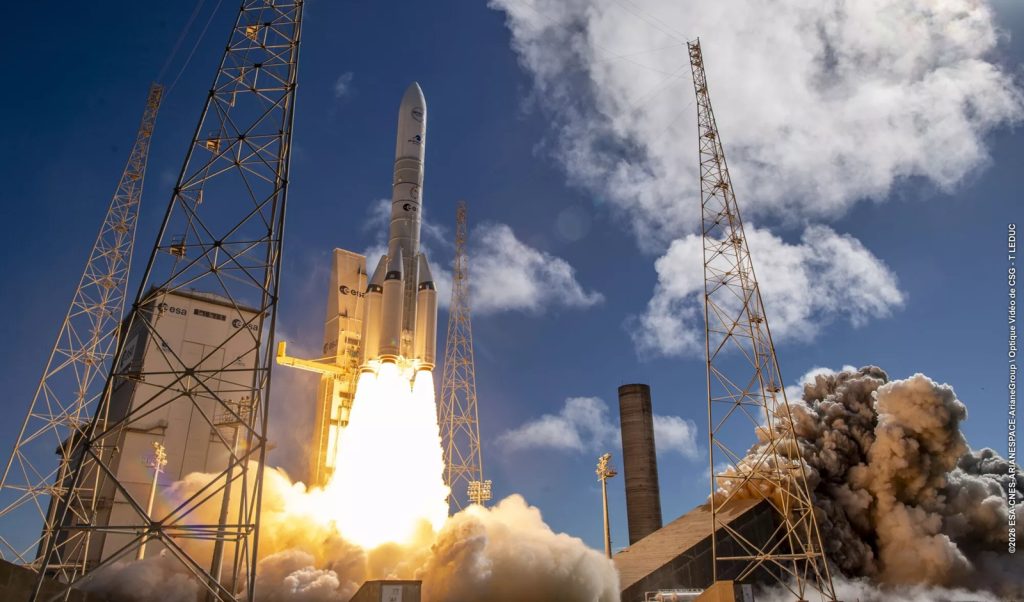
Europe took a definitive leap into the heavy-lift market this year as Arianespace successfully completed a trio of historic flights powered by its new, four-booster configuration. The consecutive missions in February, April, and June 2026 marked the debut of the heavy-lift Ariane 64, proving that Europe can deliver immense launch power without sacrificing orbital precision.
By flawlessly deploying 100 Amazon LEO satellites into highly complex trajectories, the newly upgraded vehicle has officially signaled a new era of reliability and deep-space muscle for European aerospace on the global competitive stage.
“With three launches, Ariane 64 has deployed 100 Amazon Leo satellites with a level of precision relatively rare on the world competitive stage today, especially for missions of this complexity. This demonstrates both the technical maturity and the operational robustness of Ariane 6 in its 4 boosters configuration, allowing each satellite to reach its intended orbit with accuracy,” Julie Lenoir, Senior Vice President, Chief Brand and Communications Officer at Arianespace told Universelost.com.
The Ariane 6 in its “64” configuration represents Europe’s newest modular heavy-lift design. While the smaller Ariane 62 relies on just two side-mounted solid rocket boosters for lighter, institutional missions, the Ariane 64 anchors four of these massive boosters to its central core. Standing 62 meters tall, this variant effectively doubles the rocket’s lift capacity. By generating a staggering 15,400 kilonewtons of thrust at liftoff, the four-booster layout elevates the launcher’s baseline capability from 10.3 tonnes to 21.6 tonnes to Low Earth Orbit (LEO).
This immense power makes the 64 configuration Arianespace’s premier workhorse specifically optimized for the demanding architectures of commercial mega-constellations and dual-satellite geostationary missions.
On the latest flight, on June 17, Ariane 64 also premiered its advanced P160C solid rocket boosters. They are among the world’s largest carbon-fiber one-piece solid-propellant rocket motors and are designed to replace the P120C, the version of the booster that has flown on the first flights of Ariane 6.
“To remain at the forefront of the space industry and to deliver cutting-edge solutions that meet the evolving needs of our customers, we continuously drive innovation. To deploy 36 Amazon Leo satellites, 4 more than the first two missions, Ariane 64 flew for the first time on June 17 with four advanced P160C boosters,” Lenoir explains. “The new P160C engine can carry up to 156 tonnes of propellant, increasing the launcher’s performance by 10 percent in LEO, compared to the P120C.”
The operational data from the three latest successful launches has validated the strategic vision behind the rocket’s modular design. Reflecting on the flawlessly executed manifest, Arianespace leadership confirmed that the heavy-lift vehicle met every engineering benchmark right out of the gate.
“The first successful flights of Ariane 64 in February and April 2026 and more recently in June 2026 with the new P160C boosters confirmed that the four-booster configuration delivered exactly as expected, increasing the payload capacity compared to Ariane 62 while maintaining the precision and robustness that define the launcher. This demonstrates that Ariane 64 is a reliable, high-performance, and versatile European launch solution in all its configurations,” Lenoir said.
Looking at Europe’s packed launch manifest, the Ariane 64 is locked in as a crucial asset for global logistics, carrying a heavy workload that ranges from a stacked schedule of commercial constellation deployments to prestigious institutional tasks like launching ESA’s future planet-hunting PLATO telescope and the groundbreaking Comet Interceptor mission.
As the global launch market grows increasingly crowded, the structural robustness and unmatched precision demonstrated by the Ariane 64 offer a compelling alternative for commercial and institutional partners alike. With a proven, high-performance vehicle now fully validated and standard operational protocols locked in, Arianespace enters the second half of 2026 ready to accelerate its launch manifest. The era of Europe riding on four boosters has officially arrived, redefining the continent’s sovereignty in space and securing its gateway to the stars for decades to come.






Leave a Reply