
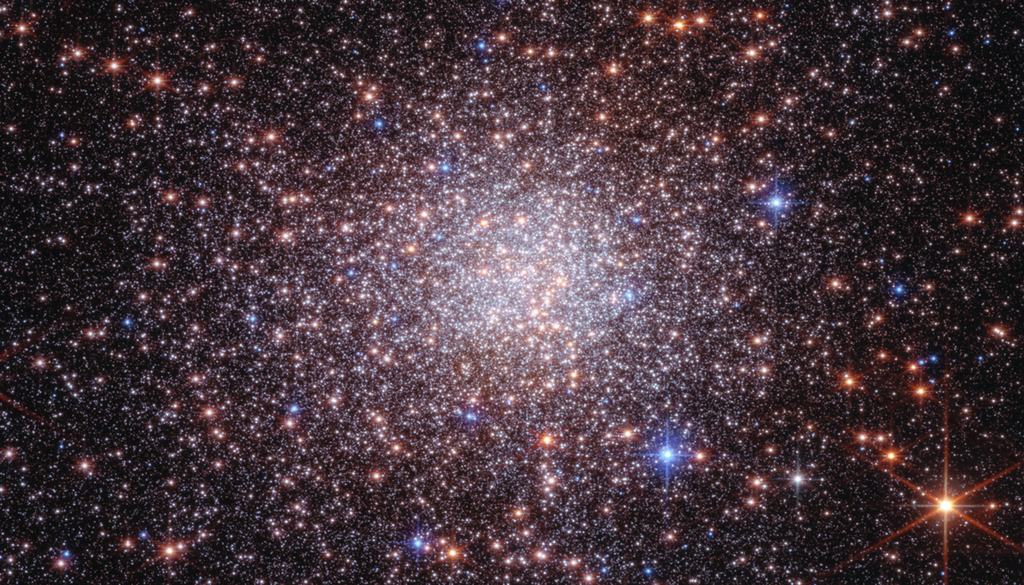
Deep in the central bulge of our galaxy lie two incredibly dense ancient stellar systems known as “bulge fossil fragments.” For decades, these two crowded neighborhoods, designated Terzan 5 and Liller 1, have teased astronomers with hints of extreme astrophysical activity. Now, the James Webb Space Telescope (JWST) has turned its infrared gaze toward them, discovering over 1,000 previously unknown variable stars and providing a crucial missing link to the understanding of exotic objects hidden within.
The Mystery of Missing Pulsars
A newly published research paper by astronomers led by Kevin B. Burdge of the Massachusetts Institute of Technology (MIT) details a groundbreaking survey of these two clusters. The findings not only map an unprecedented number of variable stars but also showcase a novel technique for extracting time-series data from JWST observations in the galaxy’s most crowded environments.
Liller 1 has long presented a stark puzzle to astrophysicists. The cluster shines brilliantly in gamma-ray wavelengths, comparable to the brightest globular clusters in the Fermi telescope’s sky. This intense high-energy glow strongly implies a massive, hidden population of millisecond pulsars (rapidly spinning, highly magnetized neutron stars).
Yet, not a single radio pulsar has ever been successfully detected in Liller 1.
The culprit? Extreme interstellar scattering. Because Liller 1 is located in the inner bulge of the Milky Way, thick clouds of gas and dust scramble the radio waves emitted by these pulsars before they can reach Earth. However, infrared light cuts right through this cosmic fog. By monitoring how stars change in brightness over time, JWST can spot the stellar companions orbiting these invisible pulsars, revealing their locations indirectly.
A Black Hole Factory?
Terzan 5 presents a different kind of extreme environment. Recent astrophysical simulations suggest that over its long lifetime, Terzan 5 may have produced an unusually high number of merging black hole binaries, far exceeding the output of a typical globular cluster. Liller 1 may be a similarly efficient engine for these violent collisions.
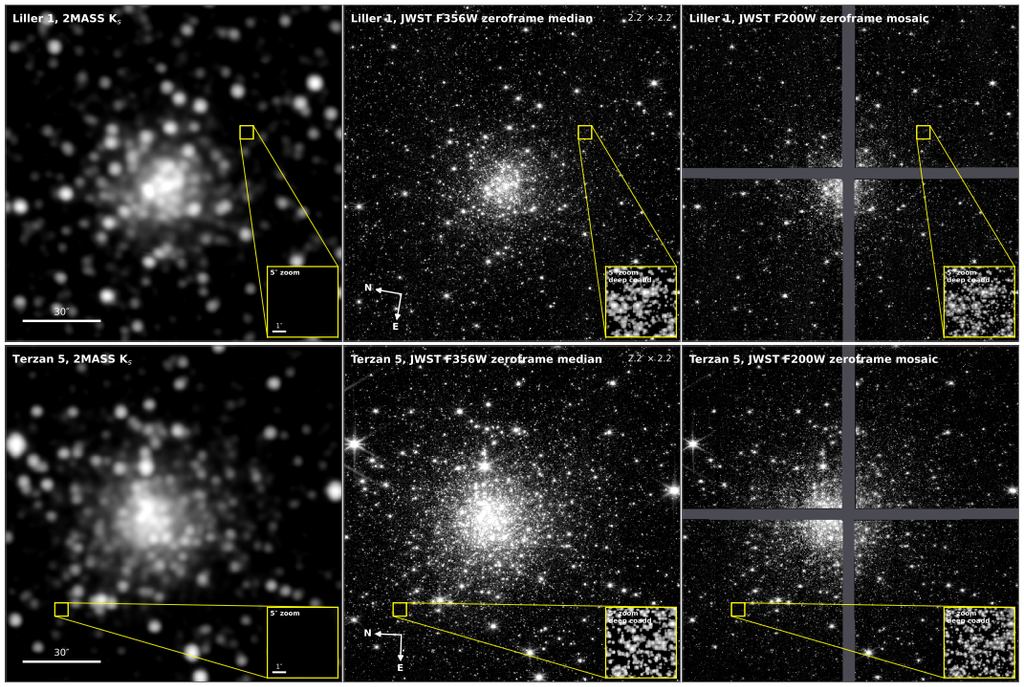
Finding the binary star systems that fuel these mergers requires looking at how their light fluctuates as the stars orbit, eclipse, and distort one another.
To accomplish this, Burdge’s team developed a specialized data extraction pipeline for JWST. Standard image-processing struggles in fields where stars are virtually stacked on top of one another. By measuring the temporal changes in infrared brightness across successive JWST exposures, the team successfully teased out the signals of over a thousand variable stars, many of which are likely the companions to X-ray sources and hidden pulsars.
What Comes Next
This massive catalog of over 1,000 variable stars marks a shift in how astronomers study the inner Milky Way. By phase-connecting infrared eclipses and flares with existing X-ray data, researchers can finally map the “dark” populations of neutron stars and black holes thriving in our galaxy’s core.
With its unmatched infrared resolution, JWST has proven it isn’t just an instrument for looking back at the early universe, but it’s also the perfect tool for dissecting the most chaotic, densely packed corners of our own galactic backyard.




Leave a Reply