
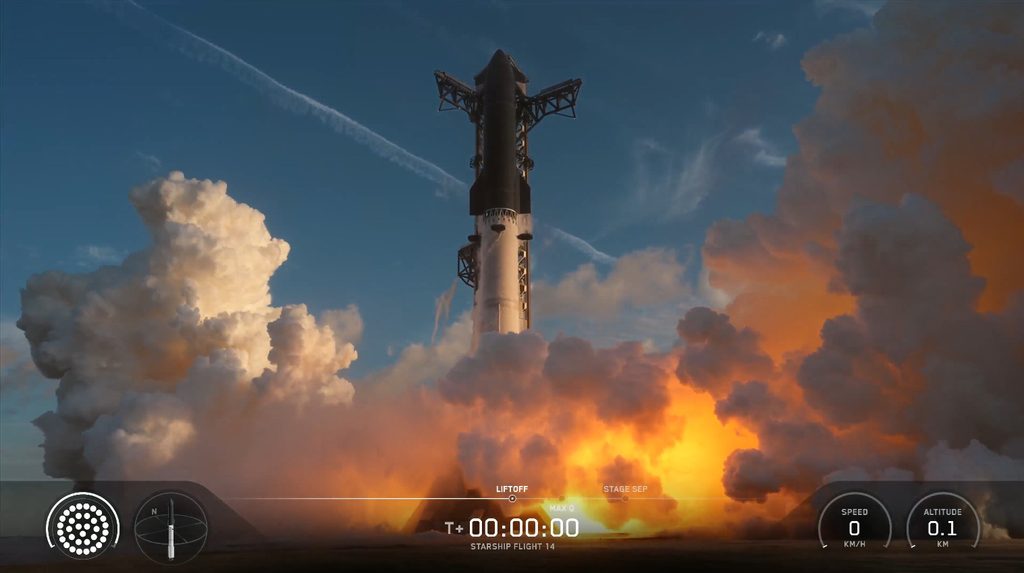
The biggest story from today’s historic Starship launch isn’t just that it finally reached true orbit. It’s the brilliant, high-stakes engineering audible the SpaceX team called in the vacuum of space. At exactly 8:46 a.m. EDT, Super Heavy Booster 21 roared off the pad at Starbase, generating 16 million pounds of thrust. The era of suborbital test hops is officially over. But the most fascinating maneuvering of the day happened after a sudden moment of tension during the ascent.
During Ship 41’s climb to space, one of its Raptor 3 engines unexpectedly shut down early. A few years ago, an engine-out might have scrubbed the mission’s primary goals. Instead, the SpaceX flight team scrambled, evaluated the telemetry on the fly, and literally took a vote on whether to push for full orbital insertion. They went for it.
The ship’s automated flight software compensated for the lost thrust, successfully circularizing its orbit at an altitude of 170 miles (275 kilometers).
Once stable, Starship executed its primary commercial objective: at T+34 minutes, it began deploying 26 next-generation Starlink V3 satellites. But hidden among that payload were three very special units acting as robotic paparazzi.
SpaceX quietly equipped three of these Starlinks with dedicated inspection cameras. Their primary job was not to beam internet to Earth, but to turn their lenses back on the Starship that just birthed them and scan its underbelly.
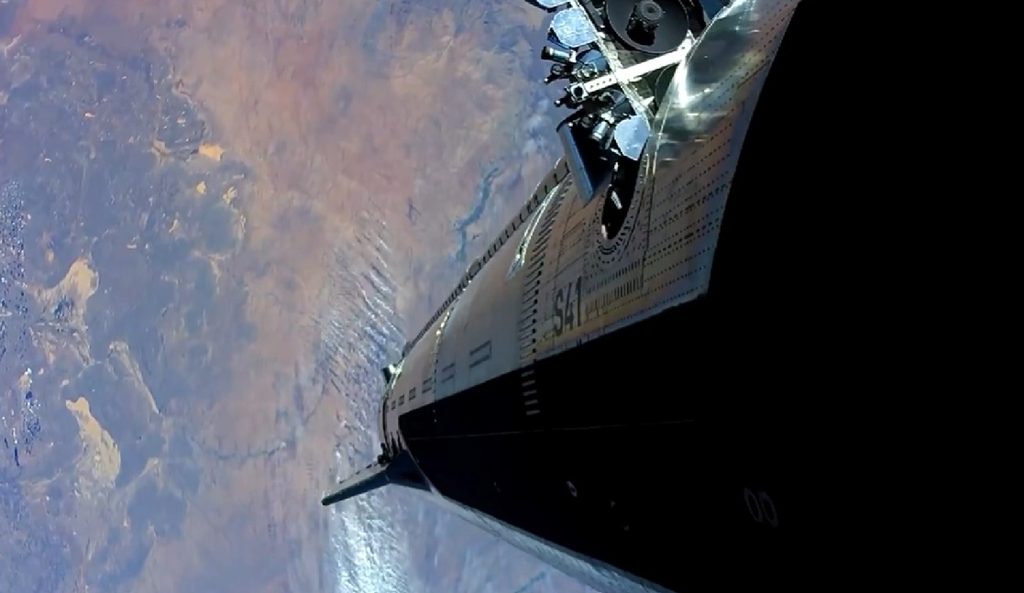
The biggest hurdle to making Starship fully reusable is surviving the blazing inferno of atmospheric reentry without losing its delicate heat-shield tiles. Until now, engineers had to rely on internal telemetry and ground tracking. Today, Starship deployed its own external mechanics to visually inspect its armor in orbit.
And that real-time data, combined with the earlier engine anomaly, is exactly why the mission timeline suddenly shifted.
Originally, Ship 41 was supposed to coast through space for a 10-hour marathon, completing six full orbits. Instead, flight controllers made a dynamic call. After evaluating the upper stage’s status at its first orbital checkpoint, aided by those visual inspections, they opted to skip the 7.5-hour joyride. At 11:00 a.m. EDT, Ship 41 fired a single Raptor engine for a flawless deorbit burn, plunging back into the atmosphere for a controlled splashdown in the Northern Pacific at 11:58 a.m. EDT. Total mission time: 3 hours and 9 minutes.
Arm-chair critics might call a shortened 3-hour flight a glitch, but aerospace engineers know it is a massive flex. It means the flight software and ground teams were confident enough to dynamically alter an orbital reentry profile on the fly based on live telemetry.
The achievement drew immediate praise from the highest levels of the aerospace industry, with NASA leadership celebrating the milestone.
But for SpaceX leadership, today’s success wasn’t just about the Moon as it was the validation of their most difficult engineering challenge. Following the splashdown, Elon Musk was quick to highlight the significance of the telemetry gathered by the inspection satellites and the ship’s survival.
“I don’t want to jinx it or anything, but I think I would consider the heat shield problem solved at this point,” Musk noted recently regarding the rapid progress of the thermal protection system. “That doesn’t mean we won’t make improvements to the heat shield… but I would say that we do not see any technical obstacles at this point to achieving full and rapid reusability.”
That “rapid reusability” is the linchpin of SpaceX’s entire business model. SpaceX President Gwynne Shotwell echoed this operational mindset, reiterating that the goal has always been to “get Starship into orbit, deploying satellites, and recover both stages with rapid turnaround.”
Beyond the immediate commercial success of satellite deployment and orbital reentry, today’s flight marks the foundational breakthrough for SpaceX’s ultimate ambition: making humanity a multi-planetary species. Every major system validated during Flight 14, from upper-stage orbital maneuvering and in-space engine reignition to real-time heat shield diagnostics, is an essential building block for the long-distance voyage to Mars. To send crewed missions to the Red Planet, SpaceX must first master routine orbital operations, in-space propellant management, and high-velocity reentry dynamics. Today proved that Starship’s core architecture can handle those exact stresses in real-world conditions.
As Shotwell famously puts it, the motivation behind all this extreme engineering is simple: “We don’t want to be one of those lame, one-planet civilizations.”
For decades, landing humans on Mars felt like a distant, almost mythic concept confined to science fiction and speculative government roadmaps. But by demonstrating that a mega-heavy rocket can reach orbit, execute orbital maneuvers, deploy payloads, and dynamically manage its own return, SpaceX has officially shifted Mars from a theoretical dream into an actionable engineering project. Today wasn’t just about putting internet satellites into low Earth orbit; it was the moment the physical pipeline for sending human civilization to the Red Planet was officially opened.
We aren’t just watching rocket tests anymore. We are watching the dawn of a fully operational, highly adaptable spacefaring infrastructure. And it is moving faster than the textbooks can keep up.




Leave a Reply