
An international team of astronomers led by Dr. Jurjen de Jong has unveiled a groundbreaking map of the universe, capturing the sharpest and most sensitive low-frequency radio image ever produced. Using the Low Frequency Array (LOFAR), the new dataset pierces through cosmic dust, transforming indistinct blobs into crisp, intricate structures and opening a new chapter for radio astronomy.
For a long time, low-frequency radio astronomy faced a major bottleneck: capturing high-resolution images across large swathes of the sky generated astronomical amounts of data that simply overwhelmed traditional processing pipelines.
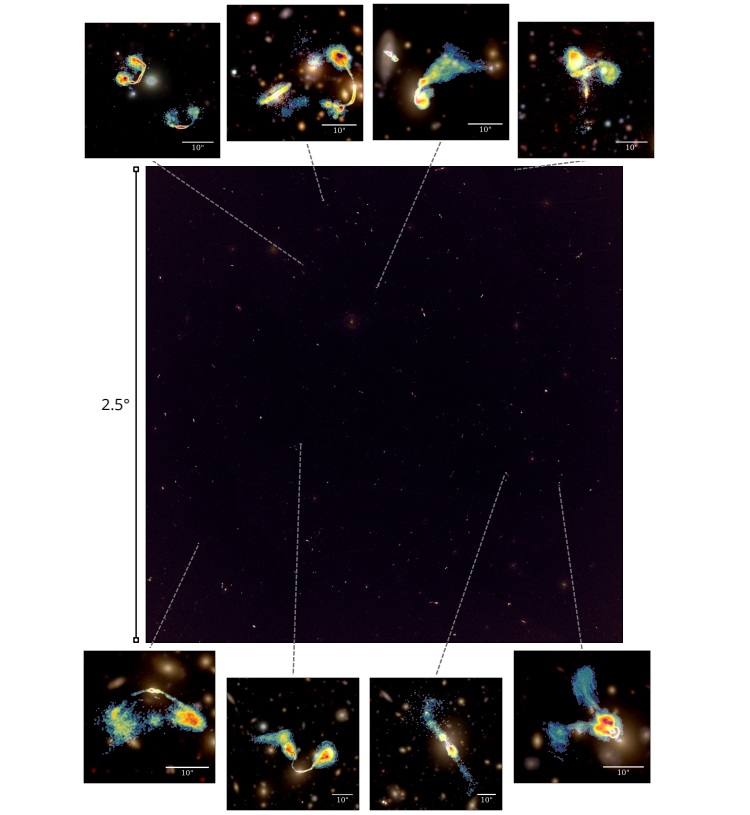
However, now, a team led by researchers from Leiden University and ASTRON (the Netherlands Institute for Radio Astronomy), tackled this challenge, focusing their instruments on the ELAIS-N1 field, which is a well-studied, pristine patch of the northern sky. The resulting image is an 8-billion-pixel mosaic built from 200 hours of observation data, with a resolution sharp enough to spot a coin from roughly 10 kilometers away.
But the path to this historic image was far from straightforward, as behind every pixel lies a computational hurdle.
“The biggest obstacle was processing the enormous volume (400 Terabytes) of data efficiently,” Dr. Jurjen de Jong, postdoctoral researcher at Leiden Observatory and ASTRON, told Universelost.com.
“The most important technique to overcome this obstacle was the development of a data compression technique, which we called ‘Sidereal Visibility Averaging’, that made the data volume 12 times smaller after calibration and before converting the data to our science images.”
Thanks to these improved calibration and data-reduction methods, processed on Spider (the powerful high-performance computing platform hosted by SURF in the Netherlands), what was once computationally impossible can now be achieved in a matter of months.
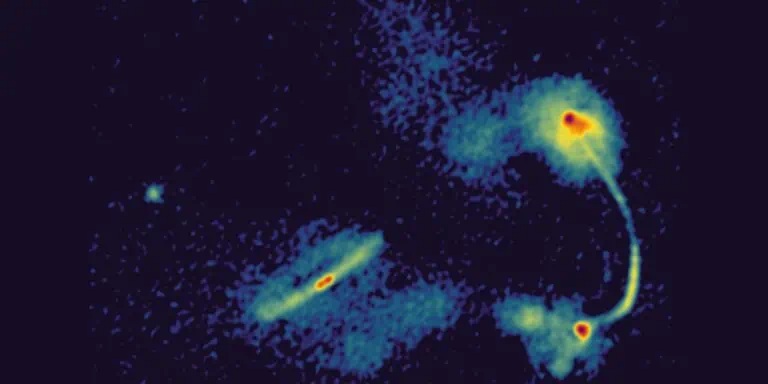
The payoff of this computational leap is visible when comparing older surveys to the new high-resolution data. In previous low-frequency maps, distant galaxies and energetic phenomena often blurred together into featureless shapes. De Jong notes that in the older, lower-resolution views, sources appear merely as fuzzy blobs, whereas in the new high-resolution imagery.
“You can see well how the blobs resolve into 2 very detailed radio jets and also a little point source on the left, which is probably a faint star-forming galaxy,” he explains.
These razor-sharp views give astronomers an unprecedented look at Active Galactic Nuclei (AGN) – the centers of galaxies powered by supermassive black holes (SMBHs) ejecting massive plasma jets. They can also help us better see distant star-forming galaxies whose light is normally obscured by cosmic dust at optical wavelengths.
De Jong’s team has made both the high-resolution images and catalogues fully public to the global research community, and much of the cataloguing heavy-lifting was done by the co-author Prof. Leah Morabito of Durham University.
The astronomers hope that with the new images and their data interpretation approach, they will be able to study the cosmic evolution of galaxies that are forming stars at a high rate.
“Our resolution lets us better distinguish their star formation from other radio sources (in particular active black holes or active galactic nuclei), as it’s not the case that we can do it for every galaxy now,” Morabito told Universelost.com.
Beyond normal galaxy evolution, the dataset opens doors to exotic phenomena like gravitational lensing, where a massive foreground object bends the radio emission of a background source, creating arcs and shape distortions visible only through statistical analysis across large populations.
The milestone achievement made by the team serves as a critical technological pathfinder for the future. As ground-based astronomy marches toward massive next-generation facilities, LOFAR is proving its enduring value.
“Our work shows that the software and data processing pipeline we developed scales to processing large datasets.This makes even more sensitive high-resolution imaging possible, and also high-resolution imaging over much larger areas, eventually covering the entire northern sky.” de Jong says.
Looking toward the horizon, including the upcoming construction of the massive Square Kilometre Array (SKA) in South Africa and Australia, de Jong highlights why LOFAR will remain an irreplaceable tool in the astronomer’s toolkit.
“This capability is unique because the current design of SKA’s low-frequency telescope (SKA-Low) has a much lower resolution, which will keep LOFAR unique at low radio frequencies,” he adds.
With the software pipelines proven, the data released, and the upgrade path to LOFAR2.0 underway, our window into the low-frequency universe has never been wider or clearer.

Leave a Reply