
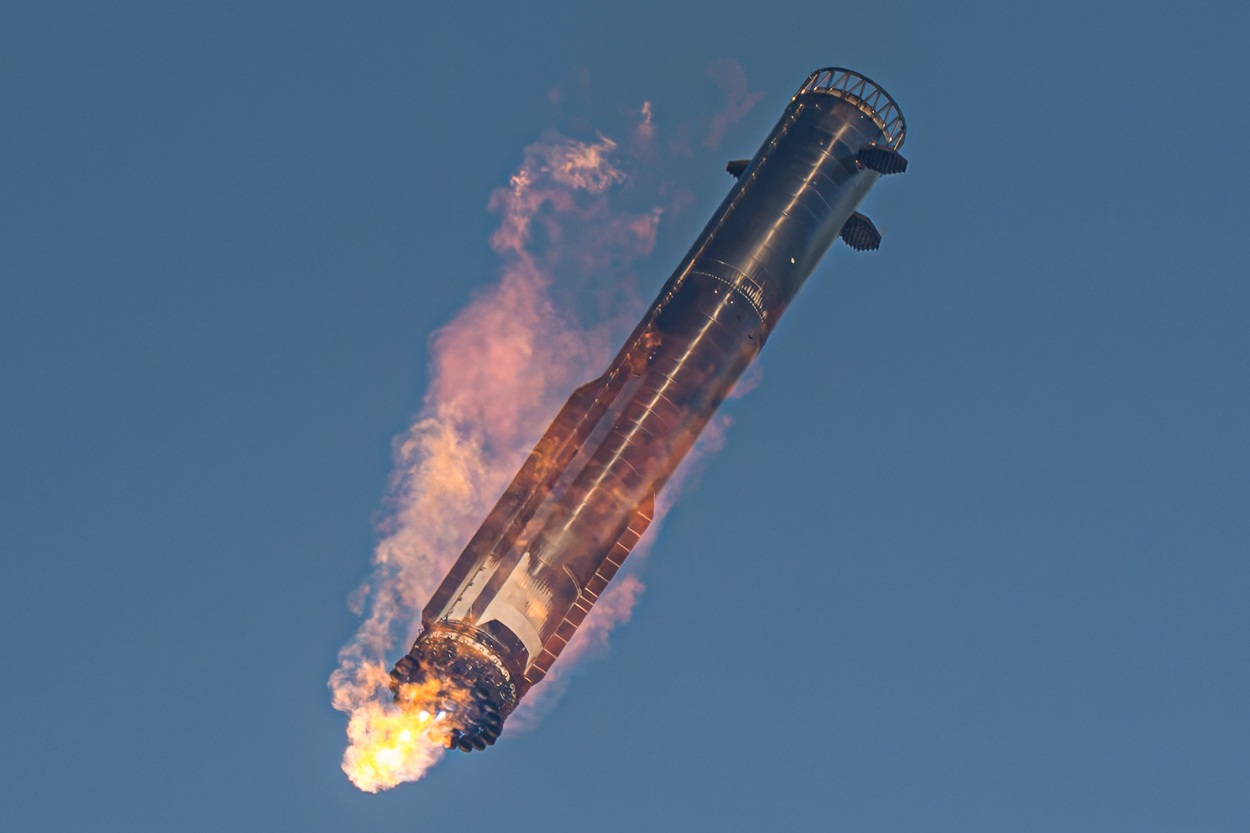
Most coverage of Starship’s fifteenth test flight on November 13, 2026 focuses on the dramatic midair explosion of Booster 22 over the Gulf of Mexico and the historic attempt to catch the upper stage with the launch tower’s mechanical arms at Starbase. Yet the true breakthrough of this mission unfolds far more quietly, inside decision-making algorithms and a new flight safety architecture that, for the first time, transformed the largest rocket in history into an autonomous inspector of itself and a tightly controlled vehicle cleared to return over populated land.
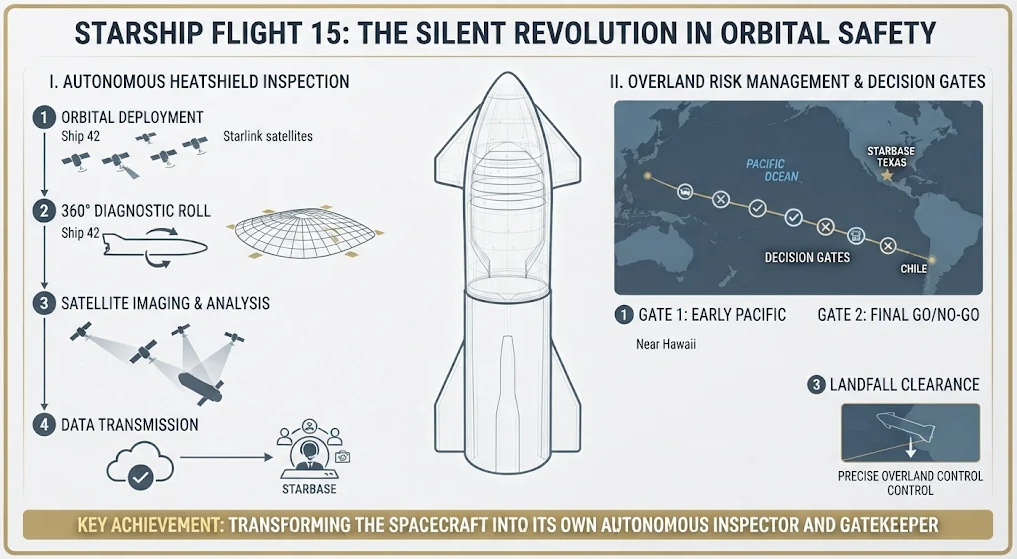
The most overlooked achievement of Flight 15 is how SpaceX solved the perennial problem of inspecting thermal protection systems in space. Until now, engineers relied on internal sensor telemetry and ground or airborne cameras that could only capture the condition of the heatshield tiles during the final phase of atmospheric descent. On this mission, the payload itself became an active component of the rocket’s diagnostic network. Rather than immediately drifting toward their operational orbits, the newly deployed third-generation Starlink satellites acted as orbital reconnaissance drones.
By executing a full 360-degree roll in front of the cameras of the satellites it had just released, Ship 42 enabled ground teams to build a complete visual map of its heatshield before committing to atmospheric reentry. It represents a shift in orbital operations in which a spacecraft provides its own external inspection infrastructure without requiring dedicated servicing missions or heavy mechanical camera booms.
An equally transformative aspect of the flight lies in the geography of its return and the management of risk over inhabited territory. Previous splashdowns in open ocean allowed for a wide margin of error, as the vehicle targeted empty water thousands of miles from major cities. Bringing Ship 42 back to Texas, however, requires flying directly over Mexico and South Texas, forcing engineers to design a multi-layered network of autonomous decision gates positioned across the Pacific near Hawaii and off the coast of Chile. Before the spacecraft is even permitted to ignite its engines for a deorbit burn, onboard computers must verify hundreds of critical subsystems in real time. If even a single parameter falls outside strict safety tolerances, the trajectory remains locked on an offshore disposal corridor, ensuring the vehicle safely impacts the ocean long before crossing any coastline.
Paradoxically, the aborted catch of Booster 22 serves as the strongest validation of this safety-first architecture. While mainstream headlines framed the booster’s divert and breakup over the Gulf as a setback, from a regulatory and operational standpoint it was a vital demonstration of precision control. Flight computers detected an anomaly in a fraction of a second and steered the 232-foot booster away from launch infrastructure and nearby communities, executing the exact contingency profile demanded by federal aviation regulators before granting approval for overland recovery.
Starship Flight 15 ultimately demonstrates that rapid, airline-like reusability in space no longer depends solely on the strength of stainless steel or the raw thrust of Raptor engines. The real prerequisite for routine orbital flight is autonomous decision-making and a spacecraft’s ability to diagnose its own structural health while still in orbit. Regardless of how the final catch maneuver plays out at the tower in Texas, SpaceX has just proven the invisible safety infrastructure without which regular, large-scale spacecraft landings on solid ground could never become reality.


Leave a Reply