
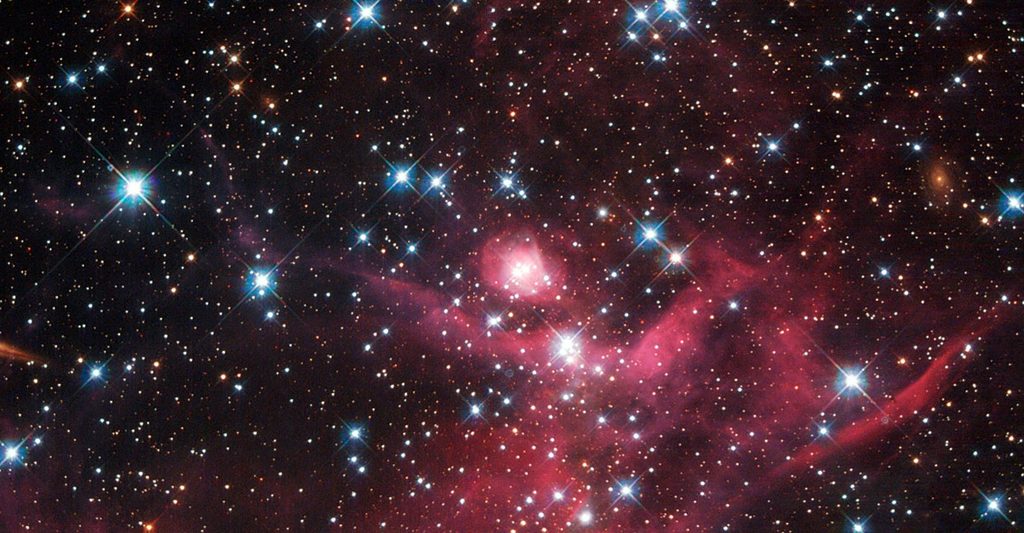
Using multi-epoch optical spectroscopy from the Sloan Digital Sky Survey V (SDSS-V), astronomers have identified three new O2-class massive stars lurking in the Large Magellanic Cloud (LMC), a dwarf satellite galaxy neighboring the Milky Way.
Representing the absolute hottest and most luminous end of the standard stellar sequence, O2 stars serve as critical cosmic benchmarks for models of extreme stellar atmospheres, massive stellar winds, and late-stage evolution. By re-examining targets previously misclassified or cataloged as ordinary stars, including one once thought to be a young stellar object, a team of researchers led by Alexandre Roman-Lopes of the University of La Serena in Chile utilized high-resolution blue-wavelength spectra to capture decisive nitrogen emission lines expanding our known sample of these ultra-hot stellar behemoths.
O2 stars reside at the absolute peak of the main-sequence thermal hierarchy. Surface temperatures for these objects can top 50,000 Kelvin, driving intense radiation fields and powerful stellar winds that shape their local interstellar environments. Because of their brief lifespans and initial physical requirements, finding an O2 star is a rare event.
Historically, cataloging these giants has proven tricky. Target classification relies on faint optical signatures, particularly the specific balance between ionized nitrogen emissions (N IV dominating over N III) alongside visible N V lines and an extreme absence of neutral helium (He I). Without access to high-resolution blue optical wavelengths, previous surveys frequently mistook O2 stars for cooler O-type subtypes or missed them entirely due to nebular contamination and dust extinction.
In this survey, researchers re-evaluated three specific targets in the LMC that had slipped through earlier spectroscopic nets.
Particularly, the star [WSI2008] 778, which was originally tagged in infrared surveys as a post-asymptotic giant-branch (post-AGB) candidate or an encrusted young stellar object (YSO), was found to have a high-ionization profile of a true ultra-hot O2 star.
Another star, designated MGSD LH 117-43A/140, was previously classified as a cooler O3 or O5 star by surveys lacking coverage of key diagnostic nitrogen lines. The new SDSS-V data confirmed its place among the O2 subclass.
In the case of Sk -69 135, which was long cataloged as a nondescript OB star, high-precision multi-epoch spectra finally unveiled its extreme temperature and true evolutionary state.
These discoveries, detailed in a paper published September 21 on arXiv.org, were made using multi-epoch observations from the Baryon Oscillation Spectroscopic Survey (BOSS) spectrographs operating under the southern component of the SDSS-V Milky Way Mapper. By gathering repeated observations across different epochs, Roman-Lopes’ team controlled for binary motion, stellar variability, and local nebular lines that typically complicate single-snapshot spectra.
Reclassifying these targets helps refine mass-loss models, stellar wind mechanics, and chemical enrichment theories for low-metallicity environments like the LMC. Moreover, as astronomical surveys expand their spectral coverage into the blue regime, these findings suggest that additional extreme stars may be hiding in plain sight within existing stellar databases.





Leave a Reply